
"If affiliate traffic and commissions grew by 30%, why did the total revenue barely move?" This is the question affiliate marketing managers often get asked.
But do you know why this happens?
One possibility? Your affiliate partners aren’t creating incremental demand. They’re taking credit for demand your brand has already captured.
And this isn't a one-off problem with one bad partner.
Affiliate marketing is one of the fastest-growing performance channels, with US affiliate marketing spend alone expected to reach nearly $16 billion by 2028 (eMarketer).
Moreover, it is assumed to be a safe channel, because brands only pay for outcomes. That's the real blind spot. Pay-per-action doesn't stop affiliate fraud. It only changes its shape. Instead of faking clicks, fraudsters claim real actions.
The result? You end up paying commissions for traffic that was either not genuine or would have converted anyway. And the damage spreads. Your honest affiliates lose credit when their tracking gets overwritten at checkout, your dashboard rewards the wrong partners, and once leadership stops trusting the numbers, the whole channel budget comes under question.
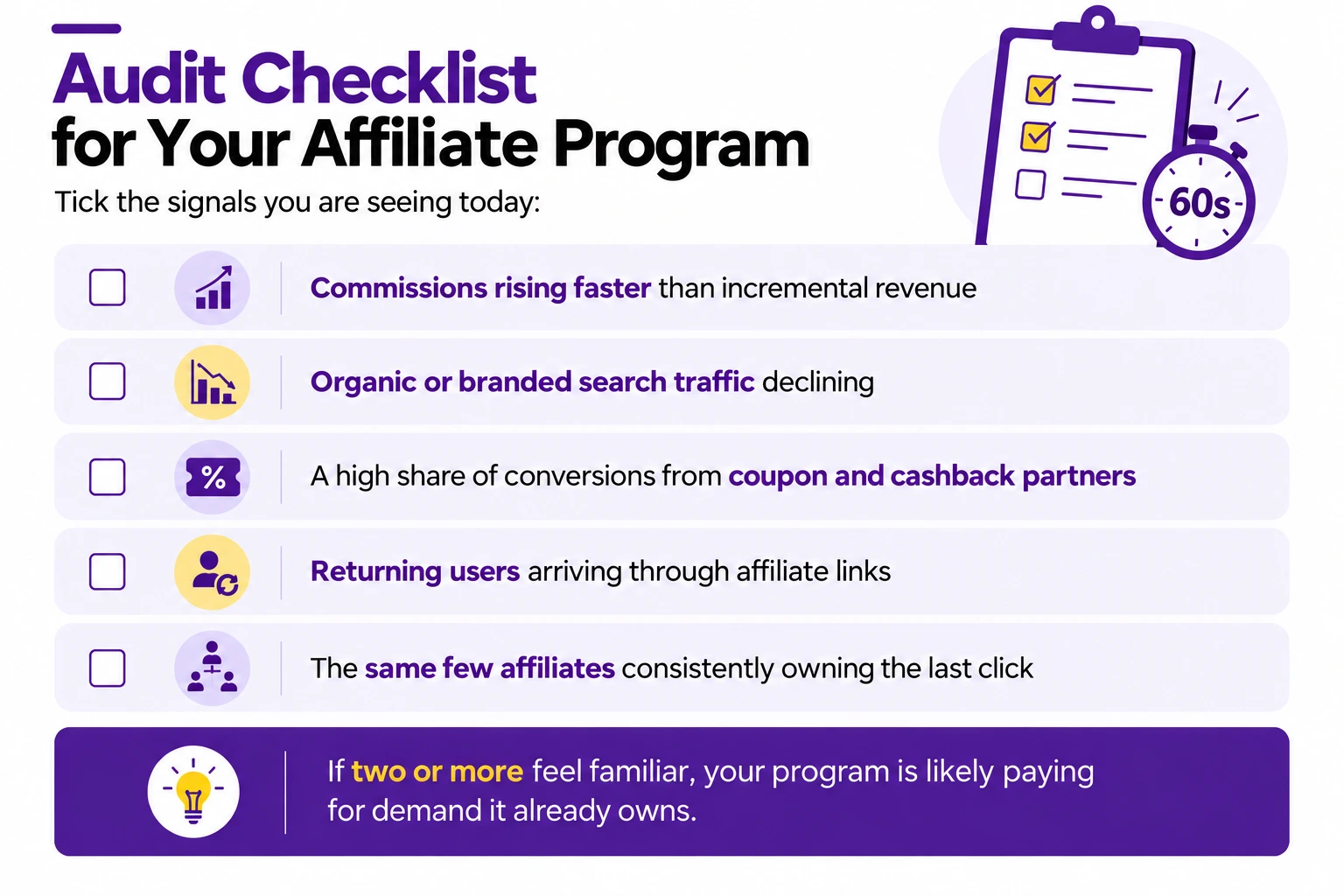
This is why affiliate fraud detection matters. Here are the 5 signs to watch out for in your affiliate campaigns.
5 Signs Your Affiliate Network is Cannibalizing Organic Traffic
1. Affiliate conversions grow, but the overall business doesn’t
If affiliate conversions rise 20% while total orders stay flat, your partners are not creating demand. They are relabeling it. This is attribution, not incrementality. Worse, these partners often look like your top performers, so they get rewarded with higher commission tiers.
A common cause is cookie hijacking: covertly planting or replacing an affiliate cookie in a shopper’s browser, so a partner gets credited for the sale. The result is inflated payouts, distorted ROI, and no clear way to see which partners actually perform.
2. Organic and branded traffic declines while affiliate conversions rise
Users who were already looking for your brand get intercepted on the way to you. Common tactics include brand bidding on your trademark keywords and typo squatting, where a misspelled version of your domain quietly redirects visitors through an affiliate link.
It is also called Organic Listing Modification (OLM). In one case, our mFilterIt experts investigated, a coupon extension with 50,000 users injected cashback icons into a leading marketplace’s own organic Google results. When shoppers clicked on the brand’s genuine listing, the extension added its affiliate parameters. A free organic visit became a paid commission.
3. Affiliate clicks recorded seconds before conversion
Real affiliate influence takes time. A shopper reads a review, compares options, then buys. When the affiliate clicks land seconds before a purchase, with no prior engagement on the partner’s page, it points to cookie stuffing, click injection, or attribution hijacking.
In one example, a browser extension with 60,000 users, a tool that has nothing to do with shopping, silently redirected organic clicks through a third-party tracking domain. Users landed back on the brand’s site with affiliate parameters attached, without clicking anything. This is a sophisticated level of affiliate click fraud.
4. Existing customers reported as new acquisitions
A returning customer already knows your brand and has items in their cart. Before checking out, they search for a discount code, visit a coupon or cashback site, click an affiliate link, and then complete the purchase. That click didn’t create the sale. But because it was the last click, the affiliate gets the commission, and your report may count it as a new customer.
Some partners do this intentionally through coupon fraud involving use of fake, expired, or unapproved codes just to get that final click and claim the commission.
5. A few affiliates drive most of your conversions
If two or three partners bring in most of your affiliate sales, look at where they appear in the buying journey. Coupon, cashback and deal sites appear right before checkout. They will always convert better than partners who introduce your brand to someone new. That makes them look like your best performers, when they are simply the last click before a sale that was already going to happen.
There is another problem. When a few partners own most of your volume, no one wants to question them. Reviewing their traffic quality feels like putting your own numbers at risk. Judge partners on how many new customers they bring and how clean their traffic is, not on conversion counts alone. Your smaller partners may be doing the real work.
How mFilterIt Helps You Pay Only for Real Growth & Stop Affiliate Fraud Detection
Every sign above points to the same gap. Your tracking records who got the last click, not who actually caused the sale. The fix is not blocking a few partners. It is seeing the entire journey.
Three layers of affiliate fraud detection:
mFilterIt monitors your affiliate ecosystem from the open web down to your own landing pages:
Across the web (OSINT-based crawling)
Scans extension stores, deal forums, coupon sites, public trackers and redirect domains to find where cookies are being seeded, often before the problem shows up in your reports.
Across your partner network
Ingest brand partner lists, approved domains and referral URLs, and whitelist/blacklist inputs for focused scanning. It exposes misattributed partner domains and hidden redirects, and links each incident to a specific partner, which also keeps false positives low, so good affiliates are not penalized.
Pixel integration for active protection
A lightweight pixel captures referral headers, cookie writes and full click paths in each session. It catches silent cookie drops, mid-journey redirects and forced cookie insertion in real time, so you act on proof, not suspicion.
Conclusion: From raw data to a clear verdict
Every touchpoint is stitched into a single user journey. AI models learn what normal partner behavior looks like, flag deviations and assign each partner a unified risk score. Because it runs as a self-learning loop, new fraud patterns feed straight back into detection.
What this answers for your team
Your question | What mFilterIt analyzes |
Is this partner driving new growth? | Partner incrementality measurement |
Who is intercepting my organic and branded traffic? | Brand bidding, OLM and typo squatting detection |
Are these last-second clicks real? | Click-to-conversion timelines; cookie stuffing, click injection and click spam detection |
Am I paying to acquire existing customers? | New vs. returning user analysis |
Are my top partners my best partners? | Partner quality scoring beyond volume |
The outcome: With mFilterIt's affiliate fraud detection solution, commission payouts will be based on genuine contribution. Budget will move to partners who actually grow the business, and your honest affiliates stop losing credit.
Find Out What Your Affiliates Are Really Driving
Your next commission cycle will pay for every claimed sale, real or not.
Book a detailed affiliate audit with mFilterIt and see how much of your affiliate revenue is truly incremental.
Frequently Asked Questions
What is affiliate fraud detection?
Affiliate fraud detection is the process of identifying affiliates who earn commissions through deceptive tactics, such as cookie stuffing, brand bidding or fake leads, instead of driving real, incremental sales. It combines traffic analysis, journey tracking and partner monitoring.
How does affiliate fraud work?
Most affiliate fraud manipulates attribution. Fraudsters plant or overwrite tracking cookies, intercept branded searches, redirect misspelled domains or generate fake leads and referrals, so they get last-click credit for sales and sign-ups they did not influence.
How can brands detect affiliate fraud?
Watch for affiliate conversions rising without overall growth, falling organic traffic, very short click-to-conversion times and returning customers arriving via affiliates. Session-level tracking and web monitoring confirm which partners are responsible.
How to detect affiliate cookie stuffing?
Look for cookies written without a real user click, unexpected redirects through third-party tracking domains, and browser extensions active on your site. A pixel that records cookie writes and click paths in each session provides definitive proof.
How to detect fake affiliate clicks?
Compare click volumes with engagement and conversions. Clicks with no page activity, unusual bursts from single sources, or clicks recorded seconds before purchase are strong signs of affiliate click fraud, click spam or click injection.