
Every year, advertisers spend more to stay ahead of invalid traffic. And every year, ad fraud finds new ways to catch up. In 2025, the global cost of ad fraud crossed $114 billion against a digital ad spend market worth over $855 billion, with invalid traffic accounting for close to a fifth of all impressions served. This scale is exactly why invalid traffic detection has become a non-negotiable part of every media plan.
Why isn't this gap closing? Even in 2026, many advertisers, ad platforms and validators are still using bot detection tools that were built for identifying sources of general invalid traffic (GIVT) like blacklisted IPs, UAs, and geos. But unfortunately, ad fraud no longer exists in just these forms. There is a need to adopt and implement new-age fraud detection tags for real-time ad campaign reporting and optimizations.
As bots advance, so does the need for protection. This blog breaks down:
Why bot detection has to start with better measurement?
Why can fragmented measurements and multiple tags never solve the full-funnel validation problem?
How a One Tag for All approach helps advertisers simplify validation while catching ad fraud that legacy tools were never built to see.
AI Fraud Industrialization: Advanced Bot Detection Has Evolved
With the advent of AI, programmatic, retail, OTT, CTV, and increasingly complex omnichannel journeys have all multiplied the number of surfaces where an action can be fake.
AI has industrialized ad fraud. And this exactly what legacy tools were never meant to handle.
Modern, AI-powered bots can:
Generates fake ad clicks to drain campaign budgets called click fraud.
Fakes installs, sign-ups, purchases, or leads.
Mimics scrolling, clicks, and browsing patterns to appear genuine
Jumps IPs, devices and geos to avoid detection.
Modern bot detection has shifted from rule-based filters to multi-signal intelligence combining device fingerprinting, behavioural analytics, and deterministic attributes for full-funnel validation- the foundation of any dependable ad fraud protection strategy today.
Why is Traditional Bot Detection Falling Behind?
It’s been years since advertisers and the advertising industry have relied on essentially two techniques for fraud detection. One is a sampling-based pre-bid validation of impressions, which has essentially brought forth only 1-2% ad fraud detection. The second is the use of 1x1 pixel tag technology for post-bid analysis, which is getting outdated due to the lack of parameters it analyses. Neither technique was built to work as reliable click fraud tools capable of validating intent-level activity.
A 1×1 tracking tag was designed to record that an impression occurred, not to determine the quality or legitimacy of that impression. It can capture signals after an ad renders, but distinguishing a genuine user from sophisticated bot traffic requires analyzing far more than the fact that the tag fired.
So, what is the modern alternative for this?
JavaScript and VAST tags close this gap by capturing a fundamentally richer set of signals at the point of delivery.
JavaScript-based verification can capture signals to help detect:
Bot traffic
Automated clicks
Non-human browsing behavior
Hidden iframes
Ad stacking
Pixel stuffing
Browser automation
Abnormal event sequences
Viewability and Attention metrics
VAST/Video measurement can help detect:
Video impression fraud
Video completion fraud
Video spoofing (with verification partners)
Viewability
Behavioural signals
Device intelligence
Placement-level visibility
Environment validation
Advanced IVT (invalid traffic) indicators
The comparison below shows how far that gap has grown against modern JavaScript and VAST-based measurements.
Parameter | 1x1 Tag (Legacy) | VAST / JavaScript Tag (Modern) |
Primary Purpose | Basic impression counting only | Verify ad delivery, quality & campaign performance |
Data Captured | Minimal — impression fires only i.e. | Rich signals: viewability, IVT, ad interactions, device data, video events |
Fraud Detection | Limited | Advanced IVT detection, behavioural signals, anomaly checks |
Brand Safety / Frequency Cap | Not supported — no context, no exposure data | Supported — detects unsafe pages, frequency abuse, misplacements |
Measurement Accuracy | Cannot independently verify if an impression was viewable or human | High — validates delivery, environment & viewability |
Campaign Optimization | Limited diagnostic value | High — actionable data for optimization & attribution |
Suitability for Modern Campaigns | Outdated & insufficient for impression-level logging | Purpose-built for quality control, compliance & fraud prevention |
One Tag for All: A Smarter Approach to Bot Detection
The one tag for all approach replaces:
Multiple implementations to manage and maintain
Multiple tracking tags firing on the same placements
Multiple dashboards that rarely agree with each other
Conflicting reports that slow down decision-making
Higher implementation and licensing costs
Slower campaign optimization while teams reconcile data
With a single tag that creates one implementation, one measurement layer, and one source of campaign intelligence, while still supporting multiple validation capabilities simultaneously, from ad fraud detection to brand safety to frequency control.
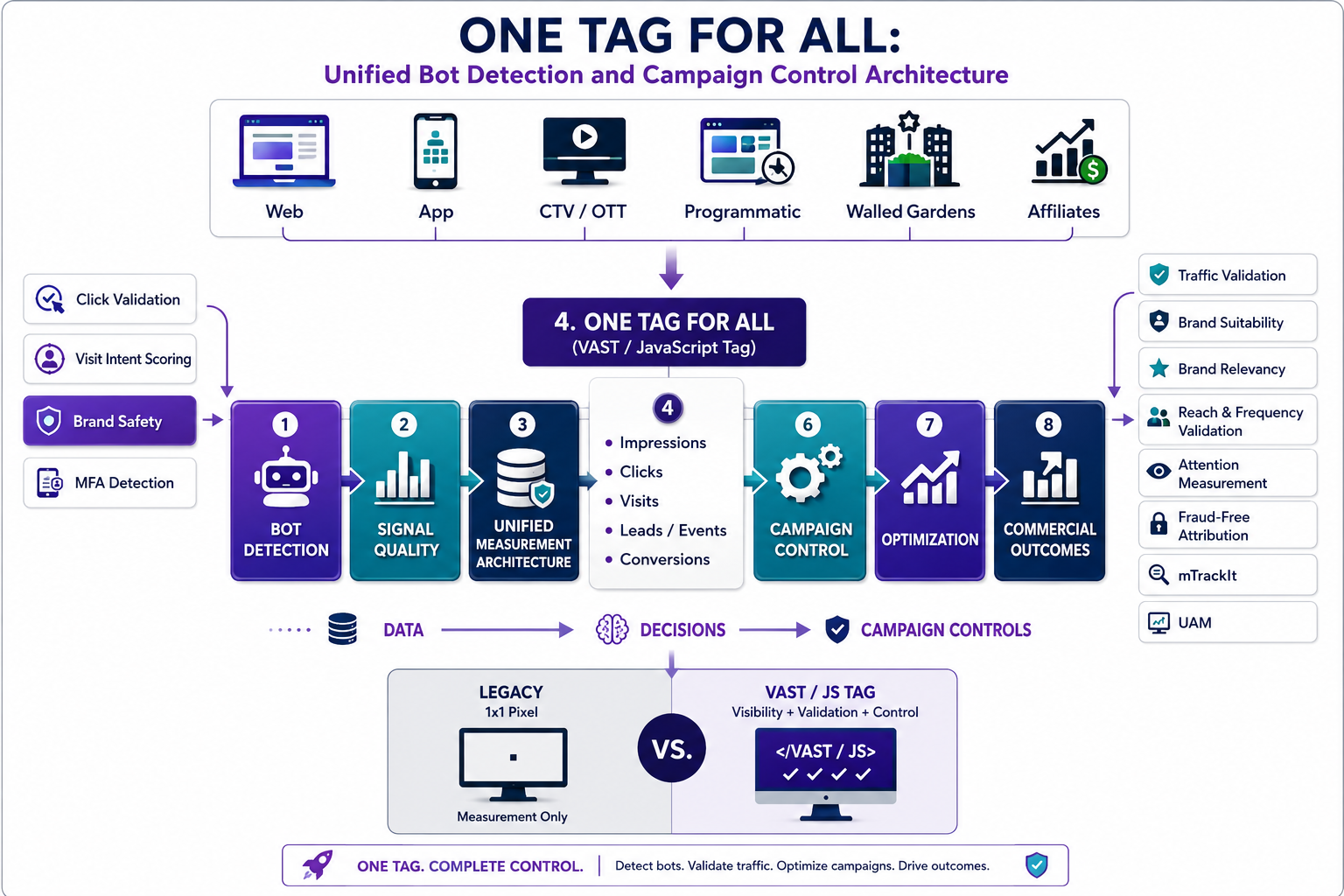
How mFilterIt’s One Tag for All Approach Helps Advertisers Build Smarter Bot Detection
Richer Campaign Intelligence
Richer signals only matter if they change decisions. mFilterIt's single tag doesn't just collect deeper data; it acts on it, flagging sophisticated bot traffic with far greater accuracy, feeding real-time inputs into campaign optimization, and stripping invalid traffic out of the numbers before they reach a media plan or a performance report.
One Tag, Multiple Outcomes
A single implementation simultaneously powers ad fraud detection, brand safety, reach and frequency validation, attention measurement, frequency cap monitoring, and brand relevancy. What would typically require six separate vendors, and six separate integrations instead runs through one tag, one dashboard, and one consistent dataset.
Full-Funnel Traffic Validation
Fraud doesn’t stop at the impression, so mFilterIt doesn't either. The same tag validates clicks against genuine customer intent rather than automated activity, distinguishes real visits from those driven by ad fraud bots, filters malicious leads out of the funnel, and separates organic sales from falsely attributed ones, giving advertisers a single, trustworthy view from the first impression to the final conversion.
What This Means for Advertisers
Rather than functioning as another standalone bot detection tool, mFilterIt operates as a unified media traffic validation platform, simplifying implementation while improving campaign trust, measurement accuracy, and optimization.
Proof in Practice
A leading automobile brand used mFilterIt's full-funnel ad traffic validation suite to validate campaign quality beyond impressions. The platform detected bot-driven anomalies across post-event metrics, significantly reduced frequency cap violations, and lowered brand unsafe traffic from 2.32% to 0.95% across the campaign period, while maintaining viewability above 92%.
The outcome was $1.1 million in media savings and a 41% reduction in impression-level fraud, demonstrating the value of full-funnel campaign validation.
Conclusion: The Future of Bot Detection is Simplicity, Not More Complexity
Adding more point solutions on top of an already fragmented stack isn't the answer against AI-driven fraud. The new approach comes down to five shifts: better measurement, richer campaign intelligence, one unified implementation, cleaner optimization, and trusted campaign validation So, if you’re still relying on multiple vendors and legacy ad tech tags to detect bot traffic?
Talk to mFilterIt about how a single, unified tag can simplify campaign validation, catch sophisticated bot traffic with greater accuracy, and protect every advertising dollar you spend in 2026.
Frequently Asked Questions
How does bot traffic affect digital advertising and ROAS?
Bot traffic disrupts ad campaigns by inflating impressions, clicks, and visits without real intent, wasting spend and skewing performance data. This lowers ROAS, making campaigns look effective while actual conversions and revenue stay flat.
How does bot detection work, and how can you block bad bots in 2026?
Bot detection analyses signals like IP repetition, device intelligence, and behavioural patterns to separate real users from automated traffic. In 2026, blocking bad bots requires full-funnel validation, not just basic impression-level checks.
Why is bot detection so challenging as AI bots evolve?
AI-powered fraud bots mimic real browsing behaviour, rotate devices and IPs, and adapt continuously to evade detection. This makes behavioural bot detection essential in 2026, since static, rule-based methods can no longer keep up.
Which industries are most affected by bot attacks, and why implement bot detection?
E-commerce, BFSI, OTT, and app-based businesses face the highest bot attack volumes through ad stacking, device farms, and fake clicks. Implementing bot detection protects ad spend and keeps campaign data accurate across every channel.