Imagine this: A customer's UPI payment fails. They search for their bank's helpline, tap the first link on Google showing the bank's logo, and dial the on-screen number. The person who answers is not from the bank. Within minutes, an OTP is shared, and the account is drained.
This is brand infringement in banking, and it has moved far beyond logo infringement. Here's what we found during scans of four major Indian banks. Over three months, from 17 June to 13 September 2026, our scans picked up 2,48,584 cases of brand infringement, that is more than 2,700 a day. Most of these cases used bank's name to sell a loan, a credit card, a job or a helpline that isn't real.
India has public sector banks, private banks, small finance banks, payments banks and hundreds of cooperative banks. Each of them has a name that customers trust, so each one is a target. If four banks face nearly 2.5 lakh cases in three months, the real scale across the banking sector is far larger than any single bank can see on its own. Hence, the exploitation.
Below, we break down that data and take apart real samples to show how these attacks work and how they can be stopped.
Why Banks are a Prime Target for Brand Infringement
BFSI brands carry what fraudsters target the most: instant, unquestioned trust. Large financial groups also multiply their attack surface. A single brand lends credibility to insurance, credit cards, payments, mutual funds, and pension arms.
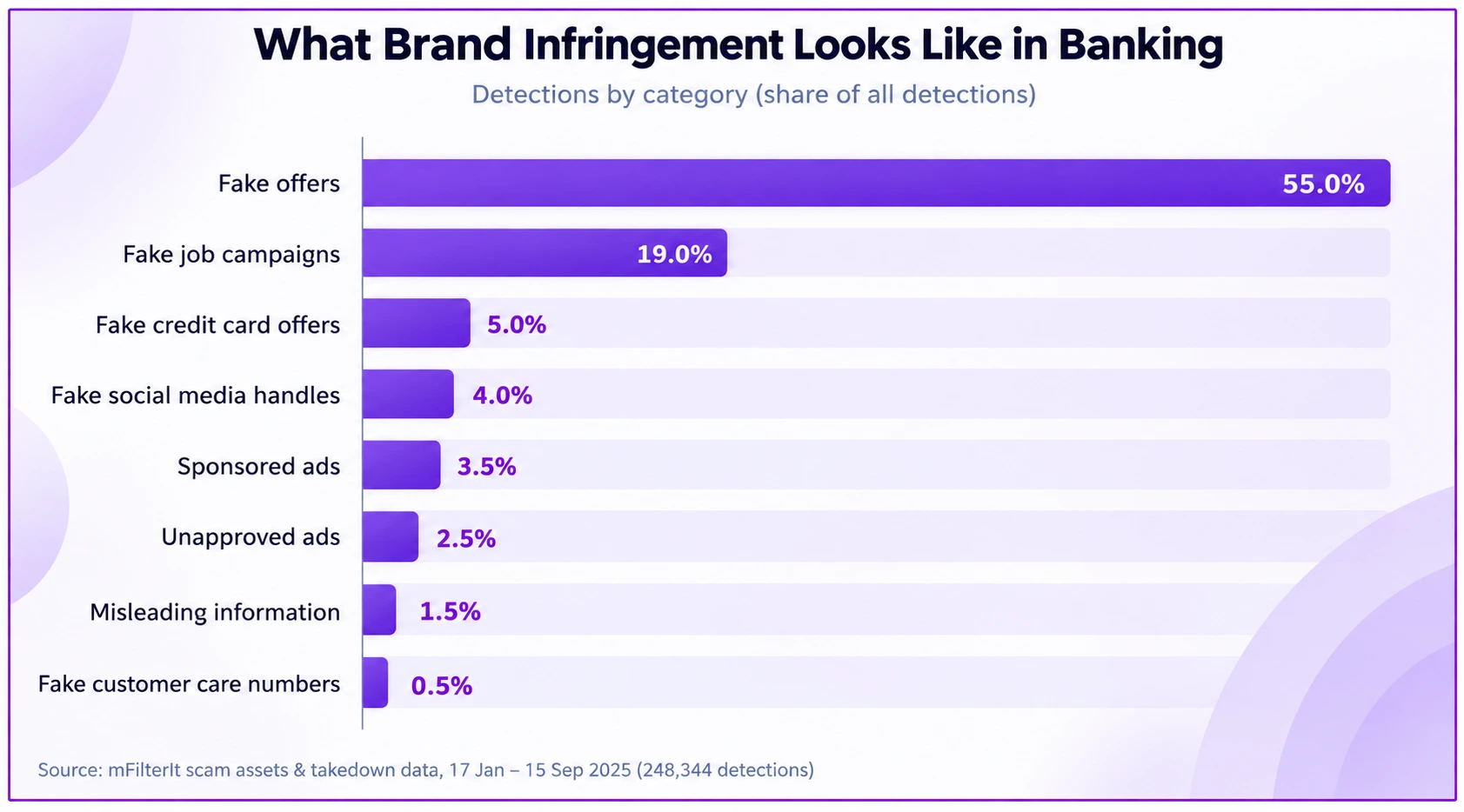
Fake offers dominate: 136,589 detections (55%) were fake offers using a bank's identity, more than half of all the detections.
Recruitment is the second-largest target: 47,185 fake job promotions (19%), about one in every five detections.
Paid ads are part of it too: 14,900 sponsored or unapproved ads (6%) used the banks' brands.
Moreover, we found brand impersonation taking place on more than 10 platforms, including websites, app stores, Google Maps, YouTube, Facebook, Instagram, Pinterest, Quora, Reddit, and Telegram.
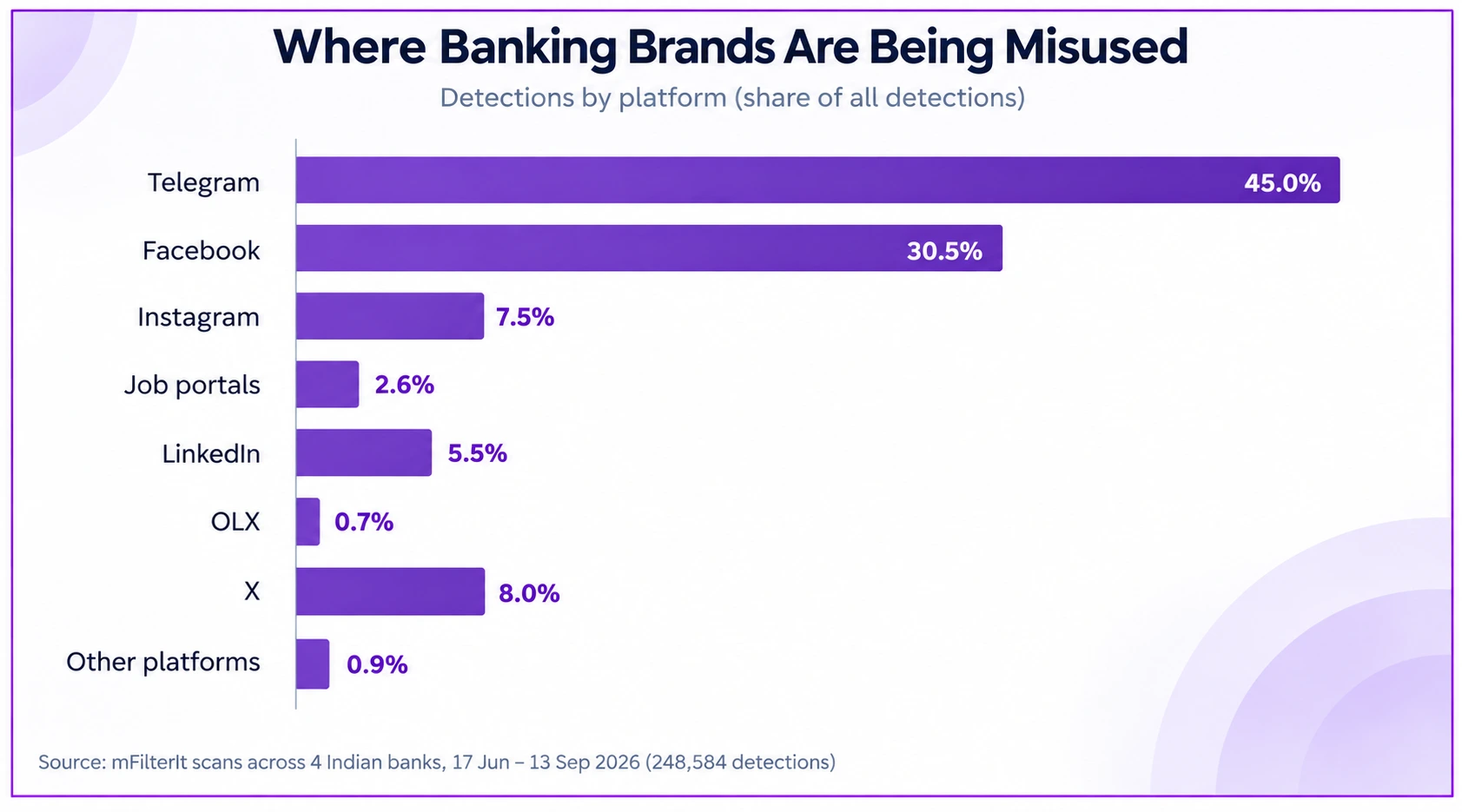
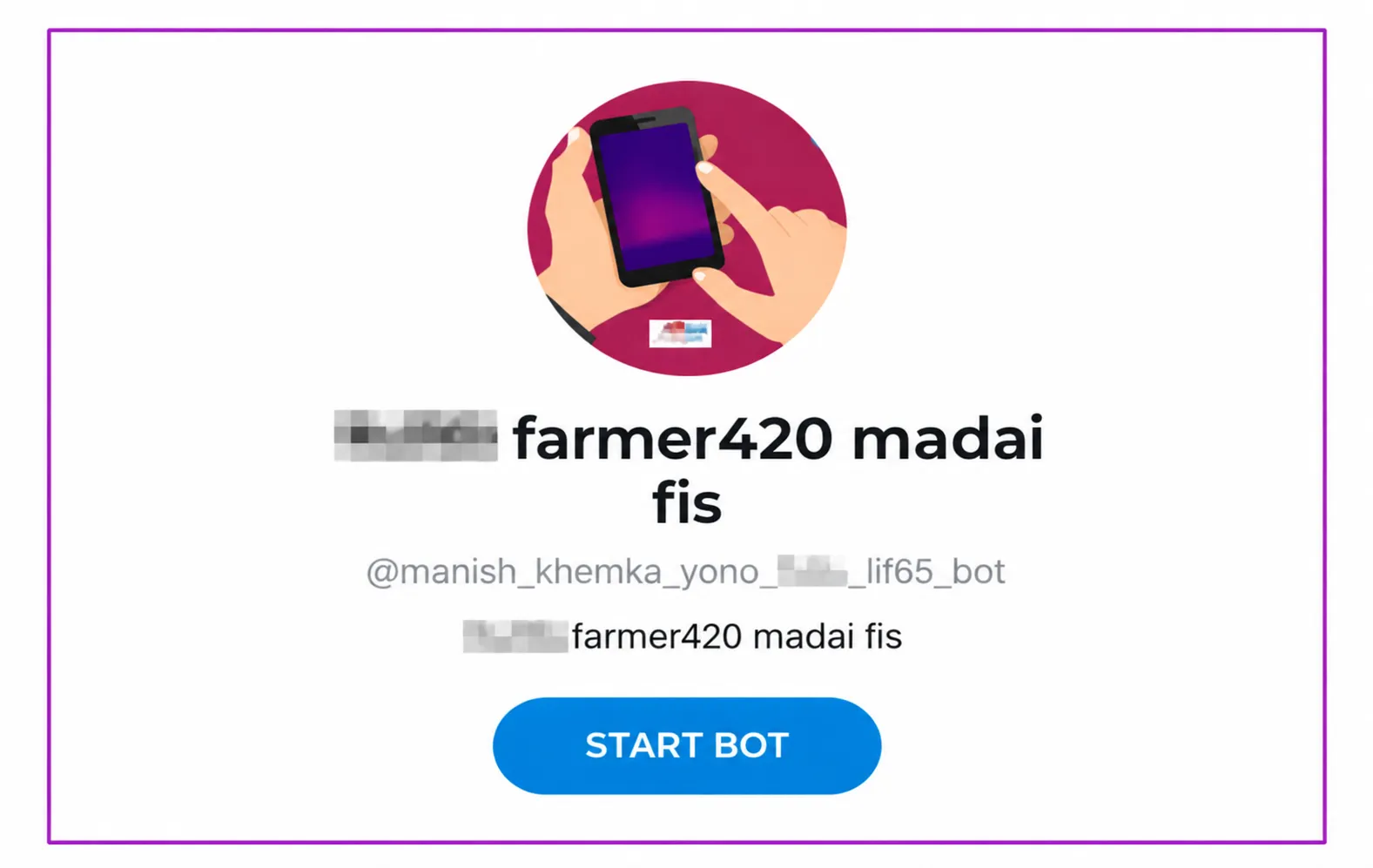
Telegram accounts for 1,49,572 detections (45%), and almost all of them are fake offers. In fact, Telegram carries nearly 80% of every fake offer in the data. Closed channels and bots named after a bank app make it easy to push "exclusive" deals to large groups, away from public view.
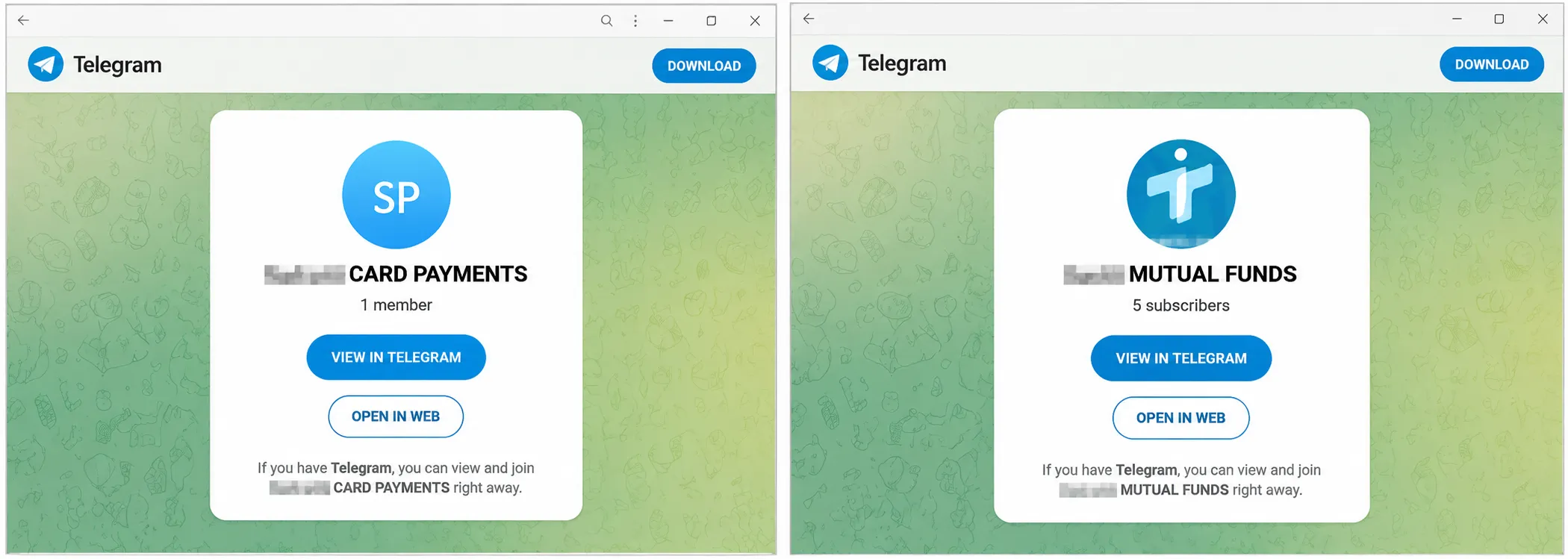
Facebook accounts for 75,911 detections (30.5%) and has the widest mix of threats. Fake offers (34,583), fake job posts (22,258) and fake credit card offers (6,165) lead the list.
Together, the two platforms account for about 91% of detections. This means that brand protection for brands is no longer limited to just social media. It is spread across more than 20 other platforms, including job portals, LinkedIn, Instagram, X, OLX, and YouTube.
Common Examples of Online Brand Infringement in Banking
Each type of brand impersonation targets a different group of people. Here's how the most common ones work.
1. Fake Loan and Credit Card Offers
Targets: People looking for a loan or a credit card
Fake offers promise deals the bank never made. One post advertises home loans with a "0% processing fee" when the actual fee is 0.35%. Another promises ₹20 lakh personal loans at 0% interest. Others promote referral schemes that do not exist.
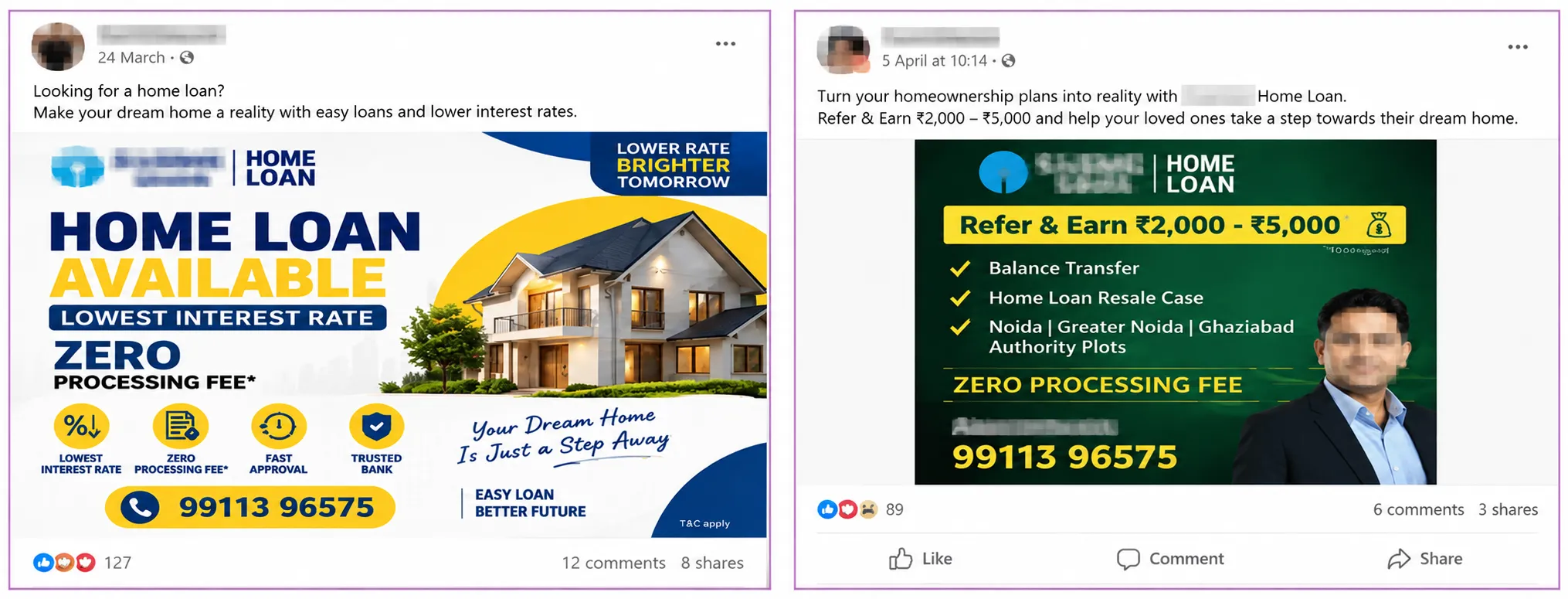
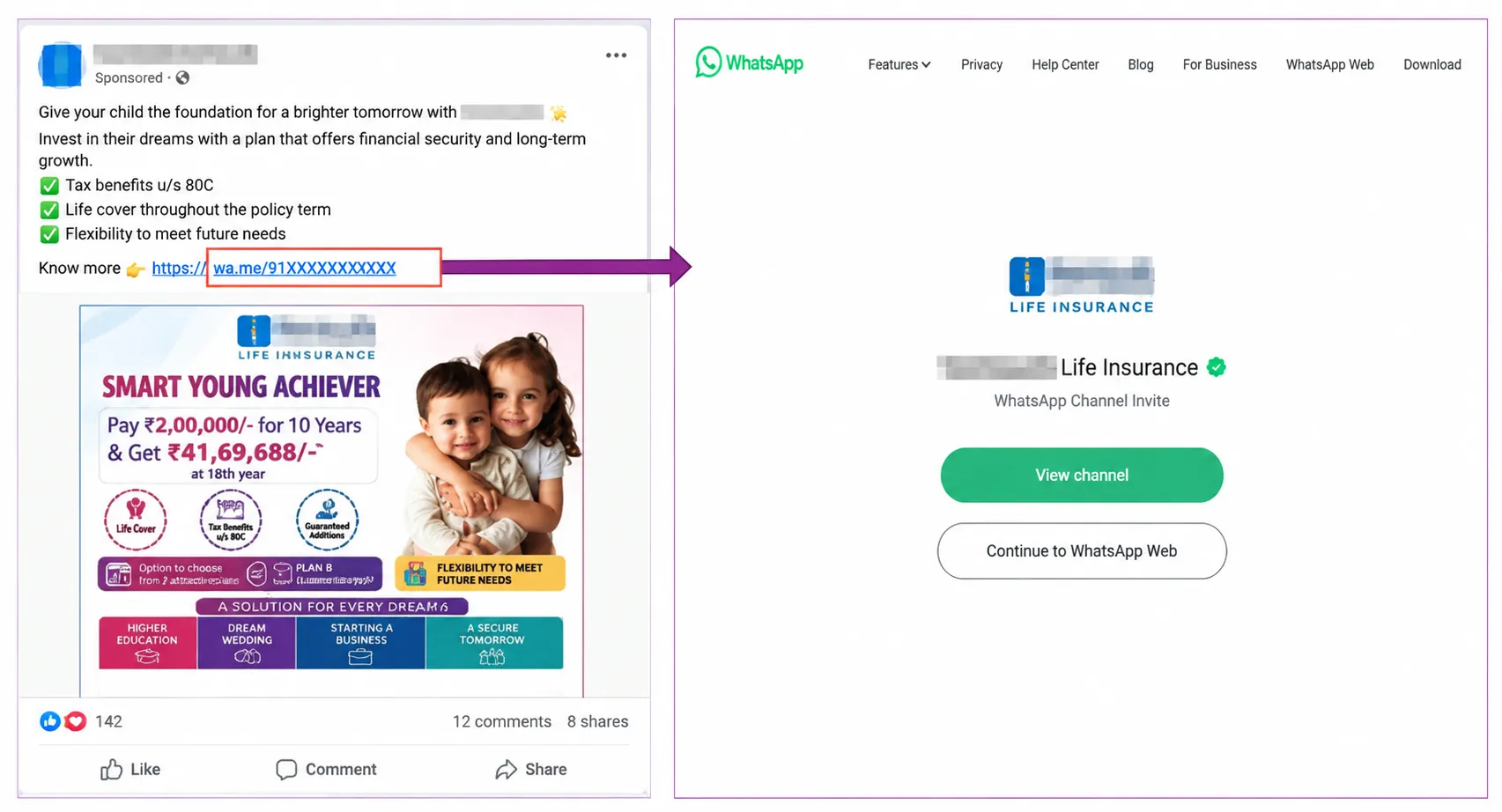
Some fake offers also steal leads. In one sample, we identified a paid ad using the bank's own product creative, but its link was sending people to a private WhatsApp group instead of the bank, leading to hijacking of leads.
2. Fake Job Promotions
Targets: Job seekers
Fake recruitment posts use the bank's name to look official. Most follow the same pattern: "urgent hiring" for a bank project, roles like help-desk executive or ATM inspector, an application through a Google Form or a lookalike email address, and a small line saying, "charges applicable". That last line usually means candidates pay a fee for a job that does not exist.
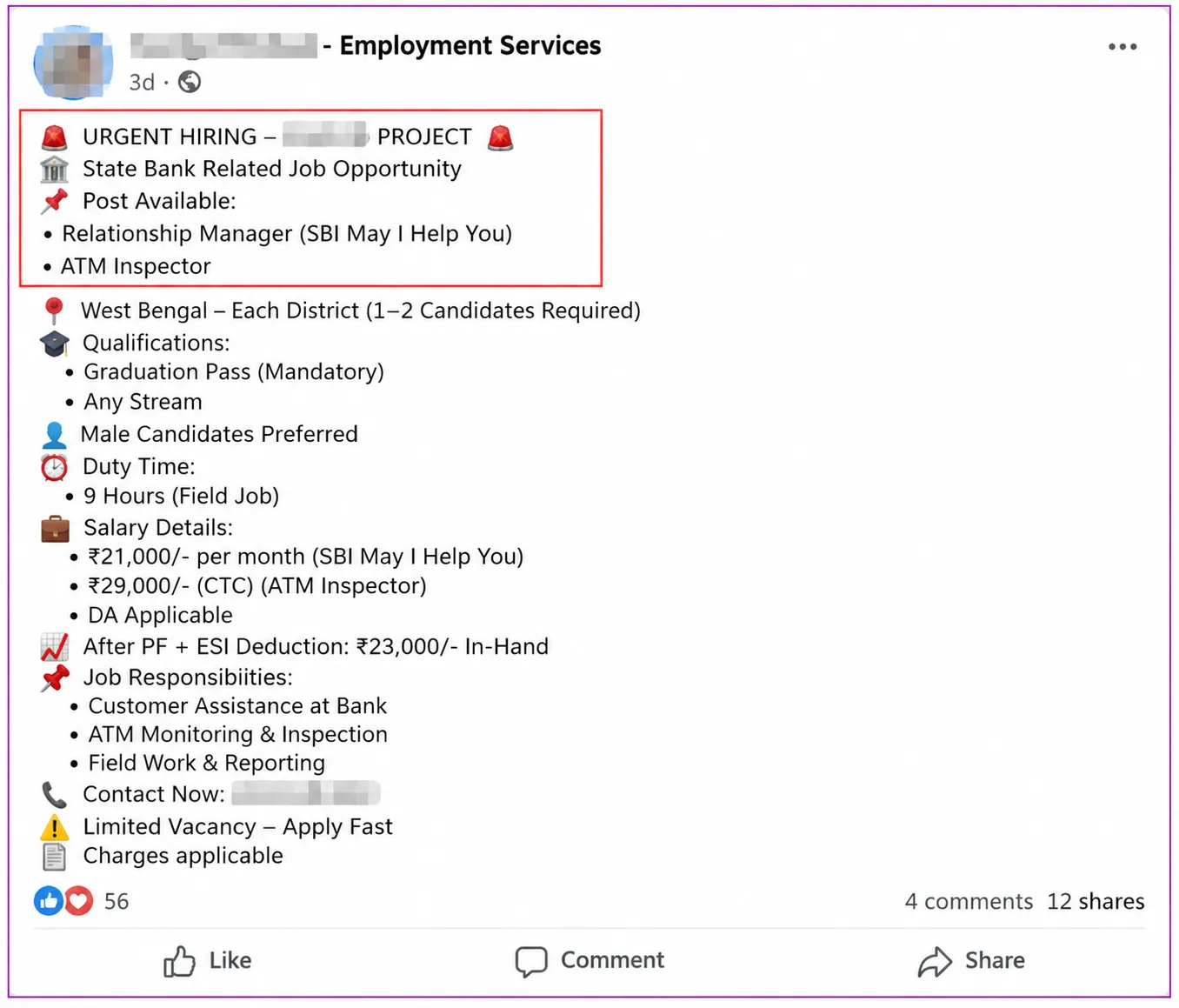
What the data shows: 37,066 fake job promotions, spread across Facebook (22,258), job portals (6,865), LinkedIn (4,598) and OLX (1,807).
This makes brand infringement a problem for HR and the employer brand, not just for fraud teams.
3. Fake Bank Customer Care Numbers on YouTube, Instagram and X
Targets: Customers who need help
Fake helplines exploit customer concerns through YouTube Shorts and Instagram Reels, using bank logos and “24/7 Helpline” numbers to appear genuine. Titles like “Customer Care Number” help them surface in search results. Others mimic call screens for “Payment Related Issues” or pose as local “Customer Service Points” offering zero-balance accounts.
X (Twitter) is a bigger risk than most teams expect. As per mFilterIt scans in last 3 months, 1,095 fake customer care detections, 701 (64%) are on X. Customers often complain there by tagging their bank, and a fake "support" account can reply before the real one does.
4. Clone Apps, Lookalike Websites and Fake Branch Listings
Targets: Customers ready to log in or visit a branch
These threats are rare in volume, 59 clone apps and 35 lookalike websites, but their impact can be far more direct. Each is designed to capture login credentials or facilitate financial theft. This is why banks cannot assess brand-infringement risk by volume alone.
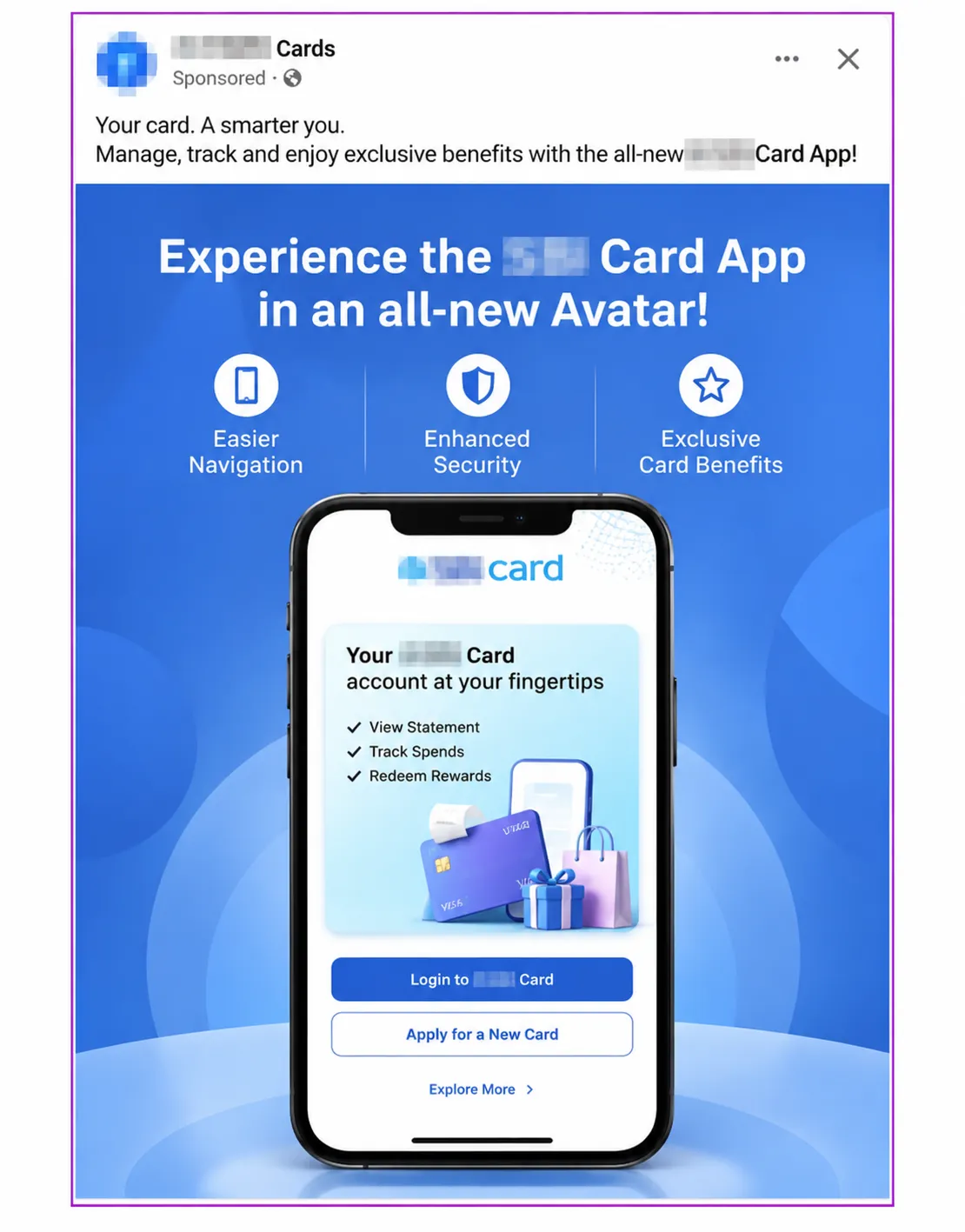
Clone apps
Modified copies of legitimate banking apps, distributed as APK files through third-party app stores, closely mimic the official experience. Yet, small inconsistencies in their app details can expose them.
Check | Clone A | Clone B | Clone C |
Version (clone vs official) | 1.5 vs 12.3.4 | 7.5.8 vs 7.5.8 | 6.5.1 vs 2.29.02 |
File size (clone vs official) | 17.58 MB vs 95 MB | 127.4 MB vs 68 MB | 42.7 MB vs 60.84 MB |
Warning sign | Asks for access to storage, camera and internet | Collects user data for lead generation | Unknown developer, different app ID, unusual file format (XAPK) |
Clone B is a clear example. It uses the same version number as the official app but is nearly twice the size, suggesting that additional code may have been added. Clone A goes a step further by replicating the legitimate developer’s name, making it harder to distinguish from the genuine app during a quick check.
Lookalike websites
Fraudsters add the bank's name to an unrelated web address (for example, brandname.unrelated-site.in) or register it on cheap domain endings such as online. The pages copy the bank's logo and menus, then collect enquiries and personal details.
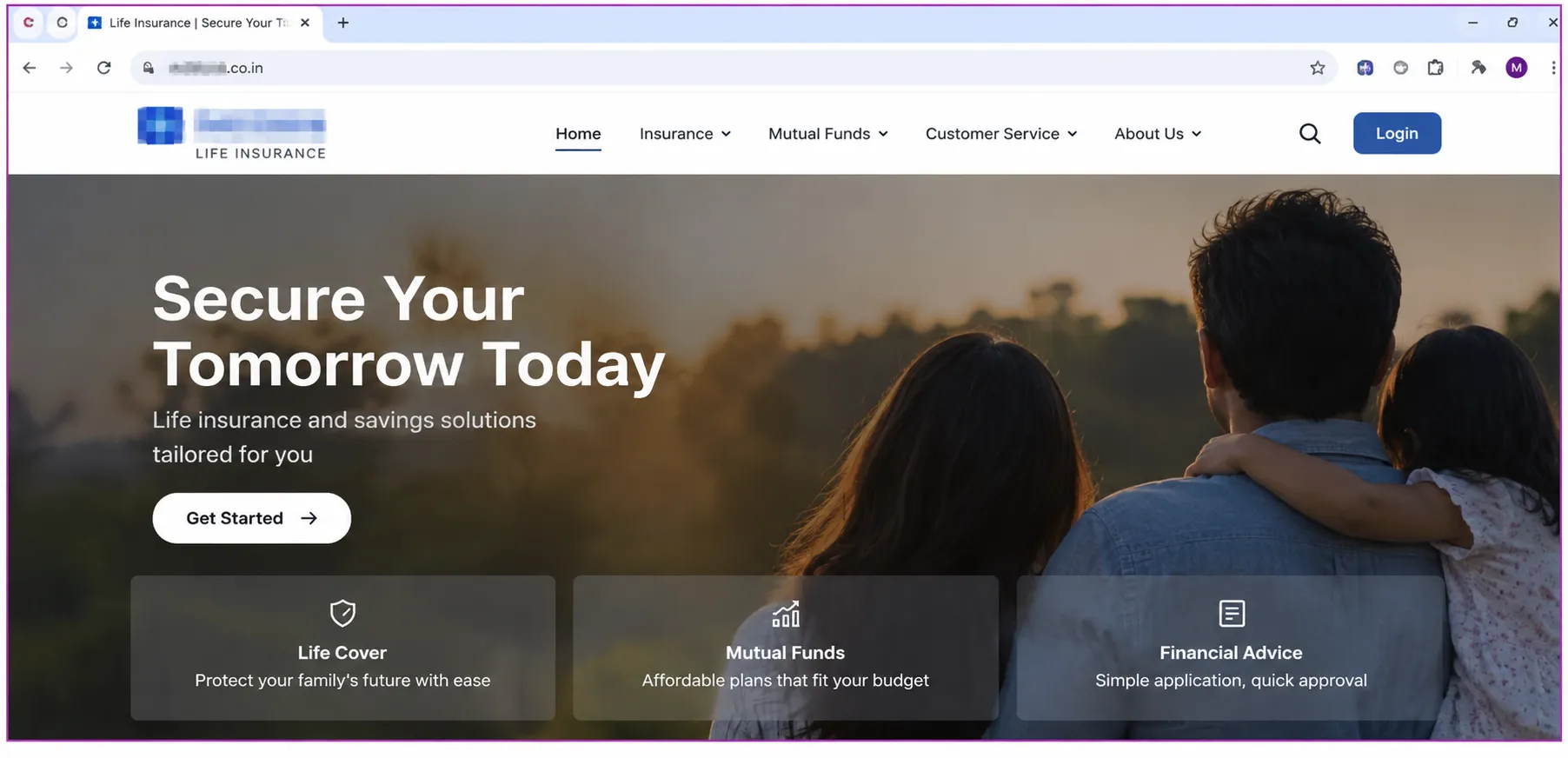
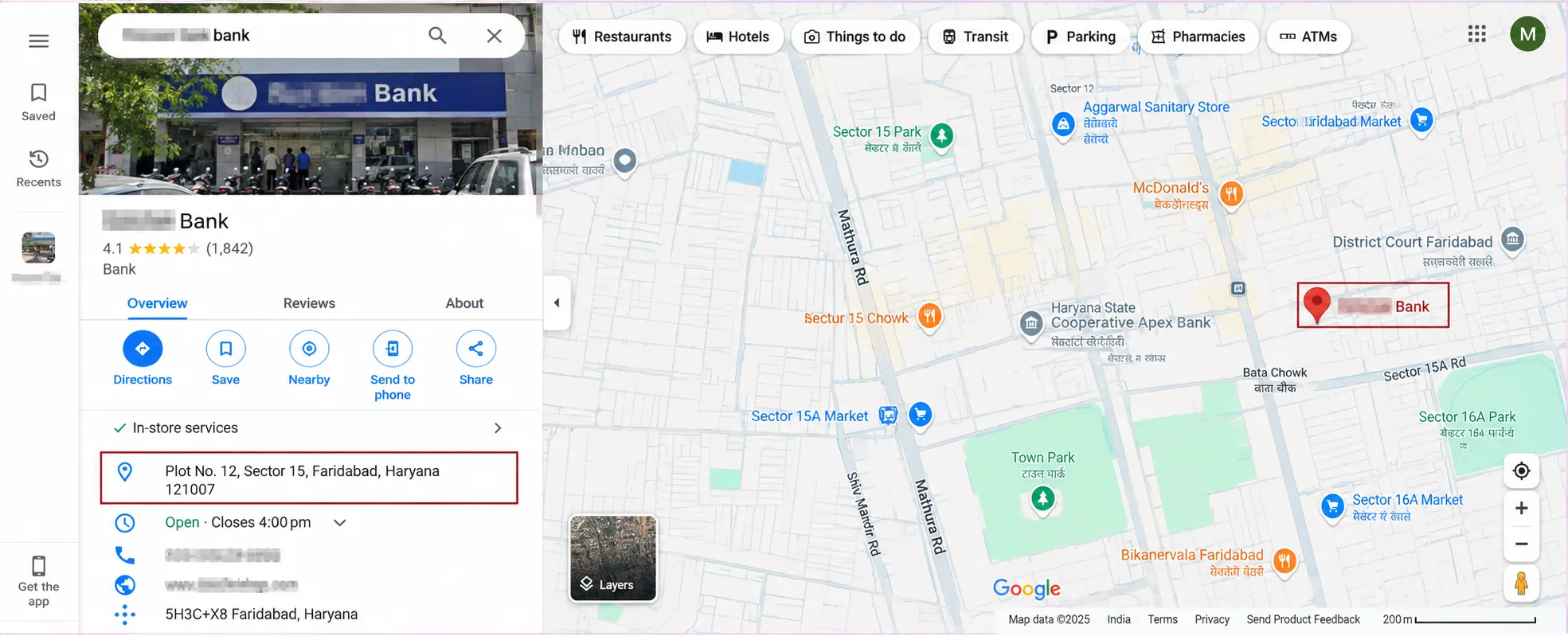
Fake branch listings
Fake Google Maps listings use the bank's real toll-free number to look genuine but point to a location with no branch. Warning signs include no branch photos, an unclaimed profile; a "location may be incorrect" flag and one-star ratings.
Misinformation and Disinformation: The New Face of Brand Infringement
Impersonation is only half the risk. The other half is what people say while using your name.
1. Disinformation
Disinformation is false or misleading content made on purpose to deceive, often to gain views or followers, or to set up a scam later.
Examples:
A video of a police raid on an ATM fraud gang is captioned as a warning for anyone using the bank's ATMs, suggesting the bank's machines are unsafe.
A years-old news report of cash-deposit machine theft is reshared as a fresh warning to create panic amongst customers.
2. Misinformation
Misinformation is false or unverified content shared without clear intent to harm, such as angry posts, half-truths, and rumours.
Examples:
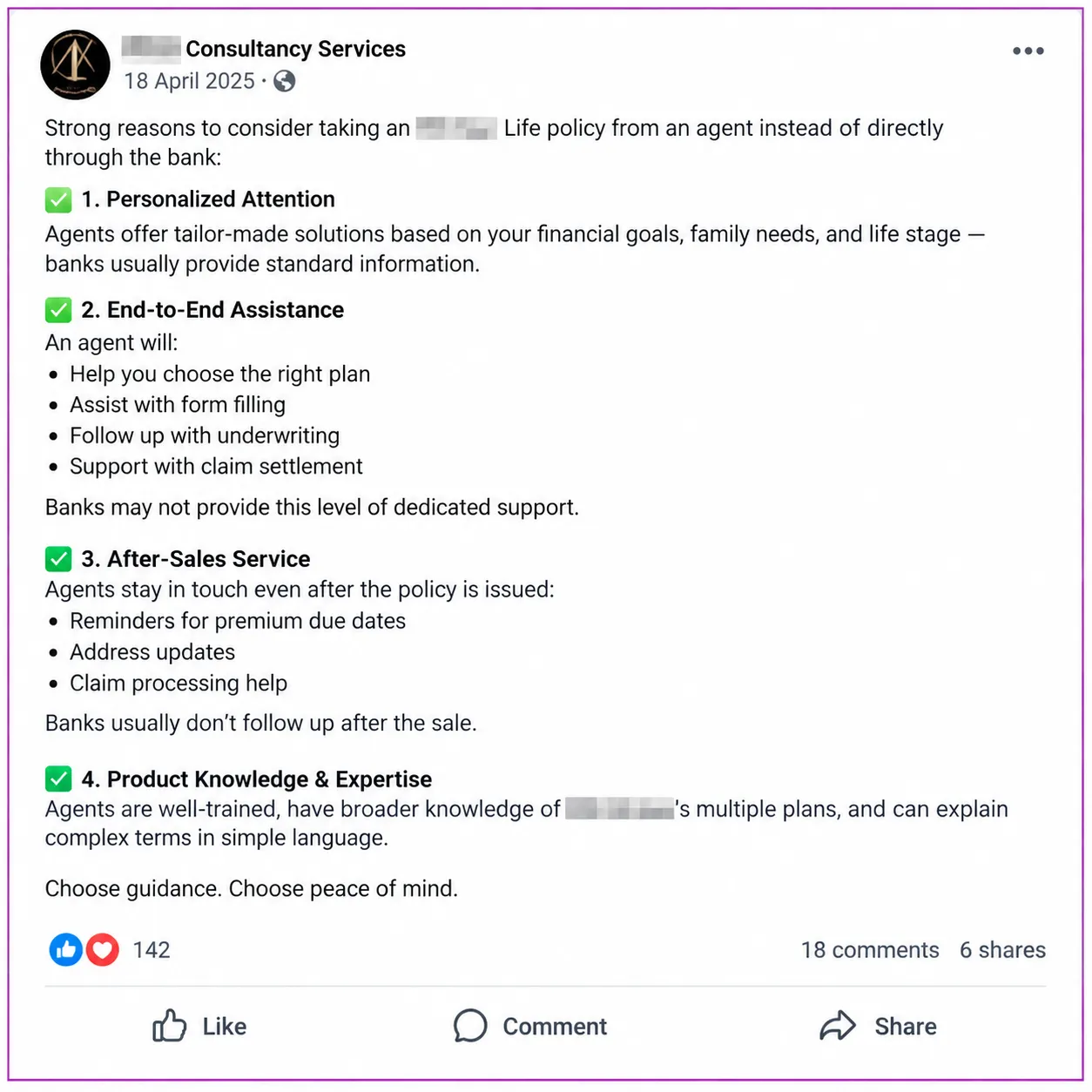
Agents post "reasons to buy from us instead of the bank". This blurs who customers should trust, the same confusion fraudsters exploit.
With AI-generated video and cloned audio now cheap, deepfakes of leaders are another medium of spreading misinformation and disinformation. The real risk is not the content itself but finding out about it too late.
That is why monitoring needs to cover text, images, audio and video in regional languages, trace who is spreading a story and where, and alert PR, legal, fraud and security teams at the same time.
Read more about types of online scams brands need to watch out for
How mFilterIt's AI-Led Brand Protection Solution Helps Detect and Monitor Brand Infringement Across Digital Channels
An effective approach runs as a pipeline:
Multi-source aggregation: OSINT crawlers scan the open web, social platforms, app stores, maps, messaging apps and the deep web, starting from the brand's official assets (logos, domains, handles, numbers).
AI/ML classification: Models tag each case by type (phishing site, clone app, fake handle) and read text, images, audio and video.
Risk scoring: Each case gets a threat score. High-confidence violations go straight to takedown, and low-confidence ones go to human analysts.
Human-in-the-loop validation: Analysts sort findings into a whitelist (legitimate partners and agents) and a blacklist. That labelled data feeds back into the models and improves precision over time.
Enforcement: Direct escalation with platforms and hosts removes content without needing a court order, and evidence is packaged for legal action if required.
Unified dashboard: A single view shows threats, takedown status and time-to-removal for security, fraud, legal and brand teams.
Detection Plus Action: 2.31 Lakh Brand Infringement Takedowns for a Leading BFSI Group
Continuous monitoring across digital platforms enabled the BFSI group to detect brand misuse at scale and act quickly on verified infringements:
2,31,018 successful takedowns (a 97.2% success rate)
2,37,565 infringement cases identified
10+ platforms continuously monitored
48 hours average takedown time
Protect Your Bank from Brand Infringement Before Customers Pay the Price
The real shift in brand infringement is not that there are more fakes. It is that fraudsters no longer need to copy a bank to exploit it. The bank's name alone is enough to make a fake offer, job or helpline look real, and most of these cases stay invisible to traditional security tools.
That changes what brand protection means for banks. It is no longer about guarding a logo. It is about protecting every place where a customer, candidate, or partner meets the bank's name. That's the difference; a brand protection solution can make banks see how fraudsters are using their name.
Talk to an mFilterIt expert to find out where your brand is being misused and how quickly it can be taken down.
Frequently Asked Questions
What is brand infringement?
Brand infringement is the unauthorized use of a company's name, logo, creatives, contact details or identity in a way that misleads customers. In banking, it usually shows up as fake websites, cloned apps, fake helpline numbers and social media accounts that pose as the bank to steal data, money or leads.
What are the different types of brand infringement?
The main types are impersonation (fake websites, apps, social handles and customer care numbers), intellectual property misuse (unauthorized use of logos and ad creatives), fake offers and promotions, fake business listings, counterfeit or unauthorized products, and misinformation or disinformation spread using the brand's name.
What is the difference between brand infringement and trademark infringement?
Trademark infringement is a legal term: the unauthorized use of a registered mark in a way likely to confuse consumers. Brand infringement is broader. It covers any misuse of a brand's identity, including creatives, helpline numbers, product names, and executive likenesses. Whether or not a registered trademark is involved, or legal action is practical.
How does brand infringement impact revenue and customer trust?
It drives direct fraud losses, diverts leads from paid campaigns to fraudsters, and raises complaint and call-center volumes. Customers who are scammed through a fake channel often blame the bank, not the fraudster, so every unresolved case erodes the trust that financial brands depend on.