
Not every click comes with real intent. Yes, that's what digital advertising is vulnerable to in 2026.
Click fraud is a more prominent issue in Google Ads than most marketers even realize. Moreover, what often gets missed are the accidental clicks, the bored scrollers, click farms, the bots that behave well enough to pass, and the visitors who were never going to buy anything from you.
None of this gets flagged. All of it gets counted, further manipulating the algorithm to push budget towards wrong sources.
Hence, the need to measure intent and not just clicks, because the future of Google Ads performance is not about generating more clicks. It is about understanding which visitors actually showed genuine intent.
Continue reading to understand how a combination of both detecting click fraud and intent scoring works for campaign success.
Technical Mechanics of Invalid Traffic: GIVT Versus SIVT
General Invalid Traffic (GIVT) comprises routine web scrapers, search engine crawlers, and basic datacenter pinging scripts. GIVT is identified and filtered using standard rules, IP blacklists, and basic user-agent filtering.
Sophisticated Invalid Traffic (SIVT) represents a much more advanced threat. SIVT relies on headless browser automation, programmed cursor movements, simulated scroll dynamics, and timed interaction delays designed to pass standard verification checks.
Why Clicks Are No Longer Enough to Measure Google Ads Performance
Earlier, a click used to be a fair stand-in for interest. One person, one desktop, one browser, and one deliberate decision. Clicking took attention, so counting clicks was a reasonable way to count interested people.
That internet is gone. Here’s what actually lands on your landing page today:
Automated and AI-driven traffic: Scrapers, crawlers and AI agents move through the web at scale, loading pages no human ever sees.
Bots that behave like real humans: Modern invalid traffic does not sit still. It moves a cursor, scrolls a little, waits a moment, then clicks, because it was built to survive exactly the checks most advertisers run.
Accidental and incentivized clicks: Mis-taps on mobile placements and reward-driven clicks still land in your report as engaged visitors.
Fragmented journeys: One buyer can create five sessions across three devices. Five strangers can look like one returning user. Neither is a clean signal.
Automation buying on your behalf: Bids are placed in milliseconds by systems learning from whatever data reaches them.
The real damage is elsewhere, and most teams underestimate it. Your campaign does not just receive traffic. It learns from it.
Read about click fraud types in detail here.
The Problem with Traditional Google Ads KPIs
CTR, CPC, bounce rate, and session duration are not wrong. They are incomplete.
They were designed to measure campaign delivery, not visitor quality. They answer questions about your media buying but were never built to answer questions about the person on the other end.
The Inadequacy of Manual IP Exclusion Lists
Manual IP blocking operates on the outdated assumption that click fraud originates from fixed server locations. Because modern bot networks rotate across millions of residential IP addresses, adding static IP addresses to an ad manager's exclusion list is ineffective. By the time an IP address appears in campaign logs, the proxy pool has already shifted to a new subnet.
Conflicts of Interest in Native Ad Network Auto-Refunds
Ad platforms operate under an inherent conflict of interest: they act as both the publisher selling ad inventory and the sole auditor certifying traffic quality. Native platform filters are built to detect gross GIVT spikes. They are not engineered to flag subtle SIVT behaviors that generate valid billable clicks while driving up platform auction clearing prices.
Traditional KPI | What It Tells You | What It Does Not Tell You |
CTR | Did people click? | Were they genuinely interested? |
CPC | How much did the click cost? | Was the traffic worth buying? |
Bounce Rate | Did users leave quickly? | Why did they leave? |
Session Duration | How long did they stay? | Was the engagement meaningful? |
Conversion Rate | Did users convert? | What stopped everyone else? |
Therefore, for better optimization, marketers need better transparency into actual campaign performance.
This brings us to the next section of this blog.
The Shift from Click Metrics to Intent Metrics to Eliminate Click Fraud
The transition here is moving from “how many clicks did this campaign deliver” to “what kind of clicks did it deliver, and which part of it deserves to influence what I do next”.
Post click, every visit leaves a signal behind. Intent measurement is the discipline of reading those signals including:
Intent Score
Every session carries clues about how likely that visitor was to want something from you. The output is not a label but a position on a scale (high intent, moderate intent, low intent).
It is built from more than on-site behaviour. Website behavioural data is combined with CRM records, sales funnel and revenue data, conversion metrics, lead metrics, and attribution metrics. Real outcomes teach the model what genuine interest looked like last month, so it recognizes it faster this month.
Navigation Pattern
Real people land on a product page, check pricing, go back, compare an alternative, and hunt for a contact option. The path is rarely straight, but it is always logical. Low-quality clicks and traffic move too directly or too randomly, skipping the steps humans take when weighing a decision. The shape of the journey says more than the number of pages.
Scroll Quality
Reaching the bottom of a page is not the same as reading it. A human reader scrolls unevenly, speeding past the familiar, slowing where it matters, sometimes scrolling back to re-read a line. Scroll depth tells you how far someone went. Scroll quality and mouse movement tracking tells you whether they were paying attention on the way.
Session Authenticity
This is where the technical evidence comes in. Analysis based on 65+ device parameters like browser, fonts, time zone, screen size, operating system, IP address, user agent and others is passed to your site during any normal web session and then combined into a device signature. That signature reveals when the “same” visitor keeps hitting your URL repeatedly.
Importantly, none of this needs cookies, a captcha or any personal data. There is no friction added for the genuine visitor, which matters, because every check you place in front of a real buyer costs you some of them.
Deterministic Checks: Catches clear, rule-based violations and known threat signatures instantly.
Heuristic Checks: Evaluates gray-zone traffic patterns like identical click times or clustered impressions.
Behavioural Checks: Analyzes human vs. machine engagement metrics, such as scroll speed and session depth.
Traditional Click Validation | Visit Intent Scoring |
Valid vs invalid | Intent confidence score |
Focuses on fraudulent clicks | Evaluates every visitor |
Binary decision | Continuous quality assessment |
Protects ad spend | Improves campaign optimization |
Detects invalid traffic | Identifies high-intent traffic |
How Visit Intent Scoring Helps Prevent Click Fraud and Improves Campaign Performance
The framework adds a qualification step where most stacks currently have a blind spot. It follows the funnel the way the money actually moves.
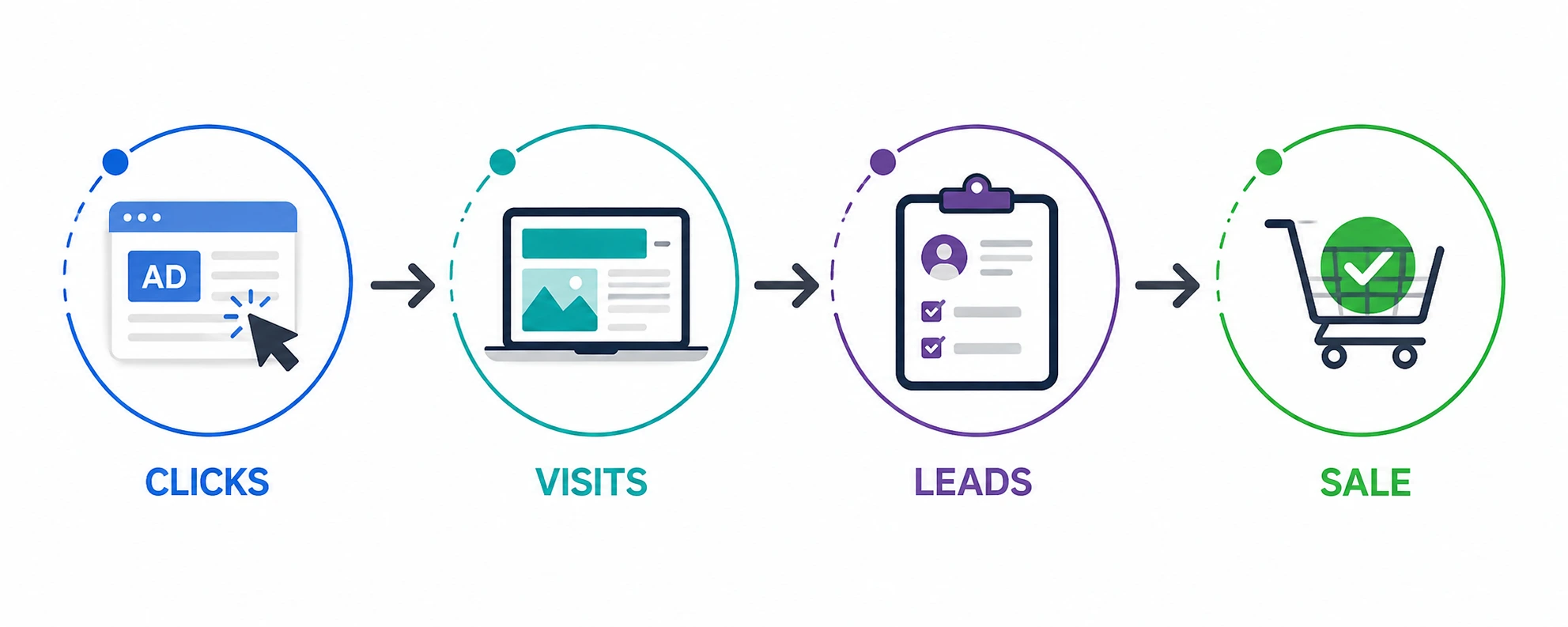
At the click, invalid traffic is detected and blacklisted. At the visit, intent is scored. At the lead, that score travels into the CRM, so sales know what it holds. At the sale, a postback closes the loop, and real conversion outcomes flow back to sharpen the scoring for the next cycle.
That last step is what makes it a system rather than a filter. Sales results teach the model. The model qualifies the traffic. The qualified traffic trains the campaign.
Three levers follow from it:
Block at the source: IPs and placements producing fraudulent traffic are blacklisted directly in Google, Bing or Meta ad managers.
Block at the audience: Low-intent users are excluded as an audience, so budget stops chasing people who will not convert.
Block at the page: A real-time flag lets you stop a known bad actor at the lead form itself.
The results?
Bidding gets better: When high-intent sessions carry more weight than low-intent ones, automated bidding chases traffic that converts instead of traffic that looks like it might.
Audiences stop inheriting noise: Retargeting pools built from qualified visits describe real buyers. Built from raw traffic, they teach the platform to find more of whatever came in.
Attribution gets honest: Once you can separate genuine engagement from hollow sessions, channel comparisons stop being skewed by whichever source pulls the most low-quality volume.
Reporting earns trust: “Our CTR improved” is not an answer when leadership asks whether the traffic was real and worth it. An intent-qualified number is.
What Does That Look Like in a Live Google Search Campaign?
One major automobile brand ran Google Search campaigns to attract new customers to their website. Despite a healthy spend on these channels, the conversion ratio was low & under suspect.
With blacklisting and intent scoring process over nine months, click fraud fell by 13% and lead fraud by 11%. The conversion ratio climbed from 3.82% to 6.71% (a 1.75X improvement), and roughly $0.47M of spend was protected along the way.
The strategic shift matters as much as the savings. With intent data in hand, retargeting moves from rule-based to value-based, and performance campaigns graduate from optimizing cost per lead to optimizing target return on ad spend.
Conclusion: See What Your Traffic is Really Telling You
Most advertisers are surprised by how much of their paid traffic shows little to no genuine intent, and by how much of their optimization budget is quietly being shaped by it.
mFilterIt helps by measuring click and visitor intent across every paid visit, so campaign decisions are made on qualified traffic instead of raw volume.
With the help of click fraud prevention tool, see the intent profile of your current campaigns, find out which sources deliver genuinely engaged visitors, and discover what your existing KPIs have been hiding. Request an intent analysis now.
Frequently Asked Questions
What is click fraud in Google Ads?
Clicks on your ads with no genuine buying intent from bots, click farms, competitors, or reward-driven users is called click fraud. Everyone drains budget, inflates CTR, and pollutes the data your campaign optimizes on..
How do I know if my campaigns are affected by click fraud?
Watch for the gap between metrics and money: traffic rising, qualified leads flat. Also, CTR spikes without conversion lift, repeat hits from the same IPs, and CPLs climbing with no bid changes.
Does Google Ads already detect and refund invalid clicks?
Yes, partly. Google filters clicks it identifies as invalid and credits them back. But that detection covers the click itself. What happens after the click, on your website, sits outside its visibility.
What is Visit Intent Scoring, and how is it different from click fraud detection?
Visit Intent Scoring evaluates every visit and scores how likely the visitor was to have genuine intent. One protects spend; the other improves optimization.
How can I stop click fraud from distorting my Google Ads optimization?
Blocking alone won't do it. Smart Bidding keeps learning from whatever it receives. Blacklist fraudulent IPs and placements, exclude low-intent users from audiences, and feed only validated conversions back into the platform.