Most advertisers discover app install fraud in an MMP report, days after the payout has cleared. The install is flagged, the publisher disputed, and the budget already spent. What the report rarely shows is where the problem started.
App install fraud does not begin at the install. It begins at the click. By the time a fraudulent install surfaces in attribution, a fraudulent click has already been bought, recorded and credited. The useful question is not how many clicks a campaign generated, but how many genuine users those clicks were capable of creating.
All Clicks are Not the Same as Genuine Users
Click volume is one of the easiest metrics to manufacture and one of the most trusted. Four mechanics do most of the damage:
Click spamming
Firing clicks in the background, without the user's knowledge, to catch an organic install and claim credit for it.
Click injection
Triggering a click at the moment of installation, so the last-click window is captured by a source that contributed nothing.
Fake clicks
Generated at scale by bots, emulators, device farms, VPNs and data-centre IPs.
Repeated and automated click behaviour
The same device ID or IP cluster clicking at machine speed and machine scale.
None of these requires a real user. All of them manipulate an install record that looks like one.
When High Click Volume Doesn’t Mean Good Performance & is Actually App Install Fraud
Bot traffic on ad campaigns runs between 8% and 32% depending on industry and geography, and the click layer is where it concentrates.
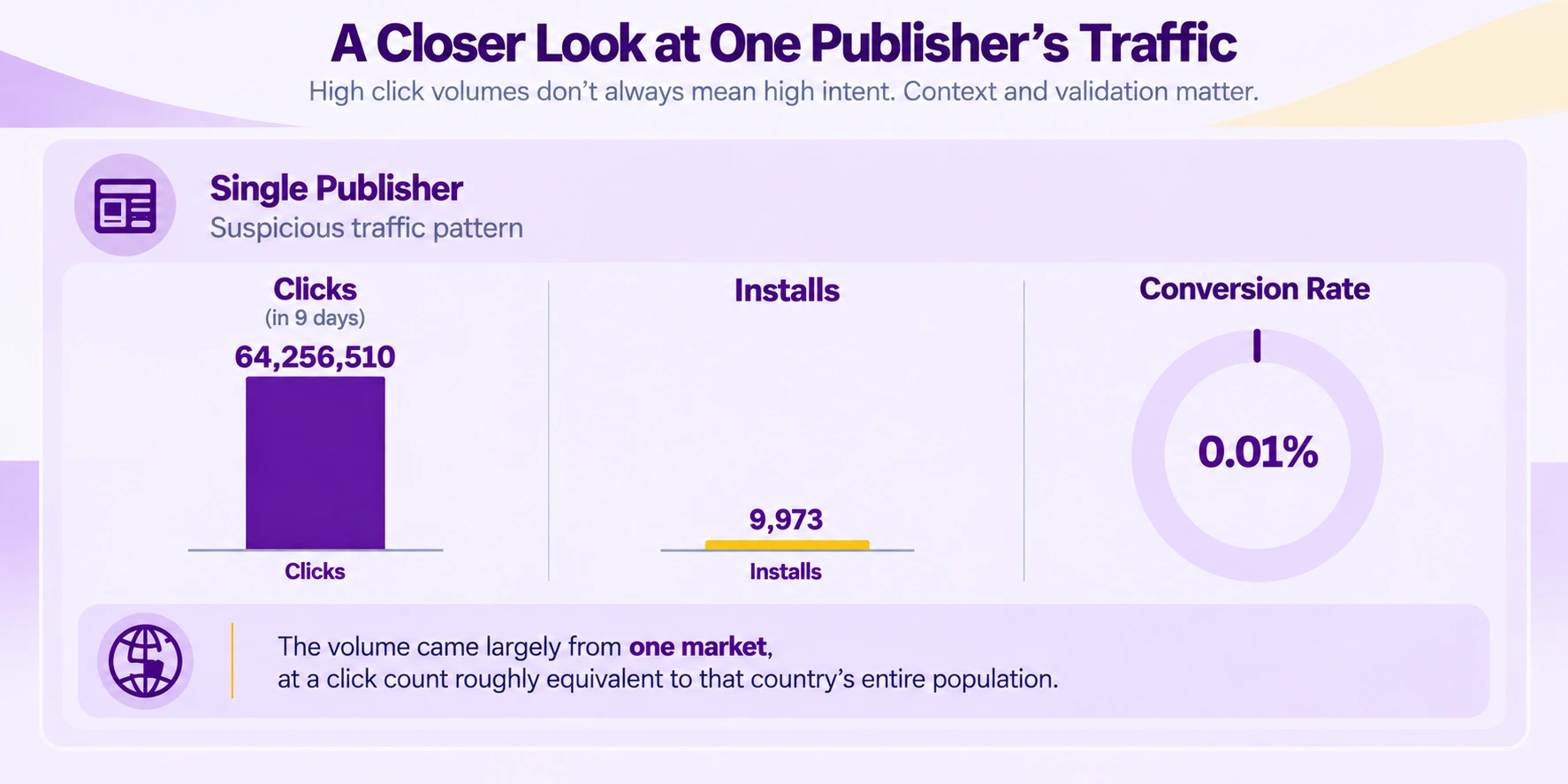
In one recent analysis, a single publisher delivered 64,256,510 clicks over nine days. Those clicks produced 9,973 installs: a conversion rate of 0.01%. The volume came largely from one market, at a click count roughly equivalent to that country's entire population.
The click-to-install time (CTIT) distribution confirmed it. In legitimate campaigns, most installs occur within 0–3 hours of the click, because real users act on what they have just seen. In the spammed campaigns, 65% landed more than 96 hours later; there is no causal link between click and install, just a click positioned to claim credit for an organic user.
Therefore, high click volume does not indicate demand. It indicates click volume.
What Happens When Fraudulent Clicks Reach Your MMP
Attribution platforms are built to award the last click, not to interrogate whether a person ever made it. Once fraudulent clicks pass into the MMP, four things follow:
Installs are attributed to the wrong source, distorting channel performance.
Fraudulent publishers are credited, and paid, for users they never delivered.
Media spend is consumed by traffic that was never going to convert.
Optimization actively move budget toward the fraud, because it appears to be working.
Every reporting cycle, spend shifts toward the publisher generating the most attributed installs; in a click-spammed campaign, the publisher committing the fraud. App install fraud stops being a leak and becomes something your own optimization funds.
Real-Time Click Validation: Validate the Click Before It Becomes a Conversion
Catching app install fraud after attribution is a reconciliation exercise. Blocking it before attribution is a media efficiency one.
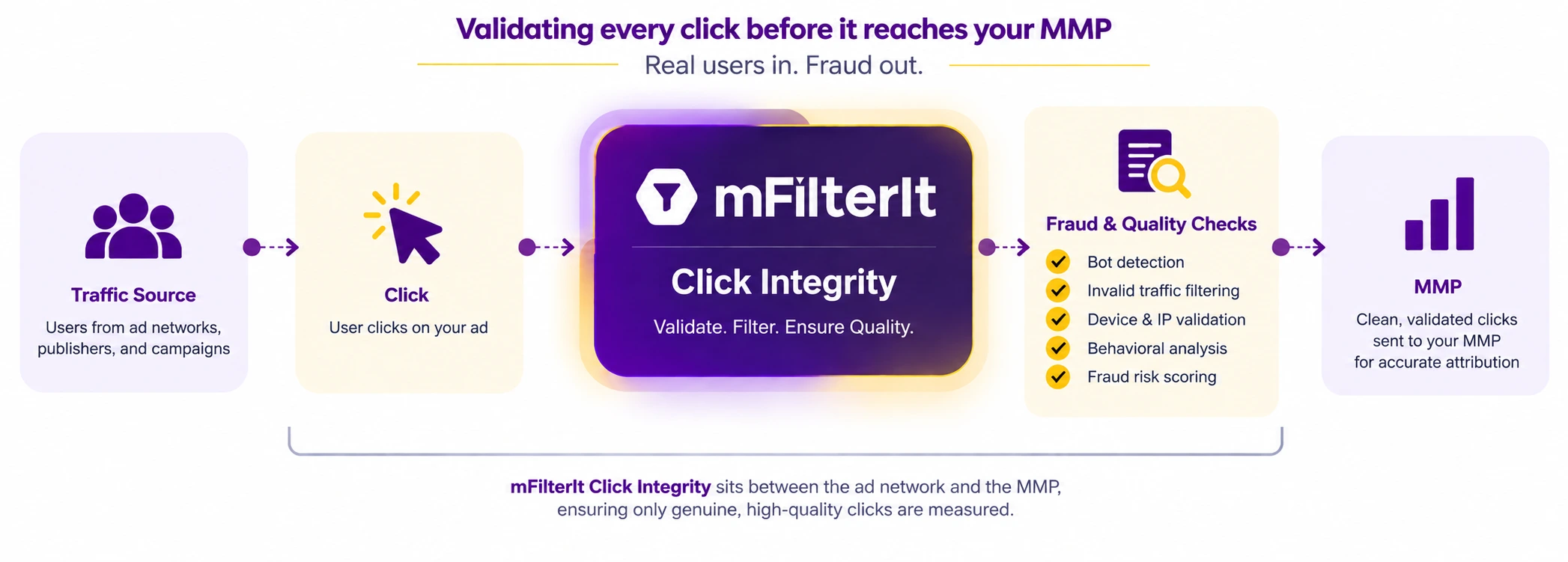
Clean clicks pass through to the MMP. Fraudulent and suspicious clicks are rejected before they reach it. The checks run in real time, against signals fraud cannot easily disguise:
Click repetition, including click spamming on the same device ID, and click on an impression injection.
IP repetitions, clusters, and volume spikes.
Malicious IPs, VPNs, proxies, and data-centre traffic.
Invalid device make and model, identified via user agent.
Non-applicable geography, verified through IP-level checks.
Rejected clicks never enter the attribution database, so they never trigger a payout, distort a report, or inflate MMP tracking costs.
What Changes When You Block Fraudulent Clicks Early
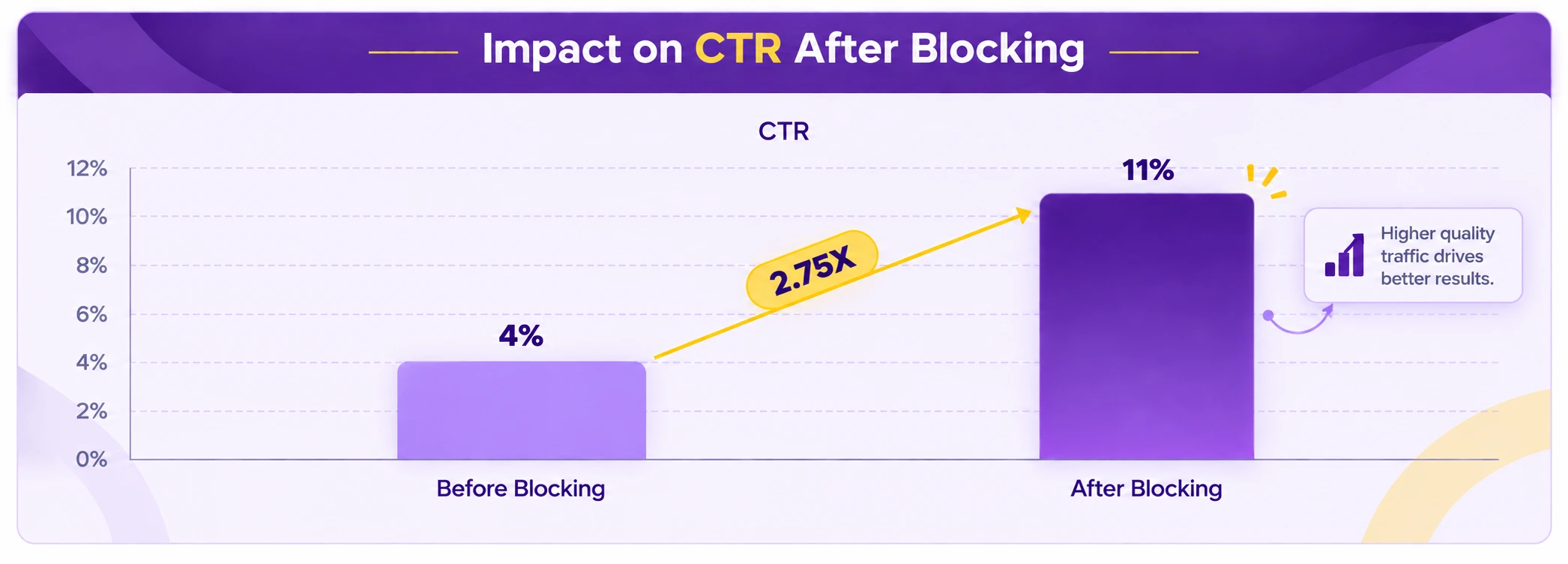
For a major e-commerce platform, mFilterIt blocked 64% of 242.2 million impressions and 6% of 10.4 million clicks as invalid. Click-through rate moved from 4% to 11%, cleaner traffic, not more of it. One publisher still showed 55% fraud at install level: app install fraud permeates the funnel and needs checks at every stage.
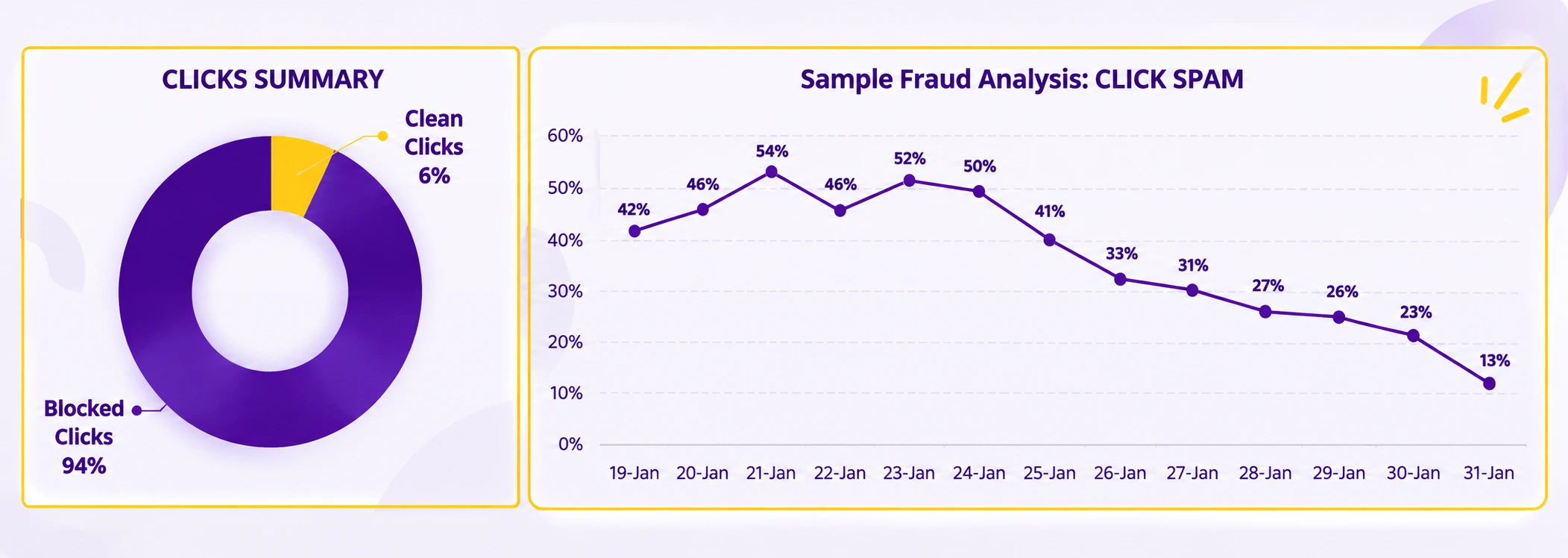
For a news and internet platform supplying app install traffic to a fintech advertiser, Click Integrity blocked 94% of incoming clicks. As a result, click spam fell 69%, clean traffic improved 15% week-on-week, and the fraud-free inventory commanded premium pricing.
The Bigger Question for Advertisers
Global ad fraud cost advertisers an estimated $114 billion in 2025 against $855 billion of digital ad spend, with roughly 18% of global ad traffic invalid. That loss is not incurred in one transaction, it is bought one click at a time.
The shift required is small but consequential, from “How many clicks did we get?” to “How many genuine users did those clicks create?” The goal was never to buy more clicks, but to make sure every click paid for can become a user.
Don't wait for a fraudulent click to become a fraudulent conversion. See where your click traffic is really coming from.
Book a traffic-quality audit with mFilterIt. We will analyze your live campaigns for click spam, injection, and device and geo anomalies, and show you how much of your spend is lost to app install fraud.
Frequently Asked Questions
How does app install fraud work?
Fraudsters create or hijack clicks so their source gets credit for an install under last-click attribution. Sometimes the install is fake, made by bots or device farms. Other times it is a real organic install that the fraudster falsely claims. Either way, the MMP pays the fraudulent publisher.
What are the main techniques of app install fraud?
The four most common techniques are:
Click spamming firing clicks in the background so the source can claim organic installs.
Click injection: triggering a click at the moment of install to win last-click credit.
Fake clicks: generated by bots, emulators, device farms, VPNs and data-centre IPs.
Automated click behaviour: the same device ID or IP cluster clicking at machine speed.
How can AI detect install fraud?
AI models learn what normal user behaviour looks like across millions of clicks and installs. They spot anomalies in real time, such as bot-like click speeds, suspicious IP clusters, emulator signatures, and irregular CTIT patterns. This lets them catch new fraud tactics that fixed rules might miss.
How can one avoid install fraud?
Validate clicks in real time, before they reach your MMP. Block malicious IPs, VPNs, proxies, invalid devices and non-targeted geographies at the click level. Also audit publishers regularly and keep checks running at every stage of the funnel, from impression to install.