
Your mobile app campaigns are delivering installs. But how many of them are real? Or are those installs further converting to genuine user activity or events?
The global mobile advertising market reached USD 262.84 billion in 2025 and is expected to grow to USD 322.67 billion in 2026. (Source: Fortune Business Insights)
And this is what fraudsters aim to target using sophisticated bot networks, click farms, invalid traffic, and affiliate networks. Because with scalability comes vulnerability if not monitored closely. And there’s a high chance that your mobile app campaigns are being attacked by mobile ad fraud at various stages of the funnel.
Another question is, how does it happen, and what mobile ad fraud techniques do fraudsters use?
That’s what we are going to talk about in this guide:
What is mobile ad fraud?
What are the different types of mobile ad fraud techniques?
Why is mobile ad fraud increasing in 2026?
What are the common signs to identify app fraud?
How to detect and prevent ad fraud using app traffic validation solution?
Continue reading ahead to learn more.
What is Mobile Ad Fraud or Mobile App Fraud?
Mobile ad fraud refers to any deliberate manipulation of mobile app campaign data and metrics like impressions, clicks, installs, in-app events, or re-engagements by fraudulent affiliates to earn payouts or claim false credits.
Various techniques like click farms, incent fraud, device farms, click injection, etc. are used to generate fake clicks and pass through standard MMP attribution checks.
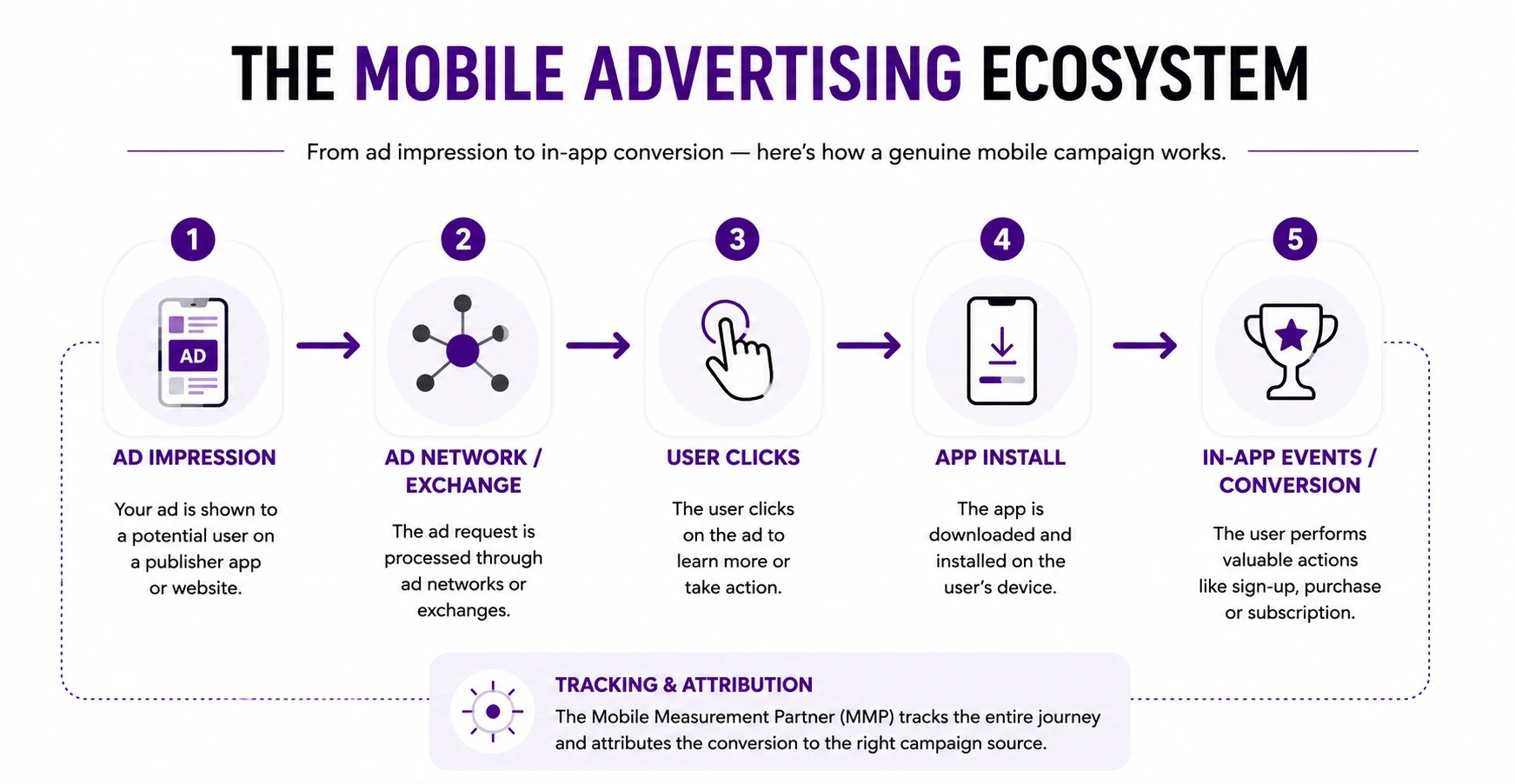
Here’s how it happens inside a campaign:
A publisher (an app or site with an audience) shows your ad through an ad network or programmatic exchange.
A user sees the ad (an impression) and taps it: a click.
That click carries identifiers and is logged by your mobile measurement partner (MMP),
If the user installs your app and opens it, the MMP matches the install back to the click, usually crediting the last click before install.
That credit triggers a postback, the signal that tells the network and its publishers “this install was yours,” which is what releases the payouts further based on events.
From there, the user’s in-app events like registrations, purchases, and deposits get attributed to the same source.
Now, if you notice, what holds this whole chain together is trust in signals. The MMP never sees a human being. It sees a click record, an install record, and a timestamp, and infers cause and effect. Whoever controls those signals controls where the money goes. This inference is exactly what fraudsters attack.
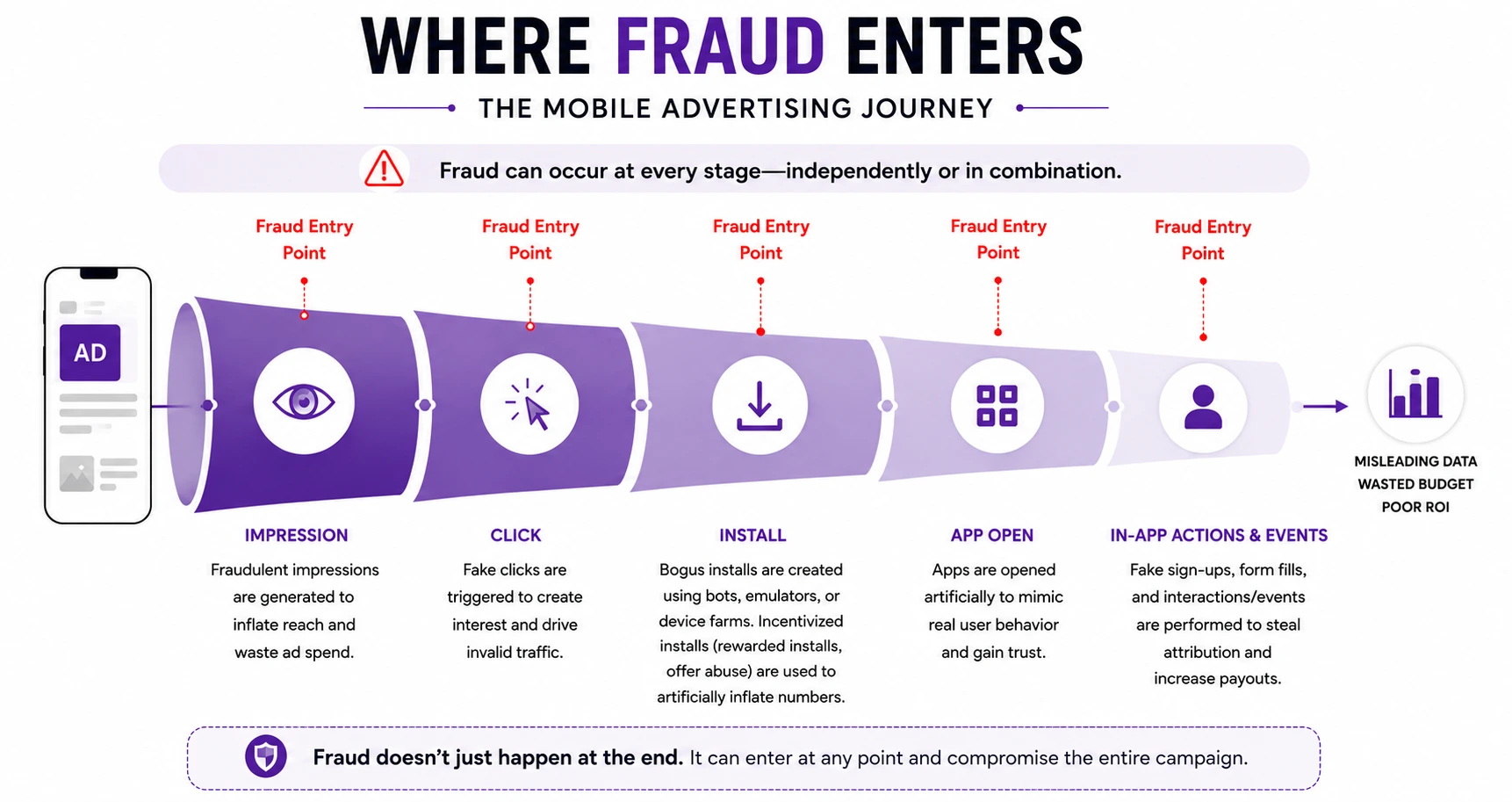
What are the Various Types of Mobile Ad Fraud Techniques?
Here’s how mobile app fraud shows up in your campaigns:
Click Fraud
Fake clicks, or the credit attached to them.
Click Spam: Click flooding at an industrial scale. It is when a huge volume of clicks is sprayed across thousands of devices and campaigns at once, gaming attribution on every install that happens.
Click injection: Malware on a device detects that an app install has started and fires a click seconds before first open, stealing credit for an install that was already happening. This is also called the last-click manipulation.
Know the difference between click spamming and click injection in detail.
Fake Clicks: Clicks with no human intent and bot-generated clicks inflate billable CPC counts, plus click farms (rooms of low-paid workers or racks of phones physically tapping ads).
Fake Attribution: This is also known as attribution hijacking. The umbrella term for claiming credit for installs and conversions that another source (or no source at all) actually drove.
Distribution Fraud
The spread of environment signals is itself the tell.
Outdated Operating Systems: Improbable concentration or mismatch in OS data.
Internet Service Providers: Traffic unnaturally clustered on one carrier, or inconsistent with the claimed geo.
Device-Level Fraud: Fraudsters manipulate device identities by spoofing or repeatedly resetting advertising IDs, making a single device appear as hundreds of unique users. Suspicious device-model patterns and recurring IDs expose this activity.
Device Fraud
An install fraud technique that brings users with no genuine interest. Fake installs are the install-stage rung between click and engagement. Every method of faking one betrays itself through device signals, which is why they all live here.
Fake Device: Device spoofing (faking make/model/OS) + emulator farms (thousands of virtual devices on one server, no hardware required).
Duplicate User: One device posing as many: reset/fabricated advertising IDs where the same IDs keep resurfacing; device/install farms cycling real phones through reset identities; and reward abuse (gaming referral bonuses and first-order coupons by becoming a “first-time user” repeatedly via cloned apps and farmed numbers).
APK Fraud: Tampered/repackaged builds and forged app-side signals; SDK spoofing (forged install signals sent straight from a fraudster’s machine, no device, no install, no user) fits here.
Incorrect Region: Device-level geo that contradicts the target market.
Device fraud is very prominent in case of affiliate marketing. Learn more with examples here.
IP Fraud
Mobile ad fraud that disguises what and where the traffic is coming from.
VPN and proxy traffic: Masking true location so traffic from anywhere appears to come from your target geography, where payouts are higher.
Data-center traffic: Clicks and installs originating from server farms, not phones. The bluntest signal there is that real users don’t live in data centers.
Affiliate Fraud
In 2026, the affiliate ecosystem is where the largest share of mobile ad fraud actually lives. Not because affiliates are inherently dishonest, but because the channel’s structure gives affiliate fraud everything it needs:
Opacity through re-brokering: Campaigns pass through chains of networks and sub-publishers; by the time your ad runs, you’re several hops from the source.
Volume-rewarding payouts: CPI/CPA models pay for outcomes, so any affiliate who can fake the outcome cheaper than earning it has a direct incentive.
Incent fraud: Fraudulent affiliates take your campaign and run it on offer/incent walls for pennies per install (“install, register, keep the app for 2 days”), pocketing the gap between your CPI and the user’s reward. The installs are real; the interest is zero; engagement dies the moment the reward clears.
Vanishing affiliates: They re-register under new IDs; without transaction-level evidence, clawing back payouts is nearly impossible.
Blended traffic: Fraud arrives mixed with legitimate traffic from the same network, so averages look healthy while individual sub-publishers run 30%+ fraud.
We have a detailed guide on everything you need to know about affiliate fraud. Check it out.
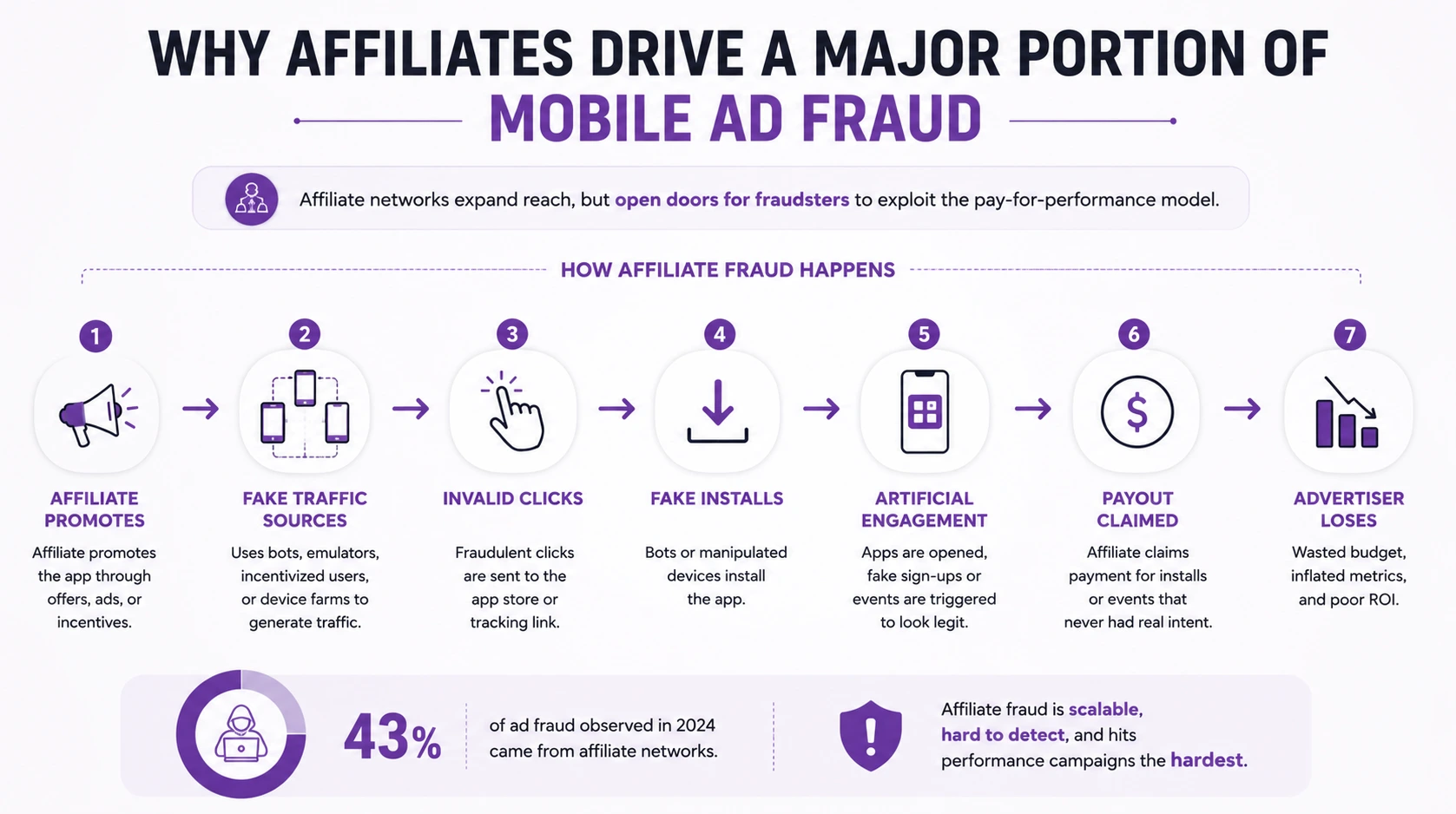
If affiliates drive a meaningful share of your growth and you’re not independently validating that traffic, assume you’re leaking budget.
Which Campaign Metrics Get Manipulated Because of Mobile Ad Fraud?
Almost every metric you report to your leadership team. Mobile ad fraud doesn’t just waste your budget; it distorts campaign performance, making it difficult to understand what’s actually working.
CTR (Click-Through Rate): Fake clicks generated by bots or click farms artificially inflate CTR, making ads and placements appear more engaging than they really are.
CVR (Conversion Rate): Click flooding and invalid traffic bring in users with no real intent, causing conversion rates to drop and masking genuine campaign performance.
CPI (Cost Per Install): Fraudsters can generate fake installs at a much lower cost than acquiring real users, making your CPI look impressively low while delivering zero business value.
CPA (Cost Per Action): Fake registrations, sign-ups, purchases, or other in-app events reduce CPA on paper but fail to generate meaningful customer outcomes.
ROAS (Return on Ad Spend): Attribution fraud steals credit for organic or legitimate conversions, making underperforming channels appear profitable and encouraging unnecessary budget allocation.
Retention Rate: Fraudulent users rarely return to the app after installation. As these fake users disappear, retention rates decline, making it difficult to assess actual user quality.
LTV (Lifetime Value): Since fake users don’t generate repeat engagement or revenue, they significantly reduce the lifetime value of acquired user cohorts.
Incrementality: Fraud can claim conversions that would have happened organically, creating a false impression that paid campaigns are driving incremental growth.
To understand how mobile app campaign metrics get impacted, read here.
Why Mobile Ad Fraud Is Becoming More Sophisticated in 2026
Ad fraud is old. What’s new is how fast it’s evolving.
AI made fake humans cheap
Bots now train on real session data to reproduce believable touch patterns; scroll velocity, and purchase behaviour, and fraud kits are sold as monthly subscriptions. Static, rule-based filters can’t keep pace with adversaries that adapt in days.
Privacy-first attribution shrank the signals
Cookie deprecation, SK Ad Network, and aggregated measurement are wins for consumer privacy, but they leave defenders fewer device-level signals to inspect and longer feedback loops before anomalies surface. Fraudsters deliberately operate inside these new blind spots.
Emulators and device spoofing have matured
Modern virtual devices carry convincing hardware fingerprints, believable sensor data, and market-realistic device mixes. The line between a farm and a real audience keeps getting thinner.
Why MMPs Alone Cannot Detect Every Type of Mobile Ad Fraud
Let’s clear up the industry’s most common misconception.
MMPs are essential. Attribution, campaign reporting, deep linking, and partner measurement all depend on them. But attribution and fraud forensics are different jobs. Attribution tells you where conversions came from. Validation tells you whether those conversions can be trusted.
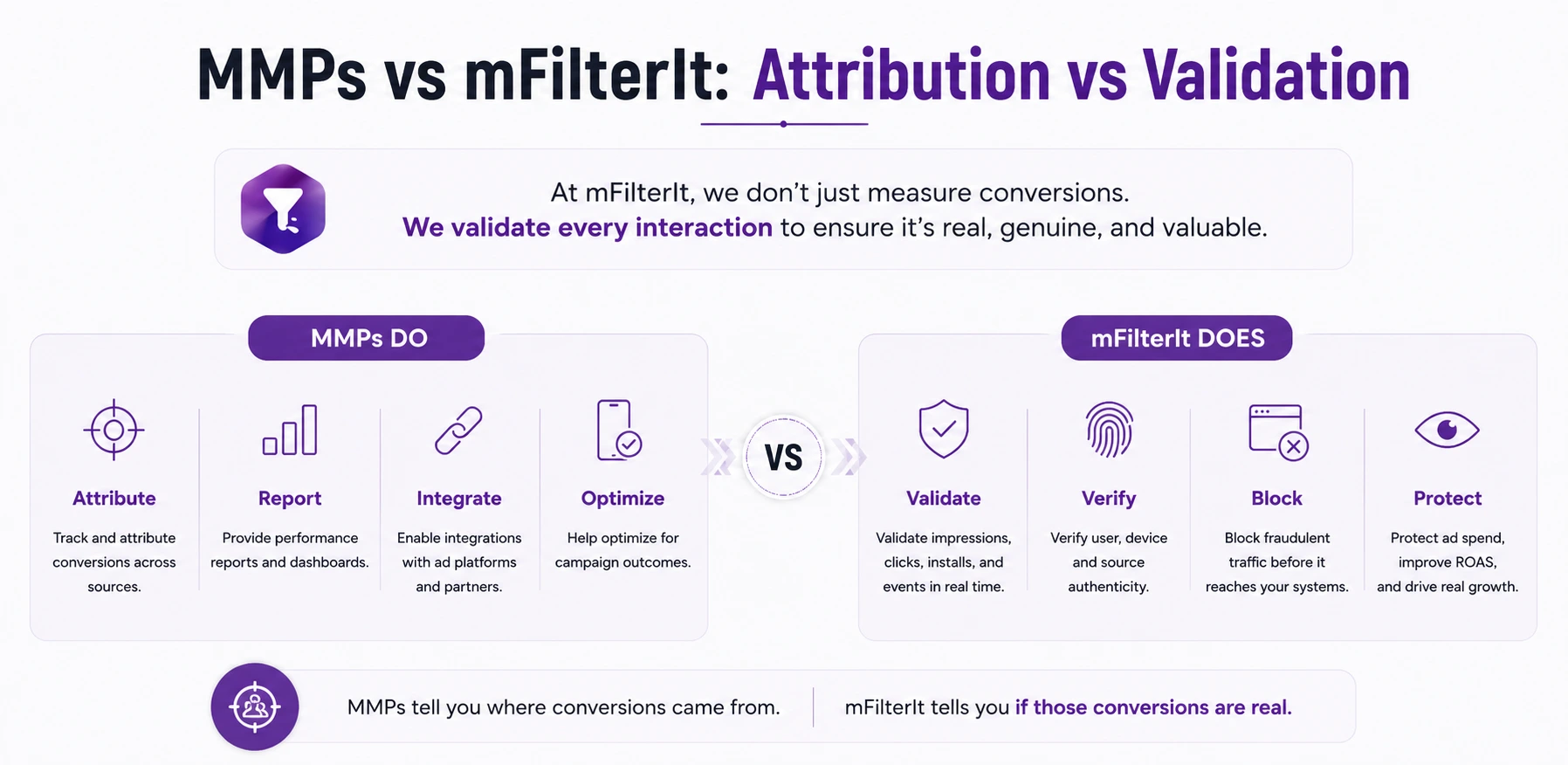
Four gaps explain why an MMP alone can’t close the loop:
Their fraud rules are documented.
They only see their own data.
They decide in real time.
Sampled or threshold-based checks miss distributed fraud.
So, the answer isn’t replacing your MMP; it’s pairing it with an independent validation layer that covers impression validation, click integrity, device and source validation, and real-time blocking.
Continue reading here to know why attribution platforms fail to show you the complete truth.
How mFilterIt Helps Detect and Prevent Mobile Ad Fraud Proactively
Prevention isn’t a report you run quarterly. It’s continuous validation, layered across the entire user journey, which is exactly what mFilterIt’s app traffic validation solution is built for. Here’s what each layer does, and why it matters.
Real-time impression and click integrity, before the MMP
The first defense sits in the traffic flow itself. Every impression and click is routed to the mFilterIt server for validation before it reaches your MMP. Clean traffic is passed through for attribution, fraudulent traffic is rejected on the spot, and a continuously updated blacklist ensures known bad actors never get a second chance.
The real-time checks cover the full fraud surface:
Click repetition behaviour: Spamming on the same device ID, click and impression injections, and IP address repetitions, clusters, and spikes.
Malicious infrastructure: Traffic from VPNs, proxies, and data centers.
Invalid make-model: Devices that don’t exist or don’t match their user agent.
Invalid geo: Traffic from non-applicable regions, verified via IP checks.
This minimizes wastage where payouts run on CPM/CPC, delivers clean traffic with safe placements, restricts payouts for invalid traffic, improves ROAS, and cuts your MMP costs, because you stop paying to attribute garbage.
Install and event validation
What real-time rules can’t catch, deep post-attribution analysis does. The approach is not sample-based, fraud is calculated by evaluating every data set. That’s what it takes to catch distributed fraud designed to hide inside samples.
Three detection methods work together:
Backend reconciliation: MMP-recorded events are compared against your backend data to flag events that exist only on the MMP side, the decisive check for event spoofing, since a fake purchase has no real order behind it.
Install-to-event conversion path analysis: Anomalies in the post-install journey, illogical event sequences, impossible conversion ratios, inconsistent user flows; isolate and block fraudulent events.
Bot concentration patterns: Bots fire click, install, and event sequences in unusually short timeframes. These compressed bursts create spikes and clusters that clearly signal automated, non-human behaviour.
Postback blocking, mobile app fraud never gets paid
With postback blocking, validation results gate the payout signal itself. Postbacks are fired to affiliates via the MMP for valid events only. Fraudulent sources stop earning immediately, and a campaign that stops paying for fraud rapidly stops attracting fraudsters. This single control changes the economics of attacking your campaigns.
Reattribution
Fraud already in your systems keeps doing damage until it’s corrected. mFilterIt reattributes hijacked installs and events to their correct source, turning fake attributions and organic hijacks into honest numbers and true ROAS. The cleaned data flows into your backend CRM, so every retargeting audience and lookalike model you build starts from reality, not from bot profiles.
Incent activity monitoring, with evidence you can act on
To catch affiliates secretly running your campaigns on offer walls, mFilterIt’s brand safety tracker monitors over 50 incent walls, including a comprehensive list of adult and torrent websites. When your brand appears on a blacklisted location, the automated system clicks the ad itself to unmask the publisher behind it.
The output is commercial-grade proof, delivered daily: the tracking URL, screenshot proof points, the name of the offer wall or broker, the full re-brokered click path, and the ad network used. That’s the difference between suspecting an affiliate and being able to withhold their payout with evidence in hand.
Referral and coupon fraud, solved at the device level
Fraudsters rotate IPs and phone numbers effortlessly, which is why mFilterIt’s referral fraud detection feature is based on the device environment rather than IP repetitions. A lightweight 50KB SDK, embedded in your app and executing in the background, identifies app cloning, parallel spaces, and VPN/proxy use, exposing one device running two or more “first-time” accounts.
It’s backed by IMEI (GSMA), IP, and VPN/proxy databases, detects fraud in real time with transaction-level reporting, and blocks the offending device ID while alerting you as it happens.
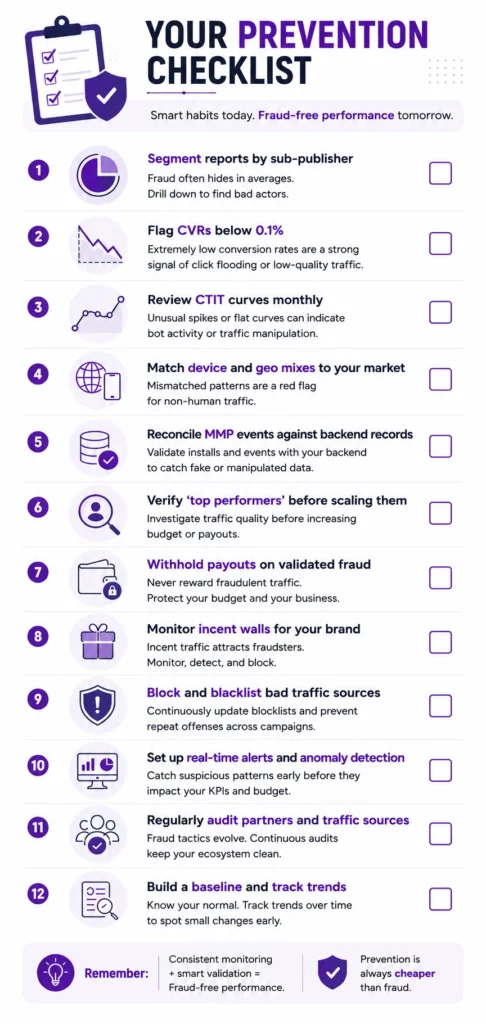
Conclusion
Mobile ad fraud isn’t going away. It’s becoming smarter, faster, and more difficult to detect. As mobile advertising continues to grow, relying solely on campaign reports or attribution data is no longer enough. Brands need confidence that every click, install, and in-app event comes from a genuine user.
The key to sustainable app growth isn’t just acquiring more users; it’s acquiring real users and making decisions based on trusted data.
Want to build fraud-free mobile campaigns? Discover how an independent mobile app traffic validation tool can help you eliminate invalid traffic, protect your ad spend, and maximize campaign performance.
Frequently Asked Questions
What is app install fraud?
Fake installs generated purely to collect CPI payouts. No genuine, interested user exists behind the download. It’s the most common form of mobile ad fraud and the entry point to deeper funnel manipulation.
What is affiliate fraud?
Affiliate fraud is the manipulation of traffic, attribution, or conversions inside an affiliate program to claim payouts that were never earned through fake leads, bot-driven clicks, and commission hijacking.
How do I know if my app campaign has ad fraud?
Look for click or install spikes without matching conversion lift, installs from geographies outside your target, high bounce rates, and heavy click volume with almost no downstream engagement.
Why are my installs high but retention and engagement near zero?
A major reason could be incent fraud or bot traffic. The install happened, but the interest never existed. This causes engagement to collapse the moment the reward clears.
What is CTIT and what does a normal distribution look like?
Click-to-install time measures the gap between ad click and first open. Normal is roughly 10–60 seconds; under 10 seconds signals click injection, beyond 24 hours signals click flooding.
Does my MMP already protect me from ad fraud?
MMPs detect ad fraud only partly. MMPs exist to keep attribution accurate, not to hunt fraud. They assess each source in isolation and trust SDK signals without independent verification.