
Did you know that even Indian households can siphon off your advertising budgets? Yes, that’s what the advertising industry is up against in 2026- a new front in Advertising Fraud.
A BestMediaInfo investigation traced this to a Gurugram-based company selling hardware it markets as "video mining" or "view mining" devices. Priced at around Rs 28,000, the device is pitched to households as a passive-income opportunity: install it, keep it running for six hours a day across 26 days a month, and receive roughly Rs 2,100 a month under a nine-year contract, with the payout rising 20% every three years.
Inside the unit sit 16 separate motherboard chips, each capable of functioning like an independent mobile phone. Together, they generate artificial views and engagement across YouTube, Instagram, Facebook, Spotify and TikTok, and the household hosting the device never has to hand over a single personal login, since the entire operation is controlled centrally through the company's own servers.
That’s a new, sophisticated way of generating invalid traffic across campaigns.
And this is a reminder that fake engagement no longer needs a warehouse. It just needs a few thousand living rooms.
What is Invalid Traffic and the Real Cost of It
Invalid traffic is any activity, a view, a click, an impression, an engagement, that does not come from a genuine, interested human - one of today’s fastest-growing forms of Digital Fraud.
Indian advertisers lose an estimated Rs 30 crore a day to ad fraud. That is close to Rs 10,000 crore a year. Globally, the figure crosses $100 billion annually.
General Invalid Traffic (GIVT) is the easy kind, known crawlers, search bots, accidental clicks, non-malicious and easy to filter with standard rules.
Sophisticated Invalid Traffic (SIVT) is the hard kind: human-like bots, spoofed sessions, and, worth reading twice, device farms, built specifically to slip past the checks that catch GIVT. It needs behavioral analysis and machine learning to uncover.
Now, in 2026, it has been relocated from a data centre warehouse to people’s living rooms.
Moreover, the damage does not stop at wasted ad spend. Video and CTV views, social engagement, and influencer marketing (since views and followers directly shape creator selection and pricing) are all exposed. Skewed engagement numbers lead to bad optimization decisions, and inflated creator metrics lead to partnerships that never had the reach they promised.
How is Device-Generated Invalid Traffic Different from Bot Farm?
Earlier, detecting fraud was much simpler.
Traditional device farms often operated from a single location, using large racks of devices to generate fake activity. This created clear patterns, dozens or even hundreds of fake actions coming from the same IP address. Once the pattern was identified, it could be blocked.
Industry practitioners have a name for this problem: IP concentration. As Dhiraj Gupta, Co-Founder and Chief Technology Officer of mFilterIt, put it while explaining what makes this model different, "The traditional problem with a device farm is IP concentration." When a large batch of simulated devices runs from a single office, they typically share one address, which is exactly what makes them easy to catch.
This device flips that math entirely. By distributing hardware across residential connections instead of one office, the fraud is spread across thousands of individual homes, each running on its own home internet connection, a pattern the industry now refers to as residential IP fraud. Instead of one suspicious address generating unusual volume, you get thousands of ordinary-looking ones, each generating a small, plausible amount.
From a platform's point of view, none of it looks like a bot farm. It looks like people at home, browsing.
Why Are Advertisers Especially Exposed to This Invalid Traffic Problem
Here are a few reasons why advertisers are unable to identify such type of invalid traffic:
Walled-garden asymmetry:
Ad networks aggregate data only after the event has already happened, which strips out the device-level attributes that would actually reveal whether a view was genuine.
The platform grading their own homework conflict:
Ad platforms have little commercial incentive to proactively discount views that technically clear their own basic threshold checks, since the same system generating the data is also the one being trusted to police it.
Post-attribution blindness:
A campaign dashboard shows delivered impressions. It does not show the legitimacy of each individual micro-interaction sitting behind that number.
Put together, these three gaps mean that if you rely only on the numbers a platform or a creator reports back, you are seeing the output of the fraud, not the fraud itself. That is not a failure in your process; it is a blind spot every advertiser shares by design.
Which is exactly why independent, third-party full-funnel ad fraud detection and risk intelligence layer matters. It is built to run real-time SIVT heuristics, session anomaly modelling and behavioural pattern detection independently across display, video, OTT/CTV and influencer marketing, rather than depending on the same walled-garden systems the fraud was built to fool.
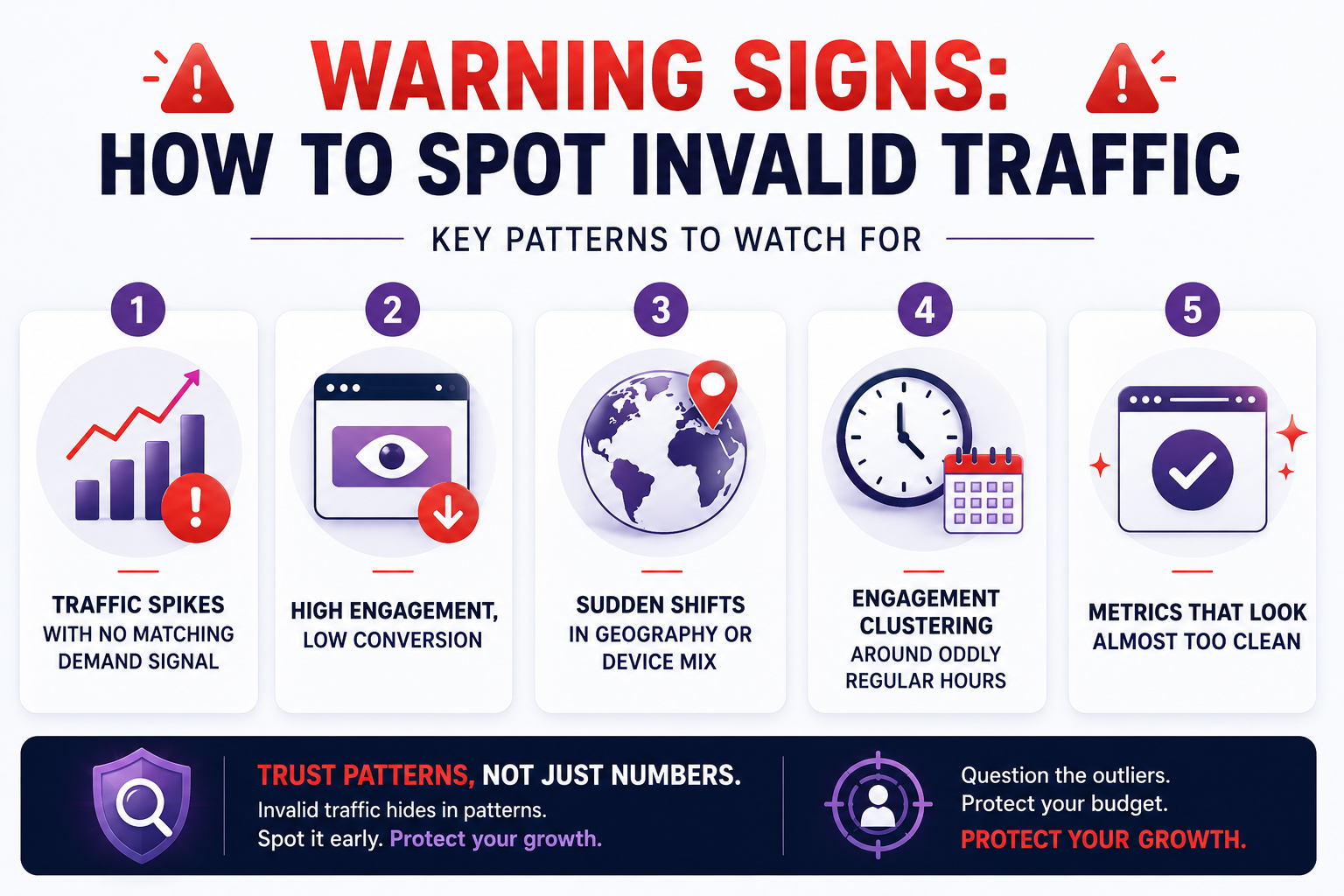
How Invalid Traffic, Including Fake Views & Engagement Are Actually Detected
Catching a network like this comes down to one shift in invalid traffic detection: checking how ad traffic behaves instead of where it comes from, since location is exactly what this kind of ad fraud is built to disguise. In practice, that means layering a few different checks together, rather than relying on any single one.
Device Fingerprinting
Every device carries a combination of identifiers, model, OS version, browser signature, session behaviour, that together form a fingerprint. When the same fingerprint reappears at an implausible frequency, or carries attributes that do not add up, it gets flagged before the impression is even counted.
Deterministic, Heuristic and Behavioural Detection
Deterministic checks catch what is already known to be bad, blacklisted IPs, known bot signatures.
Heuristic checks score traffic against established ad fraud patterns, even ones not yet formally blacklisted -the same logic behind most modern Ad Fraud Tools.
Behavioural analysis goes a layer deeper, tracking how traffic acts over time rather than judging it on one data point, which is what is needed to catch a network built specifically to look ordinary at first glance.
IP Repetition Tracking
An IP address generating impressions from the same region an unusually high number of times within a short window is a clear signature, one an ordinary home connection does not produce on its own.
Device Repetition Tracking
The same device identifier showing up far more often than normal, in a short span, is a second strong signal, visible in one household at a time, but easy to spot once patterns are aggregated across thousands of connections.
Measurement Tags Built into the Ad Stack
Detection is typically wired directly into ad serving, through VAST wrappers on video and CTV placements and pixel-based measurement tags on display, so traffic is checked as it is served rather than reconstructed afterward from a report.
Full-funnel Ad Fraud Detection, Not Just Impressions
Genuine detection follows the whole journey; impressions, clicks, visits, leads and purchases, because fraud that starts as a fake view can easily inflate engagement through click fraud or conversion numbers further down.
Real-time Flagging Over Post-Campaign Reporting
The goal is to flag suspicious traffic before spend is committed against it, ideally at the pre-bid stage, rather than identifying it once a campaign has ended, and the budget is already spent. Catching it before the money moves, not explaining afterward where it went, is what actually protects a budget.
This is exactly how a device-based, residential fake-view network can be fought against: not by blocking one IP or one data centre, but by recognizing the same behavioural pattern across thousands of individually clean-looking connections.
Conclusion
This fake views and engagement generating device is one example of a larger shift. Bot traffic is not centralized anymore, and detection cannot afford to think that way either.
Go back to where this started: an industry built on the promise that attention can be measured, running into infrastructure designed to manufacture the very signals it depends on. That is the real story, not the device or the monthly payout, but what happens to measurement once it can be faked at this scale.
If a device worth a few thousand rupees can quietly generate fake views from a few thousand homes, the real question isn't whether your campaigns could be exposed to invalid traffic like this. It's whether your current reporting would ever tell you if they were. This is what real Fraud Solutions look like in 2026
Don't wait for a quarterly report to find out. Get a clear, independent view of what's real in your campaigns and what isn't.
Talk to mFilterIt and request an invalid traffic audit today.
Frequently Asked Questions
What is invalid traffic in digital advertising?
Invalid traffic is any ad interaction, a view, click, impression or engagement, that does not come from a genuine, interested human. It spans harmless crawler activity to deliberately engineered fraud designed to mimic real users.
What is the difference between GIVT and SIVT?
GIVT covers easily identifiable, non-malicious traffic like known bots and accidental clicks. SIVT covers harder-to-detect fraud, including device farms and human-like bots, built to pass standard checks a growing form of Digital Advertising Fraud.
How can I detect invalid traffic in my campaigns?
Detection works best by watching behaviour rather than location, tracking signals like repeated IPs, repeated device identifiers, and unusual engagement patterns across the whole funnel, from impression through to purchase, rather than relying only on the numbers a platform reports back.
How can I prevent invalid traffic before it affects spend?
Fraud Prevention should consist of continuous monitoring rather than periodic auditing, by performing pre-bid filtering to verify the quality of the traffic before any spend occurs and by properly vetting influencers and affiliates, who are often the first source of fraud.
What role does AI play in fighting invalid traffic?
Static, rule-based checks cannot keep up with fraud that is designed to keep changing its footprint. AI models built on anomaly detection learn what normal behaviour looks like and flag new patterns before they scale, instead of relying on fixed blacklists, making it central to modern Ad Fraud Prevention.