
Pay per click campaigns are an exception: the platform that sells the click is also the main judge of whether that click was genuine. This has long been accepted as part of PPC advertising. In 2026, with more buying handed to automation and more non-human traffic passing as human, it deserves a closer look.
This blog explains why PPC ad fraud detection requires independent verification rather than just platform filters.
What Platforms Already Do, and Where the Gap Sits
Platforms do invest in ad fraud protection. Google defines invalid clicks as clicks that are not the result of genuine user interest, including automated, accidental, and duplicate clicks. Its systems filter many of these before an advertiser is charged, and invalid activity detected later is returned as credits (Source: Google Ads Help).
The disconnect is structural. The platform that earns from every click also decides which clicks were invalid. This is what we call a conflict of interest. Platform filters and legacy tools typically flag only 1-2% of spend. mFilterIt's independent data shows that invalid traffic on core Google Search averages 7–9%, but roughly doubles on Search Partners, the Display Network and YouTube, and reaches 35–43% on affiliate and direct publisher traffic.
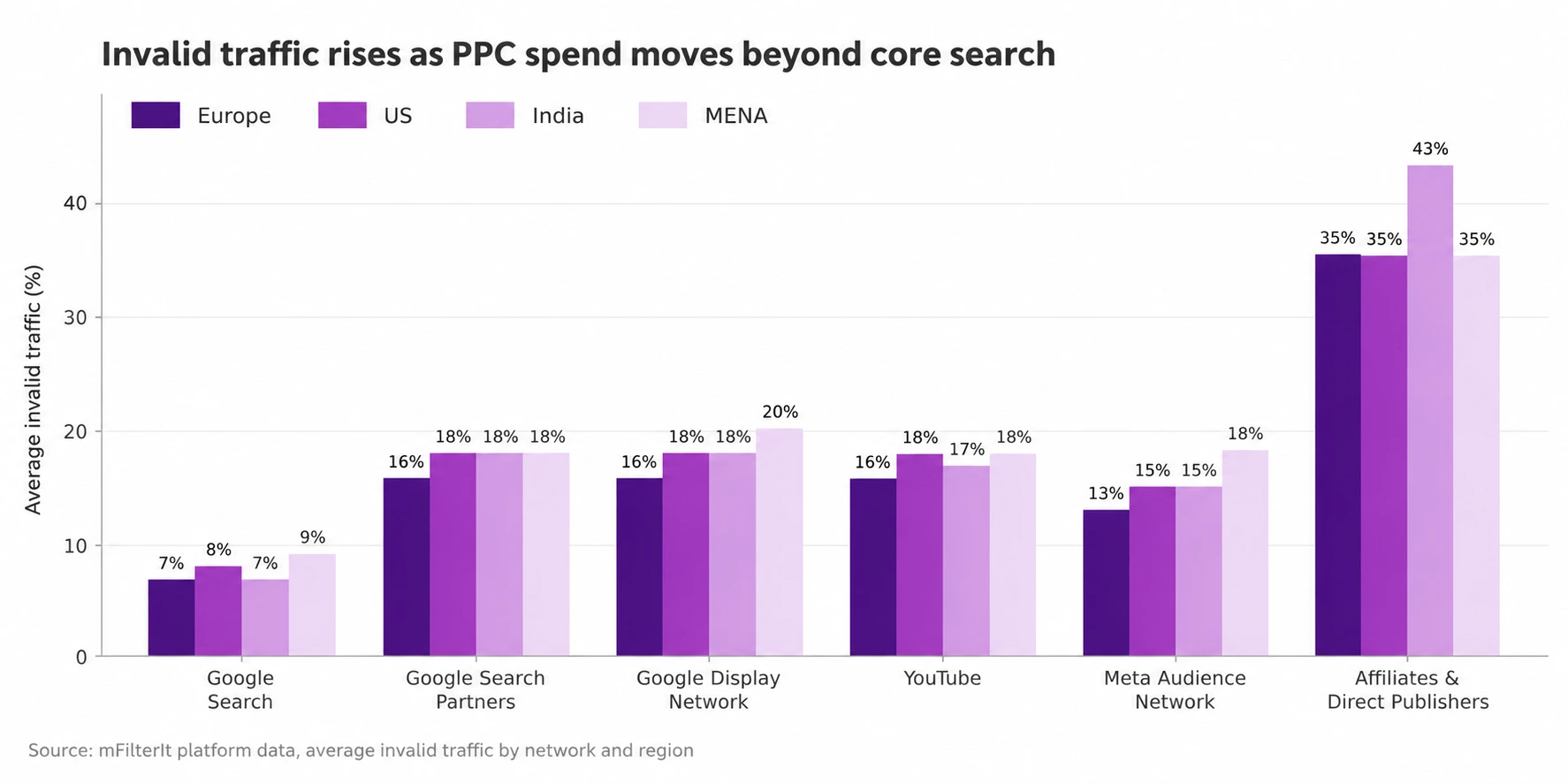
The blind spot grows in walled gardens and closed networks that report only on their own inventory, and in AI channels such as Performance Max and AI Max that decide placements with limited visibility. Without independent ad fraud verification integrated into them, each remains a black box marking its own homework.
Why 2027 Raises the Stakes for PPC Ad Fraud Detection
1. Automation is taking over placement decisions
Google has confirmed that eligible Search campaigns using automatically created assets or campaign-level broad match move to AI Max for Search from September 2026, with Dynamic Search Ads scheduled to follow in February 2027. As matching expands, advertisers control less of where their budget goes.
2. Bidding systems learn from the traffic they receive
When PPC bot traffic produces clicks, visits or form fills that look like engagement, automated bidding can read them as success and seek more of the same. Optimizing without filtering bots means spending more on fake engagement.
3. “Invalid” is becoming a judgement call
AI agents are beginning to browse and fill in forms on behalf of real users. Some of that activity is legitimate; some is built to imitate it. Once the line is no longer purely technical, the real question is who draws it. The safest answer is an independent with no commercial interest in the outcome.
The Cost That a Credit Does Not Cover
PPC click fraud rarely stops at the click. Fake clicks become invalid sessions, then fake or punched leads that consume sales time and distort CRM data and future bidding.
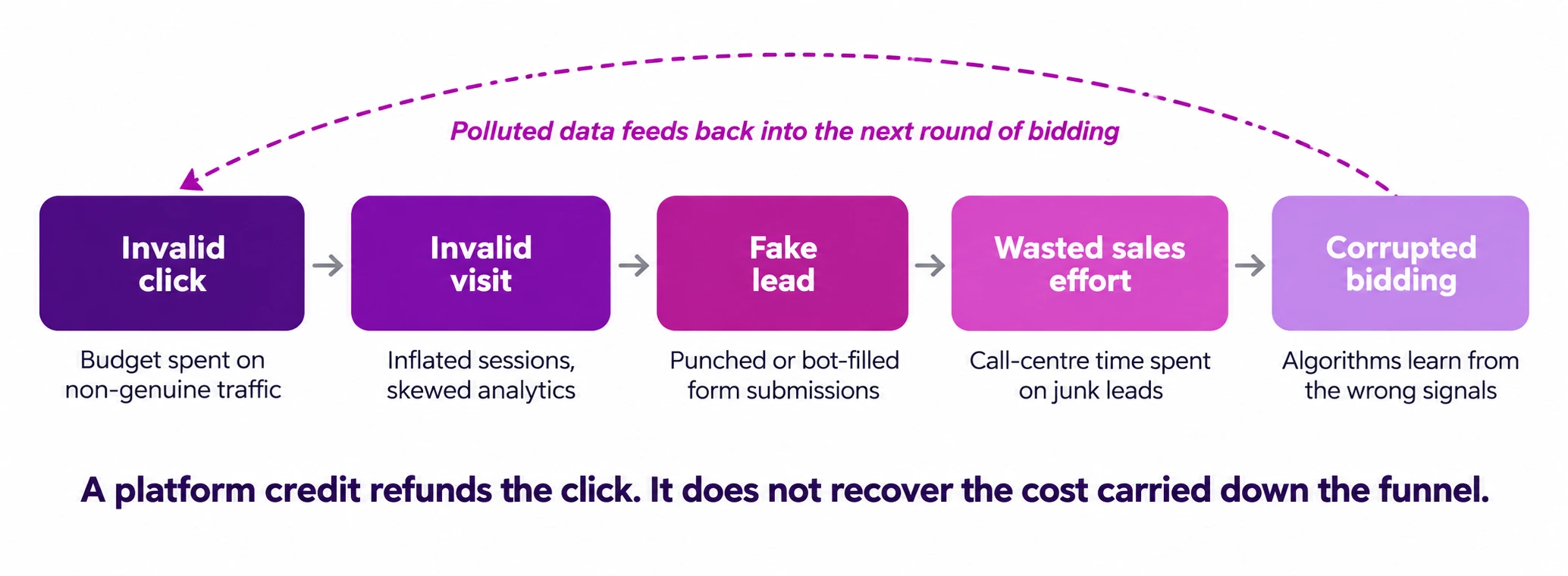
That is why click fraud detection through platform filters in PPC ads alone is not enough.
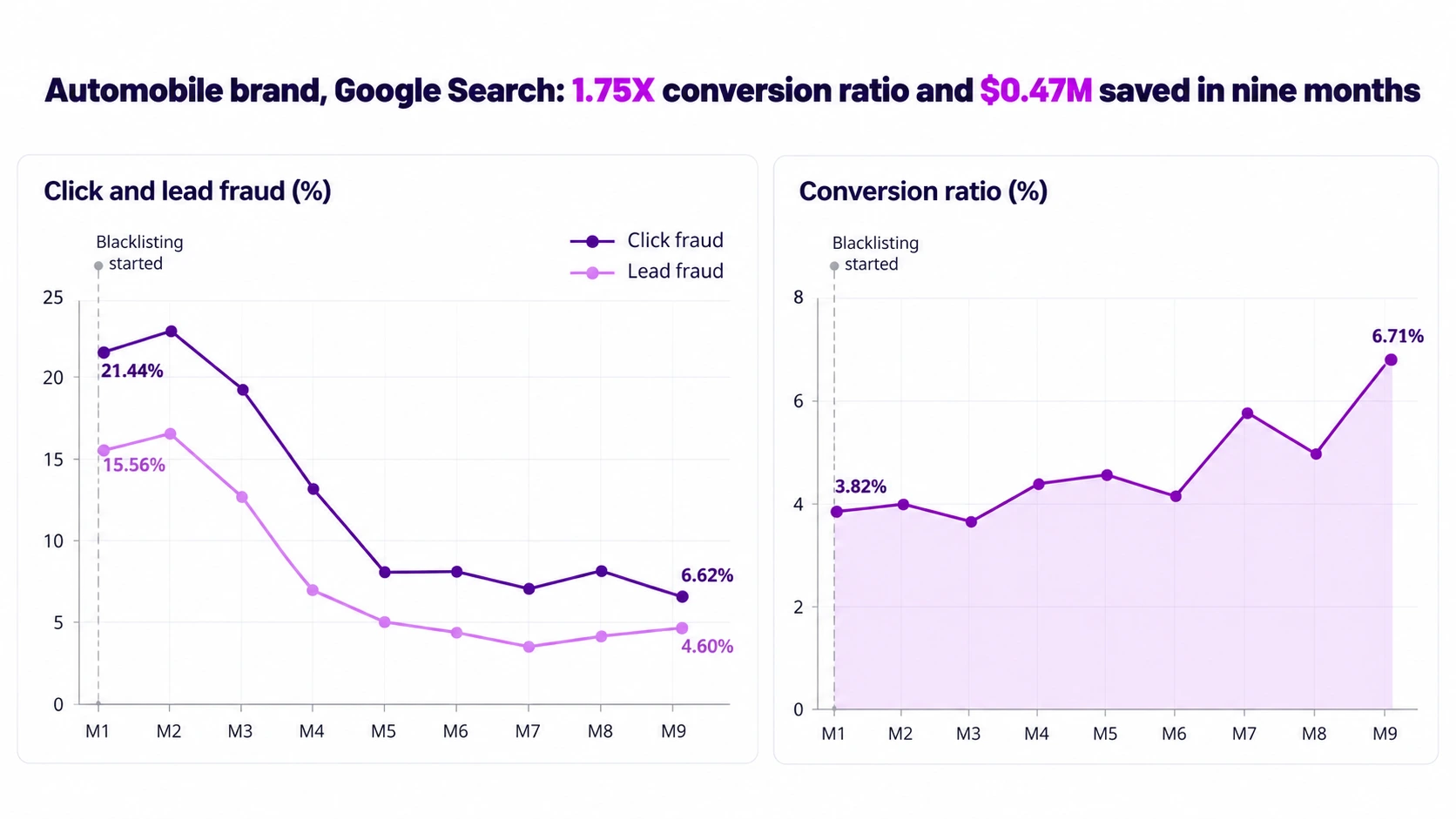
Here's what mFilterIt client example shows when validation follows the full funnel.
Automobile brand, Google Search. With independent validation and active blacklisting, click fraud fell from 21.44% to 6.62% and lead fraud from 15.56% to 4.60% over nine months. The conversion ratio rose from 3.82% to 6.71%, a 1.75X improvement, and the brand saved $0.47M.
What Independent Verification in PPC Ads Should Actually Mean for Advertisers
Independence is easy to claim and harder to prove. For PPC fraud detection, it rests on one principle: verification is only trustworthy when the verifier has no stake in the media or audience it measures. A verifier that profits from the inventory, or from the audience data platforms depend on, will always face a quiet conflict when deciding what counts as genuine.
This is the standard mFilterIt holds itself to. Detection spans clicks, visits, leads and sales without relying on cookies or personal data, and its findings are acted on through blacklisting, audience exclusions and real-time blocking.
Pillar 1: Neutrality
The first test is structural. Before looking at features, look at where the verifier sits in the ecosystem.
1. No commercial interest in the media
What it means: It does not sell any inventory nor take any part of the media’s revenue stream and does not own any audience currency.
Why it matters in PPC ads: If a partner earns more when more traffic is billed, its incentive runs against yours.
Ask your partner: Do you earn any revenue from the platforms, publishers or networks whose traffic you validate?
2. One standard across every platform
What it means: Detection techniques are used in the same way for Google, Microsoft, Meta, subsidiaries, and other networks.
Why it matters in PPC ads: Every platform measures fraud through their own systems and measurements. Having a consistent yardstick is the only way to measure each channel equally and move budgets around confidently.
Ask your partner: Will Search, Search Partners, social and affiliate traffic be measured against the same rules?
Pillar 2: Advertiser Control and Transparency
As AI-driven traffic blurs the line between valid and invalid traffic, the advertiser, not the vendor or the platform, should decide where that line sits.
3. Advertiser-defined validity
What it means: The brand determines what risk levels it will set and how it wants to handle different forms of invalid activity, like making calls or discarding leads.
Why it matters in PPC ads: A lending brand and an e-commerce brand do not share the same risk appetite. Fixed, one-size-fits-all scores leave the most important business decision with someone else.
Ask your partner: Can we define our own risk scores and decide what action follows each category of invalid traffic?
4. Transparent, explainable reasoning
What it means: Every flagged click, visit or lead is reported at transaction level, along with the specific reason it was flagged.
Why it matters in PPC ads: A black-box score cannot be challenged, audited or used to negotiate with a partner. Reason-coded data turns a fraud report into evidence.
Ask your partner: For any flagged interaction, can you show exactly why it was marked invalid?
Pillar 3: Depth and Actionability
Independence only creates value when it reaches far enough into the funnel and leads to action.
5. Full-funnel coverage
What it means: Validation continues from the click to the visit, the lead and, where possible, the sale.
Why it matters in PPC ads: Much of the damage from fake clicks appears after the click, in punched leads, wasted sales effort and corrupted bidding signals. Click-only checks miss the most expensive part of the problem.
Ask your partner: Do you validate leads and conversions, or only clicks?
6. Actionable output, not just reporting
What it means: Findings are pushed back into campaigns through IP and placement blacklisting, audience exclusions and real-time blocking on lead forms, with only validated conversions returned to bidding.
Why it matters in PPC ads: A report that sits in a dashboard does not protect budget. Fraud protection works when insight changes what the campaign buys next.
Ask your partner: How do your findings reach our ad accounts, and how quickly?
The Second Opinion Every PPC Budget Needs: Preparing Your PPC Ads Strategy for 2027
Automation will continue to enhance the process of media buying for platforms; however, automation does not provide an objective way of knowing whether such media was served to actual people.
By 2027, independent PPC ad fraud detection from platforms being measured will be a baseline necessity, not a luxury option. Brands that will incorporate this layer will base their budgets on reliable data.
Analyze invalid traffic by network: Distinguish Search, Search Partners, and expansion inventory before relying on the aggregate number.
Compare platform credits with an independent count: The discrepancy between these numbers is your blind spot.
Write fraud definitions in contracts: According to the ISA Media Charter in India, brands should outline what will be regarded as fraudulent traffic in agency contracts.
Use only validated conversions in the bidding process: Only clear signals guarantee better optimization.
Evaluate campaigns by lead-to-sale results: Low CPL is irrelevant if these leads do not convert.
Want to know how much of your PPC traffic is genuine? Benchmark your campaigns against an independent baseline with mFilterIt.
Frequently Asked Questions
What is PPC ad fraud?
PPC ad fraud is referred to any kind of practice which creates clicks, visits or conversions on the website regardless of the interest of the actual user.
How does click fraud affect PPC campaigns?
In addition to money being wasted, it results in inflated click-through rates, attribution errors, garbage entries in CRMs, and bad training for bidding.
How to detect invalid traffic in Google Ads?
For spotting fraudulent clicks on Google Ads campaigns, you should look for recurring IP addresses or devices, data centre traffic, suspicious locations and clicks without any interaction on your website.
How to reduce wasted PPC spend?
Exclude low-quality placements, prevent duplicate fraudsters from participating, vet leads before presenting to salespeople, and use only vetted conversions for bidding.