
Advertisers run ad campaigns across multiple platforms, but the real challenge is not reach alone. It is the operating effort required to move every campaign from brief to launch with speed, accuracy, and control.
And each platform repeats the same operational effort - brief translation, media planning, creative setup, tagging, compliance checks, approvals, campaign optimization and then repeat. mFilterIt's own campaign data shows what that adds up to. Setting up a single, multi-platform, multi- geo campaign can take close to 3-4 weeks. When this happens platform by platform, campaign launch becomes an execution problem before media performance even begins.
The result is a familiar set of operational challenges:
Fragmented platforms create disconnected campaign workflows
Manual processes delay campaign planning and execution with multiple iterations
Disconnected data limits real-time campaign intelligence
Traditional optimizers focus only on media bidding
Governance and optimization remain fragmented across platforms
This shift from disconnected tools to connected execution is exactly where agentic AI begins to change campaign management. As mFilterIt’s Co-Founder and CEO Amit Relan puts it, advertising’s next era isn’t defined by more AI-powered point tools; it’s about a system that "connects every stage of campaign execution into one intelligent workflow."
Introducing mPulse- mFilterIt Unified Ad Manager
A unified ad manager is a system that connects planning, activation, governance, and intelligence into one operating workflow through a unified platform rather than forcing teams to move between disconnected tools. It orchestrates the campaign lifecycle from brief to outcome. mPulse is mFilterIt's unified ad manager, an agentic AI marketing platform that brings planning, activation, governance, and intelligence into one continuous system
Most existing ad-tech solutions solve one part of this problem. Bid optimizers improve bidding. Analytics platforms improve visibility. Ad-verification tools improve quality. But the campaign itself remains fragmented across systems.
Structurally, mPulse operates as a unified ad management system with integrated data and signals, media systems, teams and partners, and content all flow in one place. A coordinated set of AI agents to plan, execute, and govern the work, and unified operations, sharper decisions, and measurable business impact flow out. One platform, running multiple campaigns, built for measurable business impact.
Agentic AI – Powered Campaign Management
At the heart of mPulse is an AI workforce designed to run campaign operations. Rather than a single AI assistant responding to prompts, multiple specialized agents work together to plan, execute, validate, optimize, and learn from campaign activity. The eight specialized AI agents work across three connected phases of the campaign lifecycle
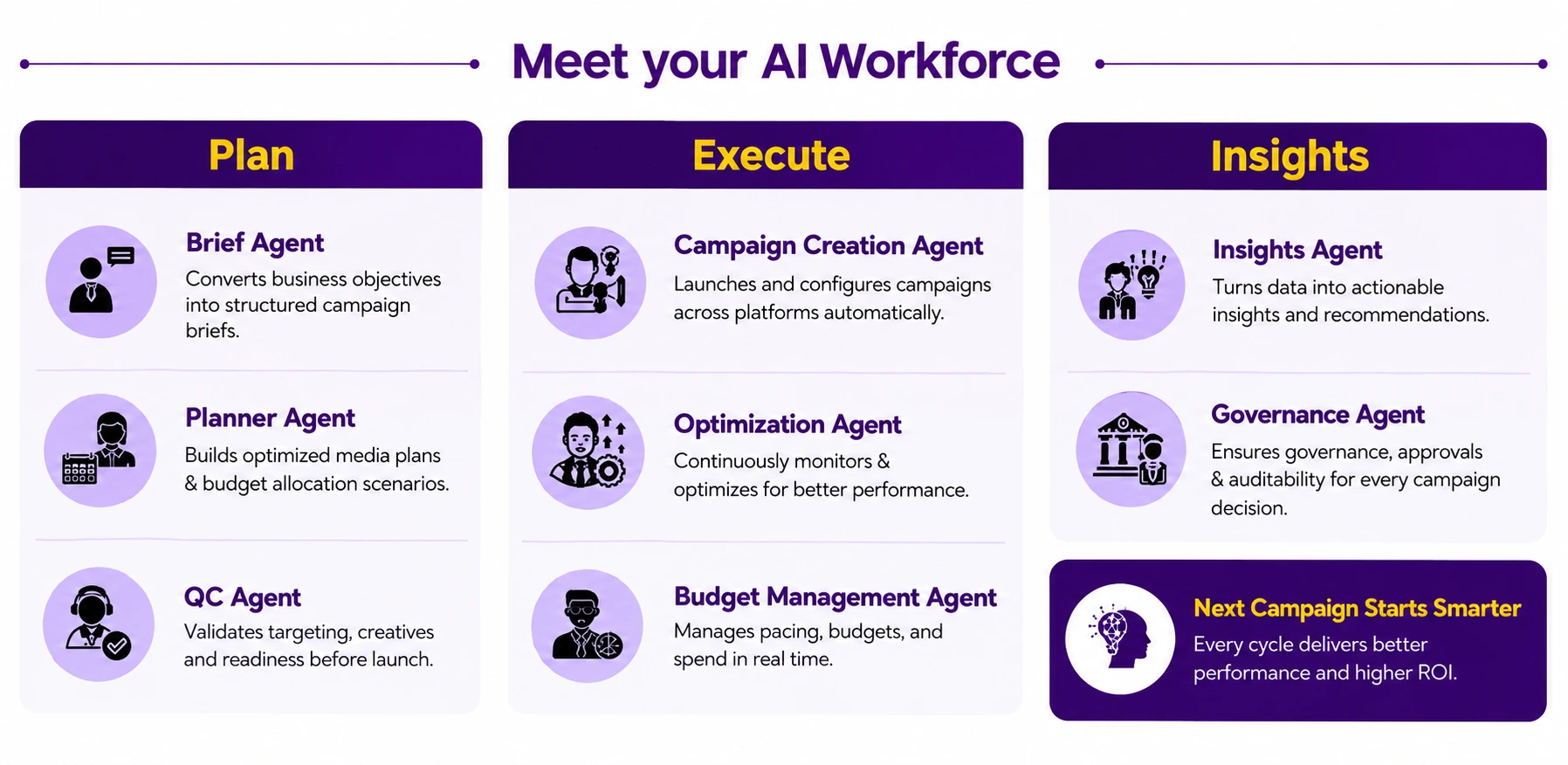
Planning Layer
Planning is usually where campaigns lose the most time to iteration, a rough brief, several rounds of revisions, and a plan that's more reverse-engineered than designed. In a unified ad management tool, the three agents work together here compress that cycle.
Brief Agent
Turns a rough ask into a structured, activation-ready brief. Brief creator drafts objectives, audience, and KPIs from a few starting inputs, while brief copilot goes further pulling from past campaign performance, quick-commerce shelf data, GWI, ComScore, and other signals to surface recommendations that sharpen the brief before planning even begins. Audience gaps, unrealistic budgets, and channel mismatches get caught early, when they're still cheap to fix.
Planner Agent
Builds the media plan from the approved brief in minutes rather than days. It draws on audience data, historical benchmarks, and channel performance to generate channel mix, budget allocation, and reach forecasts. It then produces multiple scenarios with clear trade-offs, so the team can choose between optimized options instead of reverse-engineering a single plan to see if it holds up.
QC Agent
Runs automated checks across the finished plan and campaign setup, validating naming conventions, budget math, targeting parameters, and platform configurations against best-practice rules before anything goes live. Every inconsistency is flagged and explained, so errors get resolved on the ground instead of being discovered mid-flight.
Outcomes observed by leading brands leveraging the Planning Agents:
144x faster setup from 72 hours down to 30 minutes, measured across production campaigns.
72 fields mapped end-to-end from a single approved plan, with zero manual re-entry.
Reliable at scale proven across campaigns spanning 14 geographies, 8 audience patterns, and 5 placement types in a single planning cycle.
Execution Layer
Once a plan is approved, the execution phase works in the direction of getting the campaign live without inconsistencies.
Campaign Creation Agent
Translates the approved plan straight into live campaigns, converting allocations into insertion orders, programmatic deal setups, and platform-specific configurations across channels, applying naming and structure conventions automatically. What used to be days of manual reformatting between an approved plan and a live campaign is completed in a single step.
Optimization Agent
Continuously reads delivery signals, pacing, performance against KPIs, channel-level results, and recommends or applies budget and bid adjustments as conditions shift. Course corrections happen when they matter, not when the weekly optimization call finally rolls around.
Budget Management Agent
Tracks pacing and actuals in real time against the approved plan, flagging over and under-delivery the moment it starts and maintains alignment across channels and campaigns.
Outcomes observed by leading brands leveraging Execution Agents:
99%+ reduction in manual effort, with 80+ campaign rows automated per setup.
81 optimization actions executed in 9 days across 4 live campaigns, budget pacing, bid control, placement cleanup, and frequency correction, applied continuously rather than in a weekly review.
CPM reduced by up to 32.1% within a single optimization window.
Insights Layer
Learning and validation cannot be limited to a post-campaign review. Quality, fraud and compliance controls need to operate throughout the campaign lifecycle. This is what the last phase delivers.
Governance Agent
Wires compliance and brand safety into the workflow itself, not into a review. It checks campaigns against policy rules, brand-safety guardrails, and approval workflows as they move through the lifecycle, holding anything that breaches a guardrail before it can go live.
Insights Agent
Turns campaign data into decisions, not just dashboards. Reading from the same source of truth the plan was built on, it generates narrative insights that explain what happened and why, what drove performance, where budget worked hardest, and what to carry into the next brief. Understanding a campaign stops being a post-mortem and becomes a live input for the next one.
Outcomes observed by leading brands leveraging Insights Agents:
9.21% lower CPV and 10.34% higher VTR, on average, across four live campaigns, with gains in 4 out of 4 campaigns.
CTR improved by up to 45.6% versus the pre-optimization baseline.
Frequency held stable between 1.03–1.12 throughout; proof governance guardrails hold even as optimization runs continuously.
Therefore, every agent inside the agentic AI marketing platform operates independently, but they are not disconnected. All the eight agents are governed by strict guardrails while still retaining flexible autonomy within them, so teams get speed without giving up control over what the system is allowed to decide on its own.
Conclusion
The real significance of agentic AI is not that it helps teams execute campaigns faster. It is that it changes the economics of campaign operations. As execution becomes increasingly autonomous, marketers can scale campaign complexity, channels, audiences, and experimentation without proportionally increasing operational effort.
One of the less discussed implications of agentic AI is that it begins to blur the line between campaign planning and campaign execution. The future operating model may not be built around individual campaigns at all, but around always-on marketing systems that continuously plan, execute, learn, and adapt. In that environment, the competitive advantage shifts from managing campaigns better to building systems that improve themselves over time.
So, the next question for marketers is not whether AI belongs in media, but how much of the workflow should it already be running.
See mPulse in action. Book a demo now.
Frequently Asked Questions
What is a unified ad manager?
A unified ad manager is a single platform that brings campaign planning, execution, ad serving, validation, and reporting together, replacing the separate, disconnected tools most teams stitch together manually.
mPulse is a unified ad manager built on agentic AI, meaning the platform doesn't just centralize data. It actively plans, launches, and optimizes campaigns through a coordinated set of AI agents.
How is agentic AI different from regular ad automation or bid optimization?
Traditional automation and bid optimizers react to a single signal, typically adjusting budget or bids within a campaign a human has already built.
Agentic AI is broader: a system of AI agents that plan, execute, validate, and learn across the full campaign lifecycle, operating with defined autonomy inside human-set guardrails rather than waiting for manual instruction at every step.
Can a unified ad management platform handle cross-channel advertising?
Yes. A unified ad management platform is designed to plan, launch, and manage campaigns across multiple channels and platforms from a single system, so budget allocation, creative delivery, and performance data stay consistent across channels instead of living in separate, disconnected dashboards.
Why does unified analytics matter for measuring ad performance?
Without unified analytics, ad performance is measured in fragments, one platform's dashboard for delivery, another for conversions, a third for spend, and reconciling them manually introduces delay and error.
Unified analytics brings cross-channel performance, full-funnel attribution, and validated (rather than self-reported) data into one view, which is what makes real-time, trustworthy decision-making possible.
How does a unified ad operations platform help with fraud detection?
In a unified ad operations platform built on a ad fraud-detection foundation, quality and brand-safety checks, such as invalid traffic detection, creative compliance, and pixel or event validation, run continuously throughout the campaign lifecycle rather than as a one-time audit after the campaign ends. This makes fraud detection a built-in layer of governance instead of a separate, after-the-fact process.