For a few weeks, some religious events become temporary economies. Millions of people travel, transact, donate, book accommodation, make purchases, and interact with hundreds of digital services within an unusually short period. That concentration of trust, money, and digital activity creates an environment that fraudsters are quick to exploit.
The scale of Maha Kumbh 2025 illustrates this better than almost any recent example. In 2025, the 45-day religious gathering in India generated an estimated ₹2–3 lakh crore in economic activity and drew over 66 crore visits, numbers most industries would associate with an entire year of national commerce compressed into six weeks.
And the baseline threat is already serious: Indians lost an estimated ₹22,495 crore to cyber fraud in 2025 alone, across more than 28 lakh reported cases.
Alongside that scale also came a major cost: a surge of fake websites, fraudulent apps, and brand impersonation scams. What was targeted wasn't just the event. It was the trust associated with every official name, payment channel, booking platform, and digital touchpoint connected to it.
The challenge isn't that fraud is becoming harder to detect. It's that digital ecosystems around large public events are expanding faster than traditional monitoring approaches were designed to handle.
While religious events in India provide one of the clearest examples, the same patterns increasingly appear around sporting events, government initiatives, festivals, and other large public campaigns where trust and digital transactions converge.
In this blog, we look at:
Why religious events have become fraud hotspots
Where that fraud hits, and whose trust it borrows
What real-time detection at scale looks like in practice
What government institutions, brands, and individuals each need to do about it
From Scam Incidents to Open-Internet Intelligence
Scam starts with a domain registration, a cloned page, an app upload, and other ordinary actions that happen in plain sight, days before a pilgrim loses money. The signals are never hidden. What's missing is a system built to watch all of them at once.
This is what OSINT, or open-source intelligence, is built to read. It works by first aggregating data from across the open web, search engines, social media, marketplaces, forums, and app stores, then running it through AI and ML models that flag interlinked patterns rather than isolated posts or pages. Cases that need a closer look are passed to human investigators for validation before a threat is scored and turned into an actionable report.
Once fraud is understood this way, as a continuous stream of signals across the internet rather than a series of separate incidents, real-time OSINT-led monitoring stops being optional. It becomes the only way to catch a scam website, app, or handle before it reaches the next pilgrim.
Where Does the Fraud Actually Hit?
As these event ecosystems expand, the fraud does not sit in one place. It spreads across the same channels pilgrims already rely on search results, payment pages, accommodation websites, app stores, social media accounts, and donation appeals. That is why scam protection for religious events has to be understood as an ecosystem problem, not a single-channel monitoring exercise.
Scammers during major events rarely build authority from scratch they borrow trust from official channels to strike before anyone raises a red flag. They hijack government logos, legitimate booking platforms, bank names, and temple portals to move fast and blend in.
On the ground, this shows up in various recurring patterns like:
Counterfeit channels
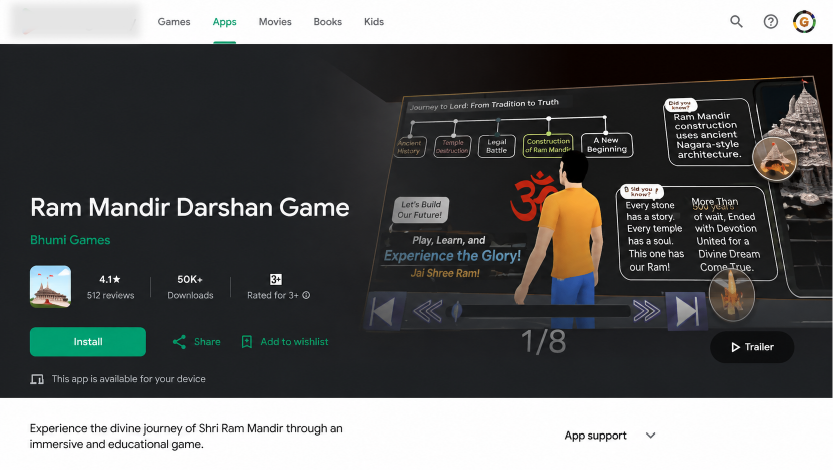
The Problem: Scammers launch fake registration portals, spoofed e-pass sites, and rogue mobile apps using legitimate government logos and event seals. They rank these portals via search engine ads or circulate APK links directly on messaging apps.
The Impact: Victims lose money due to counterfeiting by paying for useless passes, surrender sensitive identity/biometric data, and face rejection or delays at actual event check-in points. Long-term, this destroys public confidence in official digital governance channels.
Findings by mFilterIt: 225+ fake websites and apps carrying counterfeit official branding were identified during a single 45-day event.
Cloned booking and accommodation platforms
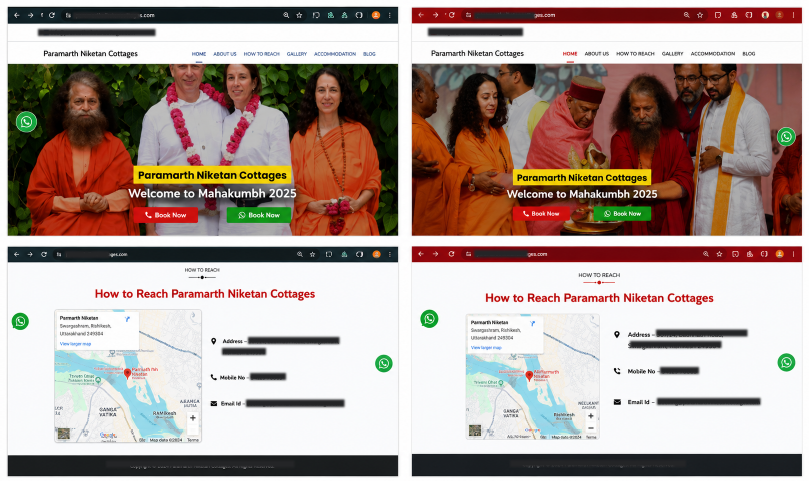
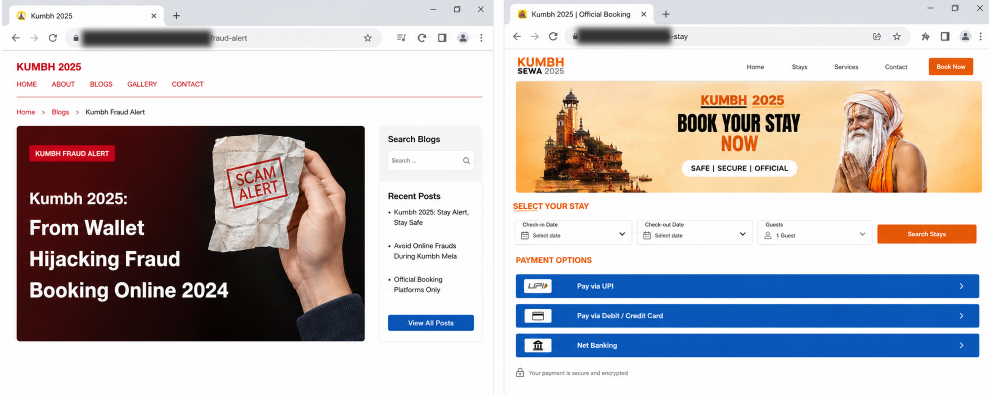
The Problem: Fraudsters spin up professional-looking websites offering riverside tents, VIP cottages, or discounted stays, often duplicating the exact template, layout, and “how to reach us” structure of one another under a different name and domain, and collect advance payments through personal UPI handles instead of verified merchant gateways.
The Impact: Pilgrims lose advance payments with no accommodation to show for it, often discovering the fraud only on arrival, at the worst possible moment to fix it. The reuse of near-identical templates across multiple domains also points to a single operator running several fraud fronts in parallel during a single event window.
Fraudulent payment and donation flows
The Problem: Fake QR codes and “seva” or “donation” payment pages redirect funds to accounts with no real connection to the organization being named. The warning signs are often hidden in the details, like a UPI ID or bank account registered under an individual's name, in a city entirely different from the one the website claims to operate in.
The Impact: These differences may be easy for a rushed donor to miss, but the right forensic tools can quickly identify them, catching the fraud before more money moves and before the organization being impersonated absorbs the reputational damage.
Impersonated religious and charitable campaigns
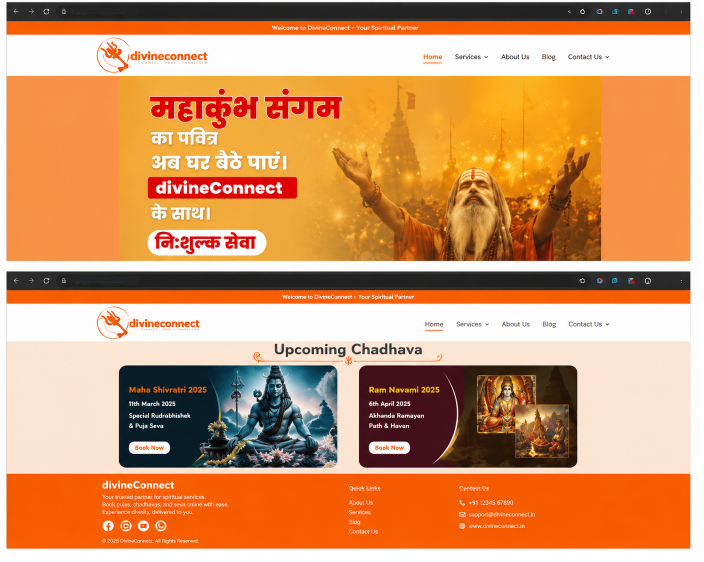
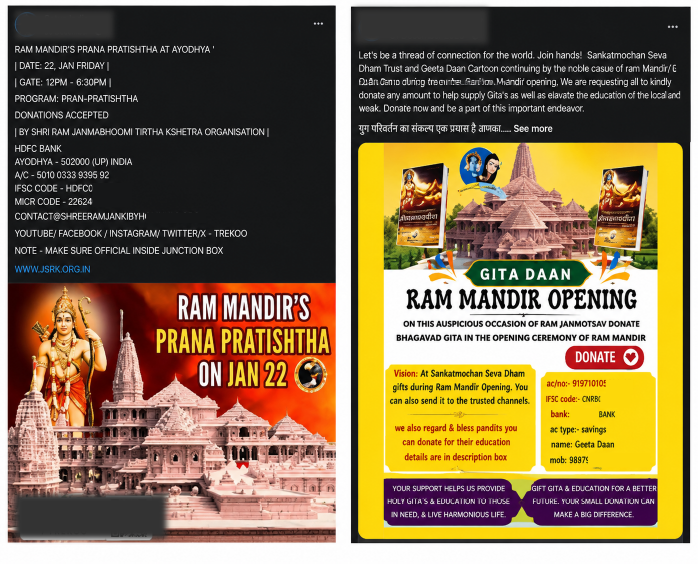
The Problem: Fraudsters don't wait for a generic opportunity; they hijack the exact emotional peak of a real event. Donation drives referencing genuine moments, a temple's opening ceremony, a major festival date, appear on social media asking devotees to contribute toward causes that don't exist, wrapped in real event branding and real religious sentiment to lower the reader's guard.
The Impact: Genuine religious sentiment is used against the donor, and the temple, trust, or campaign being referenced faces public backlash for a scam it had nothing to do with.
Findings by mFilterIt: Fake donation drives like this one accounted for several of the 40+ FIRs filed during the same event.
Fraudulent prasad and merchandise pages via search
The Problem: A separate but related pattern surfaces through organic and paid search: sites offering “free prasad,” temple-model replicas, or commemorative merchandise, several of them requesting card details upfront for shipping that never happens.
The Impact: Because these rank in search results rather than appearing on an obviously suspicious link, they often feel more credible to the pilgrim clicking through than a random social media post would, and card details handed over for “shipping” frequently get used for further fraud beyond the original purchase.
Findings by mFilterIt: Cases like this were part of the 20+ arrests enabled through shared intelligence with law enforcement.
Social media impersonation at scale
The Problem: Fake accounts posing as event organizers, official sponsors, or department handles spread phishing links and misinformation far faster than any single monitoring team can track manually. During a single event window, hundreds of such handles can surface, each one borrowing just enough visual and textual similarity to the real account to pass a quick glance.
The Impact: Pilgrims interacting with these accounts share personal details, click on unsafe links, or act on false information, and manually tracking every impersonating handle across a single event window is beyond what any one team can do at scale.
Findings by mFilterIt: 250+ impersonating handles were flagged during the same 45-day window, most within hours of going live.
A Shared Responsibility: What Everyone Needs to Do to Ensure Brand Protection for Government Institutions, Brands, and Individuals
Religious-event fraud succeeds in the gaps between official systems, brand activity, and individual decisions, not because any one of these three is missing protection, but because none of them is watching the same picture at the same time.
Governments, brands, and citizens therefore need to act as one connected trust system: institutions verify and enforce, brands monitor and escalate, and individuals validate before they transact.
What holds that system together is a layer that protects all three, reading the open internet independently of any single institution or brand's own channels. This is the role OSINT plays: an independent trust validator that continuously checks domains, apps, handles, and payment flows against what's official, surfacing the gap the moment it appears rather than after a complaint closes it.
This shift is worth naming directly: Safety by Design.
In the same way “privacy by design” moved data protection from an afterthought into an architectural requirement, scam-resistance can't be bolted onto an official portal, a brand campaign, or a payment flow after fraud has already spread, it has to be built in from day one.
What Government Institutions Need to Do
Continuous, real-time monitoring of official domains, seals, and department branding for impersonation, not limited to the security of the institution's own portal but extended to anything on the open internet causing brand infringement by using brand's name or identity.
Published, authenticated “official vendor” lists for accommodation, transport, and services, and active monitoring of those lists for spoofing, since fraudsters increasingly fake the approval, not just the product.
Pre-established, fast-track escalation channels with domain registrars, app stores, and payment platforms, set up before the event begins, so takedowns happen in hours, not after weeks of back-and-forth.
Clear public communication protocols to correct impersonation and misinformation quickly. Government identity theft is harder to walk back publicly than a private brand's, which makes speed of correction just as important as speed of detection.
What Brands Need to Do
Monitor for infringement from the moment a campaign or sponsorship is announced, as fake versions routinely go live before the official one does, not after.
Verify payment-flow authenticity systematically, treating UPI and bank account mismatches as a standing signal to check for, rather than waiting for customer complaints to surface the pattern.
Extend monitoring beyond owned domains to social media and unofficial channels, where most brand impersonation spreads and where brand teams are least equipped to self-monitor at scale.
Build, or partner for, a detection-to-takedown pipeline rather than a passive dashboard. Detection without a fast escalation path is just documentation of the fraud that has already happened.
What Individuals Need to Do
Check that a UPI ID's registered account name matches the organization it claims to represent before paying.
Cross-reference “official” vendor, booking, or donation claims against published government or organizer lists rather than trusting a well-designed website on its own.
Avoid paying into personal accounts for anything presented as an institutional or organizational booking; legitimate operators use verified merchant channels.
Verify social media handles against confirmed official accounts before acting on a donation request, a booking link, or an announcement.
Fraud infrastructure like domain impersonation, cloned apps, and impersonating handles is often built before an event is even officially announced and lingers well after it ends.
What connects government, brand, and individual responsibility is the same underlying requirement: continuous vigilance, sustained before, during, and after the event, designed into every official channel, every brand campaign, and every payment flow from the start.
Conclusion: The Future of Religious Event Safety Isn't More Checklists; It's Continuous Vigilance
Government investment in religious events will keep growing. Brand participation will grow alongside it. And fraud will keep following both, not as a one-event problem, but a recurring one, tied directly to how much value concentrates in these windows.
Religious event safety, then, doesn't come down to how fast an institution or a brand can clean up after a scam has already spread. It comes down to continuous scam readiness, sustained well before an event begins and well after it ends. That readiness rests on three things working together:
OSINT-led detection that reads open-internet signals in real time
Fast takedown escalation that turns a flagged threat into a resolved one within hours
Independent validators like mFilterIt's Brand Protection solution who can confirm what's genuine and flag what isn't, faster than any single institution or brand can do alone
If you're a government body or a brand preparing for the next large-scale religious gathering, talk to mFilterIt about building that kind of continuous scam readiness, before fraud gets there first.
Frequently Asked Questions
How quickly can a fake website or app impersonating an official event be identified and taken down?
With continuous, real-time monitoring, impersonating domains and apps can typically be flagged within hours of going live, rather than after complaints accumulate, enabling faster escalation to registrars, app stores, and law enforcement.
Does this kind of monitoring only work for government-run events?
No. The same framework applies to any brand campaign, sponsorship, or product launch tied to a large public event, wherever impersonation risk exists.
How is a fake UPI or QR code payment page actually detected?
By cross-referencing the payment identifier's registered bank details, account holder name, and domain registration history against the claimed organization, mismatches are a strong, early fraud signal.
What role do individuals play if institutions and brands already have monitoring in place?
Individuals remain in the last line of defense. Verifying vendor authenticity and payment details directly reduces risks when proactive scam monitoring is active.