A guide for brand owners, CMOs, ecommerce heads and brand protection teams
Every Black Friday, brands compete hard for customer attention, search and marketplace visibility, advertising inventory, conversions and loyalty. Budgets are committed weeks in advance. Creatives are refreshed, influencer partnerships go live, email calendars fill up, and marketplace placements are negotiated.
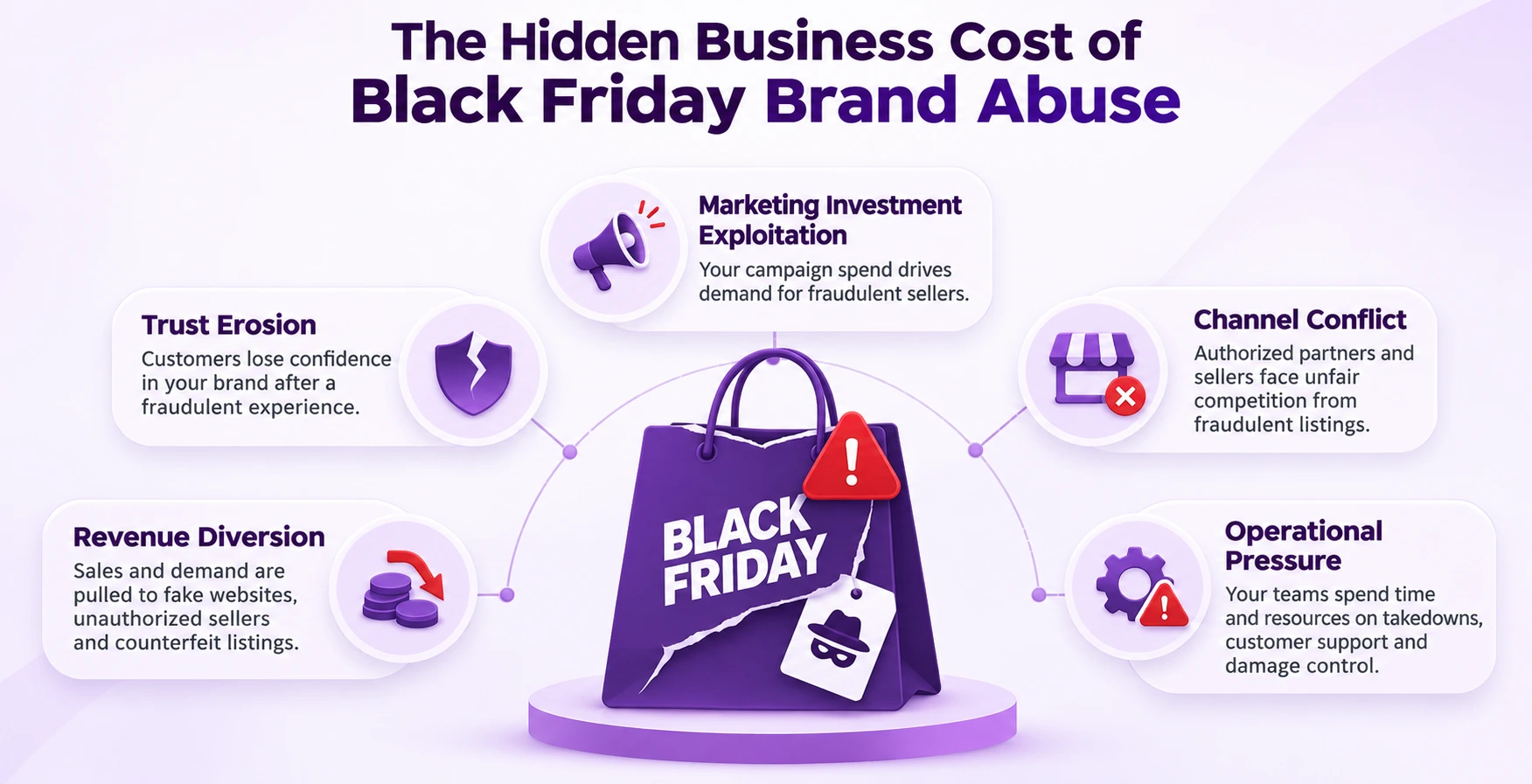
But there is a second competition running alongside the first. Fraudsters compete too, not to create demand but to capture the demand your brand has already paid to create.
Picture a brand launching its biggest campaign of the year. And later finds:
Fake social media account promoting an imitation of the sale
Lookalike domain advertising same products at unrealistic discounts
An unauthorized seller using official product images
Misleading ads sending shoppers to a fraudulent checkout
The brand spent money building demand. Someone else is monetizing that demand using its identity.
That's the real Black Friday brand protection problem. It's not just about detecting brand infringement, brand impersonation, or fake offers; it is about identifying how brand abuse spreads across customer journey, how quickly it erodes trust, revenue, and how to respond while the sale is live.
Why Black Friday is a Higher-Risk Environment For Brands
Black Friday does not invent new types of fraud. It amplifies the conditions that make existing fraud work. Four forces combine during peak season:
High purchase intent
Promotional urgency
Expected discounts
Expanded digital visibility
Independent research shows how quickly this surface area is exploited. In a festive-season engagement with a leading Indian bank, mFilterIt’s OSINT-led monitoring uncovered 2.4 lakh (240,000) fraudulent cases across just 10 platforms, all targeting a single brand. That is an average of nearly 24,000 scam assets per platform. The cases ranged from brand impersonation and fake promotional sites to phishing pages, coupon abuse and deceptive referral schemes. (In coverage with: CXOToday)
The lesson for brand owners is that peak-season risk is not one threat. It is many threats, timed to your campaign and dressed in your identity.
How Brand Abuse Follows The Black Friday Customer Journey
Most brand protection content organizes threats by category: counterfeit fraud here, phishing there. A more useful lens for brand teams is the customer journey, because that is how shoppers actually encounter abuse.
A customer may first see a fake social account, then click through to a lookalike website and finally pay a fraudulent seller. Each step uses your brand to build trust for the next.
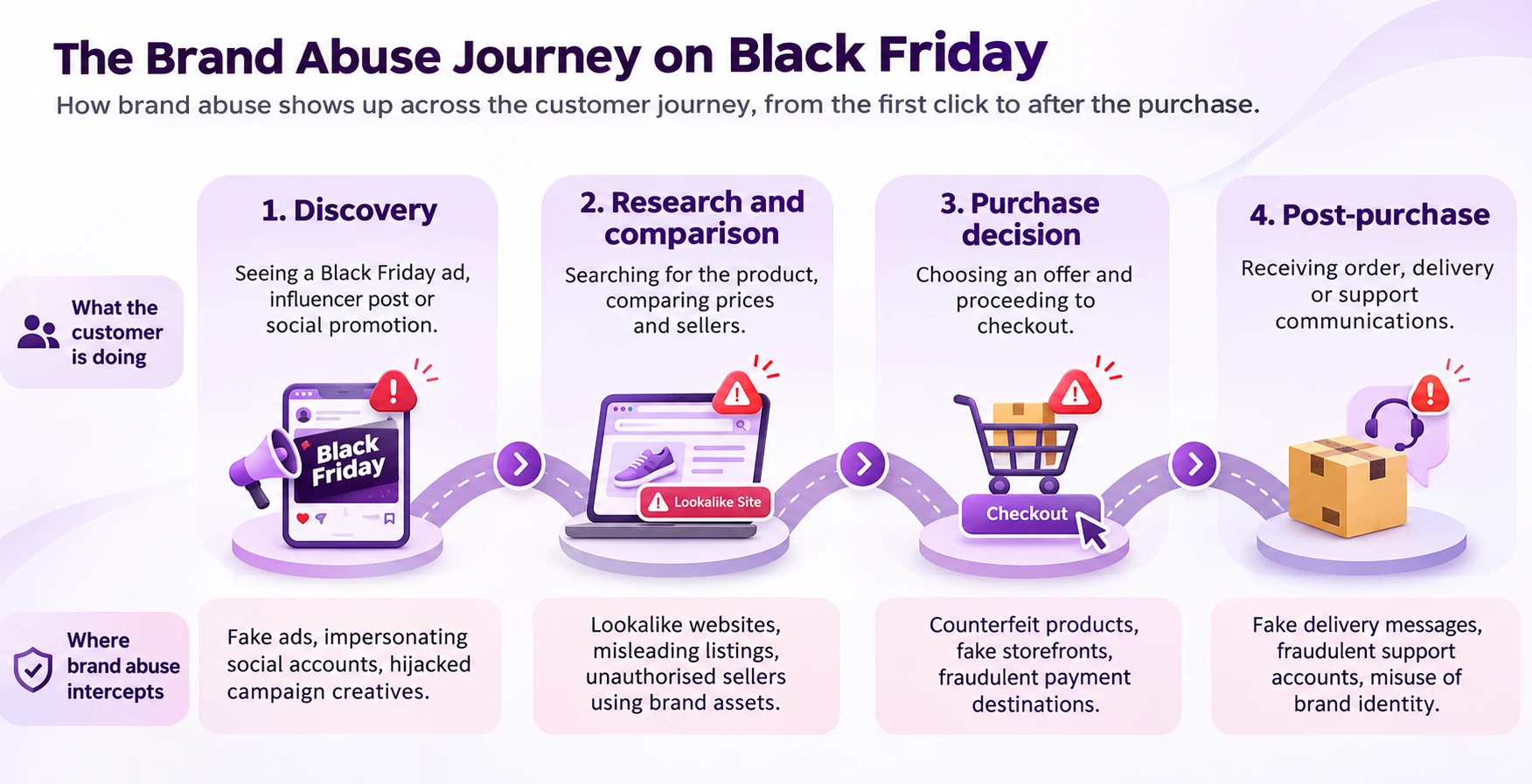
This structure exposes a blind spot. A brand that only monitors counterfeit marketplace listings sees stage three and misses the brand impersonation journey that led the customer there, and the fake support account that follows them afterwards.
Brands should monitor how their identity is being used across the digital customer journey, not just where their products are being sold.
Know What You Are Looking At: Counterfeit, Unauthorized & Misleading Offers
A common mistake in peak-season brand protection is treating every suspiciously cheap listing as a counterfeit. That approach is inaccurate, and it can create legal exposure and friction with channel partners. Before deciding whether to investigate, report, enforce or escalate, brand teams need to classify what they have found.
Type of activity | What it means | Why it matters |
Counterfeit product | A product falsely presented as genuine or as originating from the brand | Trademark misuse, consumer deception, potential quality or safety risk |
Unauthorized seller | Genuine products sold by a seller that is not an approved distributor | Channel control, warranty and customer experience concerns |
Grey-market goods | Genuine products sold outside intended distribution arrangements | Pricing, territorial and channel-conflict concerns |
MAP violation | A reseller advertises below the brand's minimum advertised price policy | A pricing-policy issue, not automatically counterfeiting |
Brand impersonation | A third party uses the brand's name, logo or assets to appear legitimate | Customer deception, reputational damage, possible fraud |
Fake promotional offer | A fraudulent offer uses the brand's name or campaign identity | Customers lose money or data believing they are dealing with the brand |
This keeps enforcement accurate and stops reseller disputes from being mishandled as brand infringement cases.
Black Friday Brand Protection: India vs USA
The tactics are broadly the same in both markets: fake websites, counterfeit fraud, impersonation, misleading ads and phishing attacks. What differs is the shopping context, the promotional calendar and where brands should concentrate monitoring. Those differences change strategy, so they deserve separate treatment.
India: An Expanding Promotional Season, Not a Single Sale Day
Black Friday is not traditionally India's central retail event, but it is fast becoming part of a longer festive and discount season. Meta's November 2025 analysis describes India's festive period as running from August through the New Year, with Black Friday and Cyber Monday increasingly absorbed into the country's retail culture, alongside value-conscious shopping, social discovery, quick commerce and cross-border selling.
In the same research, 69% of surveyed Indian shoppers said they buy online during Black Friday or Cyber Monday, and 68% said savings and discounts motivate them.
mFilterIt's own observations from the 2025 sale described fraud levels rising from a regular November range of 18–27% to over 60%, peaking at 70%, when the sale window opened, along with sharp increases in clicks, impression bursts and non-human activity. (In coverage with: Exchange4Media)
These figures relate to ad traffic during that specific sale period rather than an industry-wide benchmark, but the pattern matters for brand protection: fraudulent activity rises fast, rides campaign momentum and does not neatly disappear when the sale ends.
In India's extended festive and holiday season, brand protection needs to be continuous. A threat has not disappeared simply because the campaign has ended.
Priorities for Indian brands:
Monitor fake promotional ads and social impersonation
Identify counterfeit and misleading marketplace listings
Track unauthorized use of brand names, logos and product images
Watch suspicious domains and fake promotional landing pages
Maintain monitoring before and after the main sale dates
Coordinate brand protection with performance marketing and ecommerce teams.
USA: A Concentrated, High-Value Event with Heavy Impersonation Exposure
In the US, Black Friday is an established retail moment tied to Thanksgiving and extending through Cyber Monday and the holiday season. The concentration of spend and attention makes well-known retailers and brands prime targets for brand impersonation.
The 2025 evidence is strongest around fake domains, cloned storefronts and phishing, with the US Congress's Joint Economic Committee also highlighting the growth of Black Friday scam websites and phishing campaigns targeting US retail brands.
Because US promotions rely heavily on email, SMS, social ads and search, fraudsters can replicate the entire promotional chain: a cloned email, a matching social ad, a lookalike landing page, a fake checkout and, later, a fake delivery notice.
For US brands, protection must extend beyond ecommerce listings to the promotional experience itself.
Priorities for US brands:
Monitor lookalike domains and fake retail websites
Detect fake Black Friday promotions using brand names and creatives
Watch social and paid ads for impersonation
Identify fraudulent landing pages and checkout destinations
Monitor fake order, delivery and support communications
Prioritize high-demand categories such as electronics, footwear, fashion, and gaming.
Dimension | India | USA |
Black Friday context | Emerging moment within an extended festive season | Established event linked to Thanksgiving and Cyber Monday |
Promotional timing | Blends with festive, year-end and cross-border campaigns | Concentrated, then flows into holiday shopping |
Key abuse emphasis | Fake offers, social impersonation, counterfeit and campaign-related abuse | Fake retail domains, phishing, cloned storefronts, post-purchase impersonation |
Monitoring priority | Longer seasonal coverage, before and after sale windows | High-intensity coverage around the sale and through the holidays |
How Brands Should Prepare: Before, During and After Black Friday
Generic advice says prepare early and monitor during the sale. Effective brand protection is more specific: each phase has different actions, different things to watch, and a different business objective.
Phase | What to do | What to monitor | Objective |
Before | Baseline official assets, authorized sellers, domains, accounts and creatives. Flag high-risk products and markets. | Lookalike domains, fake social accounts, suspicious sellers, trademark misuse | Find threats before they exploit the campaign |
During | Intensify monitoring. Prioritize by customer exposure and potential damage. Coordinate brand, legal, ecommerce and marketing. | Fake ads, counterfeit listings, fraudulent sites, impersonation accounts, misleading offers | Reduce customer exposure while the sale is live |
After | Close open cases, identify repeat offenders, document impact. | Persistent fake domains, repeat seller accounts, copied creatives, post-purchase impersonation | Prevent recurrence and strengthen the next cycle |
A Quick Readiness Checklist for the Next Ten Days
Register an inventory of every official domain, social handle, marketplace storefront and authorized seller.
Share final Black Friday creatives with your brand protection team so copies can be recognised.
Agree escalation owners across brand, legal, ecommerce and customer support.
Prepare evidence templates and platform reporting routes before volumes spike.
Brief customer support on how to log impersonation reports so they feed back into monitoring.
Beyond Detection: Measuring Whether Your Brand Protection is Working
During Black Friday, a brand might surface hundreds of suspicious assets. Volume alone says little. How many were genuinely high-risk? How many were investigated? How many were removed, and how fast? Detection volume is not the same as protection effectiveness.
Brand protection teams can measure operational effectiveness with five metrics:
Time to detect: How long a threat is live before it is found.
Time to prioritize: How quickly it is investigated and risk-rated.
Time to enforce: How quickly a takedown or enforcement action begins.
High-risk resolution rate: The share of high-risk threats actually resolved.
Repeat infringement rate: How often the same offenders or assets reappear after enforcement.
Tracking these through the season turns brand protection from a reporting exercise into a performance discipline, and gives leadership a clear view of how much exposure was actually reduced.
How mFilterIt's Continuous Brand Protection Helps Brands Stay Ahead
The shift brands need is from reactive takedowns to continuous visibility, risk-based prioritization and coordinated response. That is the approach with which mFilterIt's OSINT-led brand protection solution runs scans.
Rather than watching a single channel, it gives brands visibility into how their identity is being used across the digital ecosystem:
Identity scanning to surface impersonating accounts, domains, and digital assets that misuse your brand.
Phishing detection to identify fake websites and promotional landing pages that replicate official brand experiences.
Trademark infringement detection to flag unauthorized use of brand names, logos, and protected assets.
OSINT-led monitoring and investigation to connect individual incidents into the wider fraudulent networks behind them.
This matters most during peak season, when the volume of signals is highest, and teams have the least time to separate a pricing dispute from a genuine brand impersonation threat.
Conclusion: Don't Let Fraudsters Profit from the Demand Your Brand Creates
Black Friday brand protection is not just about removing counterfeit products or fake websites. It is about protecting the entire customer experience, preserving the trust your marketing has built, and ensuring that fraudulent actors cannot turn your brand's popularity into their opportunity.
Don't let fraudsters or impersonators profit from your brand identity.
Talk to the mFilterIt team about a peak-season brand risk assessment and see where your brand identity is being misused before your customers do.
Frequently Asked Questions
How can brands prepare for Black Friday brand protection?
Start with a baseline of everything that is officially yours: domains, social handles, marketplace storefronts, authorized sellers and campaign creatives. Identify the products and markets most likely to be targeted, agree escalation owners across brand, legal, ecommerce and support, and put monitoring in place before the campaign launches, so threats are caught before they gain traction.
How can you spot counterfeit Black Friday deals and identify a website selling counterfeit goods?
Look at several signals together rather than price alone: a domain that closely imitates the official one, a recently created site or seller account, copied product images, inconsistent branding or descriptions, unusual payment methods and missing contact or returns information. For brands, the same signals, checked continuously and at scale, form the basis of detecting counterfeit sites before customers find them.
How can AI identify counterfeit products online?
AI-led monitoring can scan large volumes of websites, listings, ads and social accounts far faster than manual review. It can match copied product images and logos, detect lookalike domains, flag abnormal pricing patterns and link related accounts or sites, helping teams prioritize the highest-risk cases for human investigation and enforcement.