
Of the $114 billion projected to be lost to ad fraud globally in 2025, financial services bear a disproportionate burden. In the GCC alone, the sector carries an invalid traffic rate of 11.34%, the second highest of any industry. And that’s a conservative estimate.
For most industries, that’s an efficiency problem. For BFSI, it’s a threat to the integrity of financial decision-making. A fraudulent lead isn’t just wasted spend; it’s a corrupted data point that can skew risk models, influence credit decisions, and trigger compliance exposure.
In MENA, the risk compounds further. Digital ads spend is scaling faster than measurement and transparency standards, making it easier for fraud to go undetected and harder for brands to trust their own numbers.
The question isn’t whether ad fraud exists in your campaigns. It’s whether your growth is built on verified performance or inflated figures.
This guide covers:
- Ad fraud in branding and performance marketing: How it infiltrates your funnel
- The impact of ad fraud on BFSI campaigns: Why the stakes are higher here than anywhere else
- Why full-funnel protection is no longer optional in 2026
Ad Fraud in Branding and Performance Marketing: How It Infiltrates Your Funnel
Brands believing that ad fraud can be controlled with the surface level checks are still stuck in the loop of myths that are standing on the face of their branding and performance campaigns. As soon as these myths exists, the campaign performance will keep on suffering the most and the real threat will skip every single time. So, to keep your marketing efforts intact, the first thing to do is to bust the myths and face the reality –
Myth 1 – Walled Gardens Automatically Deliver Clean Traffic
What marketers believe: Closed ecosystems mean better fraud control. Platform signals handle quality checks, so traffic is assumed to be safer even with limited transparency.
What actually happens: Traffic quality is largely reported by the platform itself. Invalid traffic often blends into aggregated data, and limited visibility makes fraud harder to detect early.
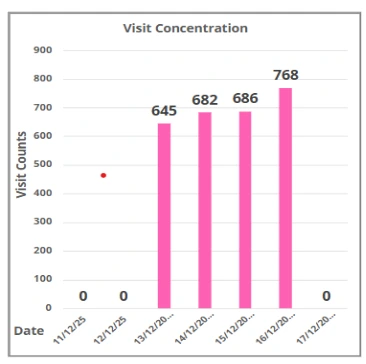
The graph above has visit counts on y-axis and 7 days dates on x-axis. The visit counts from 13/12/2020 to 16/12/2020 reached to 600+. This also symbols identical hourly patterns (28-30 visits every hour), indicating that bot traffic has entered in your campaigns.
What this can lead to: This can lead to invalid or bot traffic going unnoticed, inflating clicks and engagement metrics. As a result, marketers may make decisions based on misleading performance data and end up spending budgets on low-quality traffic.
Myth 2 – Pmax Guarantees Performance And Brand-Safe Placements
What marketers believe: PMax is a powerful, automated campaign type that finds the best placements across Google’s inventory while maintaining performance and brand safety.
What actually happens: PMax operates like a black box. Marketers have limited visibility into:
- Which placements are driving real clicks
- The actual sources of leads (Search, Display, YouTube, etc.)
- How much traffic comes from brand searches you already own
What this can lead to: Cheaper clicks, heavy reliance on brand queries, and returning users you may have acquired anyway. It can also pollute remarketing audiences. This can also give a false idea of strong ROAS but when dived deeper, traffic could be recycled or of low-quality.
Myth 3 – Premium Publishers Mean Lower Fraud
What marketers believe: Higher CPMs and premium inventory mean better filtering and more genuine users.
What actually happens: With advanced bots and AI-driven traffic, fraudulent activity can closely mimic real user behavior even on premium sites. High CPMs don’t always guarantee high-quality traffic.
What this can lead to: Apart from monetary losses including wasted marketing budgets, it also builds a false confidence in “premium” inventories.
Myth 4 – Bots Are Easy To Detect
What marketers believe: Fraud or invalid traffic shows clear, abnormal patterns in the funnel, making it easy to identify and filter out.
What actually happens: Sophisticated bots are designed to ditch the advanced solutions with complex behavioral patterns including clicking ads and even moving through parts of the funnel.
What this can lead to: Inflated clicks and engagement metrics and optimization of wrong channels that give an illusion of “fine campaign performance.”
Myth 5 – High Time On Site Means High User Intent
What marketers believe: Longer sessions indicate stronger interest. More time on the website is often treated as a clear signal of user quality and intent.
What actually happens: Session duration alone doesn’t always reflect genuine engagement. Automated scripts or passive browsing can artificially increase time on site.
What this can lead to: Overestimation of user interest and engagement. This also makes segregation between genuine user and bot traffic, harder than ever.
Myth 6 – If I Pay For Verified Leads, My Campaign Is Safe
What marketers believe: Verified leads mean clean leads. OTP verification is often seen as enough to confirm authenticity and quality.
What actually happens: Lead verification only confirms that a form was submitted, it doesn’t guarantee genuine user intent or relevance.
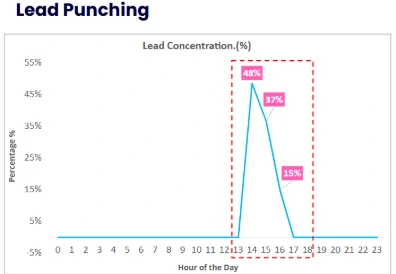
What this can lead to: Punched Leads – Lead forms are filled forcefully using repeated or irrelevant data to quickly meet targets.
In this graph, we can see lead punching where lead concentration rises abnormally during specific hours of the day.
Fake Leads – Entirely fabricated data is filled in lead forms that includes false, non-existent, or stolen information.
Non-prioritized Leads – Low-quality or irrelevant leads that do not match the brand’s target audience or intent.
Myth 7 – Paying For Down-The-Funnel Events Eliminates Fraud
What marketers believe: Fraud usually happens at the install stage. Once users complete actions after install, those signals are considered genuine.
What actually happens: Post-install events can also be manipulated. Fraudsters can fake events or mimic user activity like fake signups to make traffic look high quality. This type of fraud is also triggered by incentivized users who are paid to perform soft KPIs
What this can lead to: Fake users completing scripted actions to look genuine and lower ROAS despite strong numbers.
Myth 8 – Brand And Performance Campaigns Can Be Managed Separately
What marketers believe: Brand teams handle branding campaigns and performance teams handle performance campaigns. With separate channel controls, both can run independently.
What actually happens: Fraud and invalid traffic don’t follow team or channel boundaries. When campaigns run in silos, suspicious activity can move between channels without being noticed.
What this can lead to: Fraud slipping through gaps between teams and channels and unvalidated traffic influencing campaign outcomes.
Why Full-Funnel Protection Is No Longer Optional In 2026
Understanding the myths is the first step. But awareness alone doesn’t protect a campaign and neither does fixing fraud where it’s most visible.
The instinct for most teams is to respond to fraud at the point where it surfaces. A spike in invalid clicks gets addressed. A bad placement gets blocked. A suspicious affiliate gets removed. These are reasonable reactions — but they treat fraud as a series of isolated incidents rather than what it actually is: a system that adapts to wherever your defences are weakest.
When one channel gets hardened, fraud shifts to another. When one tactic gets detected, it evolves. Plugging individual holes doesn’t reduce fraud, it redirects it.
Why Siloed Validation Fails BFSI Campaigns
Most validation approaches are built around single stage of funnel. A click fraud tool monitors traffic quality. A brand safety tool checks placements. A lead verification tool confirms OTP. Each does its job, but none of them can see what the others are missing.
The problem is that fraud doesn’t stay in one place. A bot that passes click-level checks can go on to fill lead forms. Incentivised traffic that clears install validation can fail at activation. An affiliate that looks clean on last-click attribution may have been intercepting organic demand three steps earlier. When each stage is validated in isolation, the connections between them go unexamined and that is precisely where sophisticated fraud hides.
For BFSI campaigns specifically, the stakes of this blind spot are compounded at every stage:
- Invalid clicks don’t just waste budget, they feed optimisation algorithms with false signals, causing campaigns to scale toward fraud rather than away from it
- Fake leads don’t just inflate CPA, they consume underwriting resource, sales team capacity, and compliance bandwidth
- Attribution fraud doesn’t just misdirect commissions; it starves your genuinely performing channels of the budget they’ve earned
When these issues exist simultaneously across different stages and they almost always do siloed tools catch some of them, some of the time. They cannot catch the relationship between them.
What A Full-Funnel Approach Solves?
Full-funnel protection isn’t about adding more tools to more stages. It’s about creating a connected view of what’s happening across all of them, so that anomalies at one stage can be traced to their source, and clean signals at one stage aren’t contaminated by fraud entering at another.
In practice, this means:
Impression and placement integrity feeds click quality analysis
Knowing where your ads are appearing gives context to the traffic they generate. A click from a verified, brand-safe placement in your target geography means something different from a click originating from an MFA site or a misdelivered impression. Without placement-level visibility, click quality analysis is missing half the picture.
Click and traffic quality feeds lead validation
The behaviour of a user between click and form submission tells you a great deal about their intent — and about whether they are a real person at all. Scripted navigation, abnormal session patterns, and suspicious dwell times are signals that a standalone lead verification tool will never see, because it only examines what arrives at the form, not how it got there.
Lead quality feeds attribution accuracy
If fake or low-intent leads are entering your pipeline, last-click attribution will distribute credit for them across your partner network regardless. Without lead-level validation informing attribution, you will consistently reward partners for conversions that carry no real value and defund the channels that are generating genuine demand.
Attribution accuracy feeds campaign optimisation
Every future budget decision is built on historical attribution data. If that data is distorted by fraud at any stage upstream, the decisions built on it compound the problem. A full-funnel view ensures that what you optimise toward reflects verified performance — not an accumulation of undetected fraud signals.
The connected nature of these stages is also why full-funnel protection requires brand and performance campaigns to be treated as one unified system rather than separate workstreams. Fraud that originates in a branding campaign — bot traffic inflating awareness metrics, unsafe placements contaminating remarketing audiences — doesn’t stay there. It flows downstream into performance data, lead quality, and ultimately into the numbers that leadership and compliance teams rely on.
For BFSI brands in MENA, where digital scale is accelerating and measurement standards are still catching up, the gap between what campaigns appear to deliver and what they deliver is widening. mFilterIt’s ad traffic validation solution leverages full-funnel approach to ensure sophisticated fraud techniques don’t bypass single stage level checks, providing transparency of the traffic quality and helping marketers make an informed decision.
How did a Leading Financial Services Firm Tackle Ad Fraud with mFilterIt?
A leading asset management company was investing heavily in digital campaigns, yet results weren’t improving. Money was not the problem, but the returns from money was.
The Problems
- Search campaigns underperformed despite repeated budget and strategy changes.
- Invalid traffic increased, inflating metrics and raising acquisition costs.
The issue wasn’t scale. It was quality.
The Solution
Instead of just increasing spends, the focus shifted to full-funnel validation and traffic quality checks. mFilterit, with its ad fraud solution, Valid8, conducted a detailed traffic audit of users at every stage of the journey, removing invalid visits, blocking fraudulent sources, and stopping low-quality leads at the source before they could impact performance or increase costs.
The Impact
- ~60% reduction in wasted spend
- Stronger conversion stability
- Controlled STP costs
Conclusion
In BFSI, where every conversion carries real monetary value and every data point feeds a financial decision, ad fraud is not a media problem. It is a growth, efficiency, and compliance challenge and it requires the same rigour that BFSI brands apply to every other area of financial risk.
The brands that will scale sustainably in 2026 are not the ones spending the most. They are the ones who can verify that what they are spending is working that every impression reached a real person, every click reflected genuine intent, every lead came from a real applicant, and every conversion was correctly attributed.
Full-funnel protection is not an add-on to a growth strategy. In BFSI, it is the foundation of one.
Take the next step toward secure growth. Schedule a demo to see how it works.
FAQs
What Is Ad Fraud In BFSI Marketing?
Ad fraud happens when fake traffic, bots, or dishonest partners create impressions, clicks, or leads that look real but are not from actual users. This wastes marketing budgets and shows misleading campaign results.
Why Is Ad Fraud A Serious Issue For BFSI Brands?
BFSI companies spend a lot to acquire each customer. When fraud creates fake leads or traffic, brands end up paying for users who never become real customers.
Can Ad Fraud Happen At Different Stages Of A Campaign?
Yes. Ad fraud can happen at every stage — impressions, clicks, app installs, lead forms, and even during conversion attribution.
How Do Fake Leads Affect BFSI Campaigns?
Fake or low-quality leads waste the time of sales and call center teams. They increase costs but do not bring real business.
How Does Full-Funnel Validation Help?
Full-funnel validation checks traffic at every stage of the campaign. It helps block fake traffic, remove invalid leads, and make sure your marketing budget goes toward real users.