
Your ads are getting delivered, but to a limited audience pool.
This is what we recently saw in one of the campaigns running on CTV platforms.
While impression delivery appeared strong for this Indonesian brand, engagement metrics did not align proportionately with campaign spend. On deeper analysis, it was observed that ad impressions were being served repeatedly to a limited set of devices instead of expanding to new viewers.
This indicated a potential frequency capping breach, where ads were being delivered beyond the defined exposure threshold.
Impact? Poor campaign efficiency and ad fatigue.
So, if you are an advertiser running OTT & CTV advertising campaigns, or your audience is experiencing something similar, this is must-read.
Deep-Down to Identify the Problem
Throughout the campaign, 6.02 million ad requests were evaluated through VAST-level validation signals.
What the Data Revealed About Frequency Capping Breach
The evaluation uncovered that:
- 15.86% of impressions were exceeding the defined frequency cap
- A total of 16.47% delivery was prevented, combining frequency capping breach and invalid traffic filtration
- Over 950,000 impressions were blocked due to frequency violations alone.
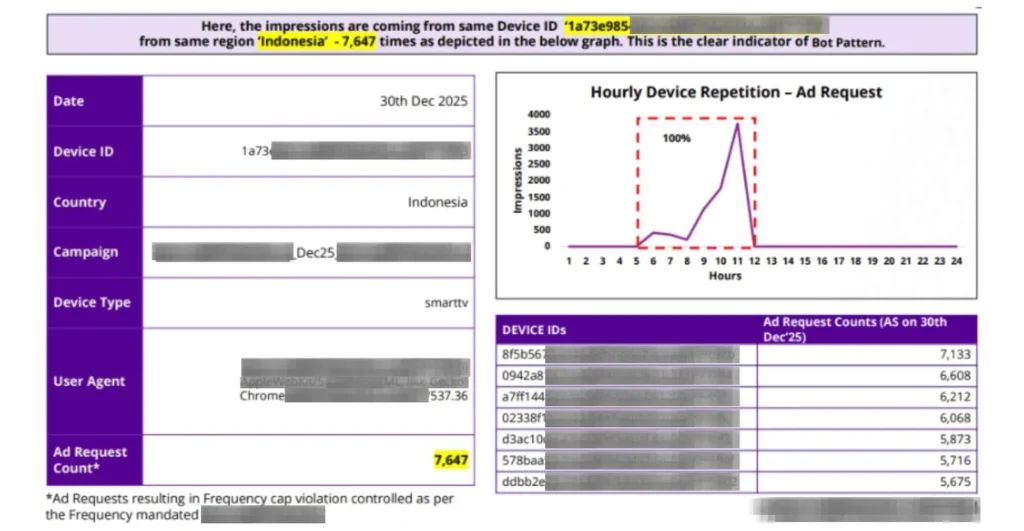
- Certain Smart TV device IDs generated thousands of repeated ad requests within short time windows
In one instance, a single device triggered over 7,600 ad requests in a single day, clearly indicating abnormal repetition behavior.
Additionally, a small portion of traffic (0.61%) was linked to data center and VPN-based IP activity, pointing toward advanced traffic manipulation patterns.
The Action Taken
To address this, real-time frequency validation was implemented at the VAST integration level. Every ad request was evaluated against the predefined frequency threshold before delivery.
If a device had already crossed the limit, a no-ad response was triggered, preventing further exposure. Repeated device patterns and abnormal request spikes were filtered out without impacting legitimate delivery. This ensured that exposure remained controlled and aligned with the campaign’s intended frequency settings.
The Measurable Impact
After filtration and enforcement:
- 691,691 impressions were validated and served cleanly.
- Video engagement remained strong.
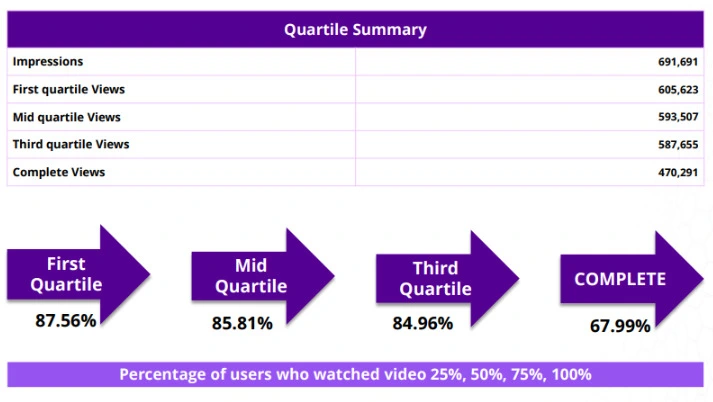
These results demonstrated that once frequency capping was enforced and invalid traffic was removed, genuine viewer engagement remained stable and healthy. More importantly, reach distribution improved, budget wastage was reduced, and exposure became more balanced across devices.
What This Means for OTT & CTV Advertisers
To prevent frequency capping breaches, simply setting up a frequency cap is not enough. What matters is whether that cap is actively enforced at the moment of ad delivery or not. mFilterIt ensures that ad exposure remains controlled, balanced, and performance-driven through real-time frequency governance. Here’s how advertisers can benefit:
Ensures Proactive Enforcement Of Frequency Caps
By validating ad requests before they are served, exposure thresholds are actively monitored and enforced. This prevents ad impressions from exceeding defined limits and ensures campaigns remain compliant throughout their lifecycle.
Prevents Impression Wastage On Limited Devices
Device identities are analyzed to monitor how frequently a specific device has been exposed to an ad. By tracking repetitions at the device level, advertisers can clearly identify when impressions are being served within a limited audience pool and take corrective actions accordingly.
Maintains Clean Reach By Combining Frequency & Traffic Quality
Ad frequency overshoot can sometimes overlap with invalid traffic signals. By evaluating both exposure limits and traffic quality together, mFilterIt ensures campaigns maintain clean reach without inflating ad impressions through excessive or abnormal delivery.
Protects Viewer Experience With Balanced Exposure
By maintaining balanced exposure levels, advertisers can ensure that audiences are not overwhelmed by repeated messaging. This helps create a more relevant and engaging viewing experience while preserving brand perception across OTT and CTV environments.
Enables Smarter Campaign Optimization
Insights from frequency analysis allow advertisers to refine targeting strategies, adjust exposure thresholds where necessary, and improve distribution efficiency. This ultimately supports stronger reach expansion and better use of media investment.
Conclusion
OTT and CTV advertising is built to deliver premium, high-impact brand moments. But without proactive validation, campaigns generate ad impressions within a limited device pool, restricting reach and draining budget on repetitive exposure.
Advanced frequency capping using ad traffic validation solution is a performance safeguard. With this approach, brands can protect reach, maintain engagement quality, and ensure that budget is directed toward incremental audience expansion, not overserving the same devices.
If you want your branding campaigns to deliver genuine impressions, balanced reach, and measurable ad viewability across OTT and CTV advertising, it’s time to move beyond settings and into enforcement.
Connect with our experts to know more!
FAQs
What Is Frequency Capping?
Frequency capping refers to the maximum number of times an advertisement should be shown to a user or device within a defined time frame. For example, a brand may decide that a viewer should not see the same ad more than three times per day to maintain optimal exposure without causing ad fatigue.
What Is Frequency Capping Breach?
A frequency capping breach occurs when an ad is shown to the same user beyond the predefined limit. Moreover, this can happen even when you’ve set a frequency cap in your ad manager, due to platform-level inconsistencies, device-level repetition, or synchronization gaps across systems.
How Are Frequency Caps Configured?
Frequency caps are typically configured based on:
- Campaign
- Publisher
- Geography
- Time duration (daily, weekly, monthly)
Why Does Frequency Capping Matter?
Effective frequency capping ensures that users aren’t served the same ad too many times within a short period. This enhances ad campaign performance, effectiveness, prevents irritation, and maintains a positive viewing experience. However, finding the right balance requires data-driven decision-making, continuous testing, and collaboration with advertising platforms.