
One of the common pain points our clients have expressed is that their number of installs doesn’t match the number of conversions. They see a high volume of installs happening, but this doesn’t convert into outcomes.
There is not just one reason behind an unusual spike in installs. It can be bots, or something more advanced which a human eye might miss easily. In one of a recent campaign data we evaluated, we observed that a new and unusual technique is used to hide invalid traffic driving fake app installs from Android mobile versions.
In the sections ahead, we’ll break down how fraudsters are hiding their trails by spoofing device related information – like mobile app versions and why it matters more than you think.
What We Found: Unusual App Version Patterns at Device-Level Validation
Real Android applications follow a consistent version structure that looks like 3.1.1, 3.1.2, 3.1.3 (dots/separators placed at the bottom).
However, malicious application versions or bot-generated installs fail to replicate this accurately. These unusual app version patterns appear as 3·1·1, 3·1·2, 3·1·3, where dots/separators are placed in the middle instead of the bottom.
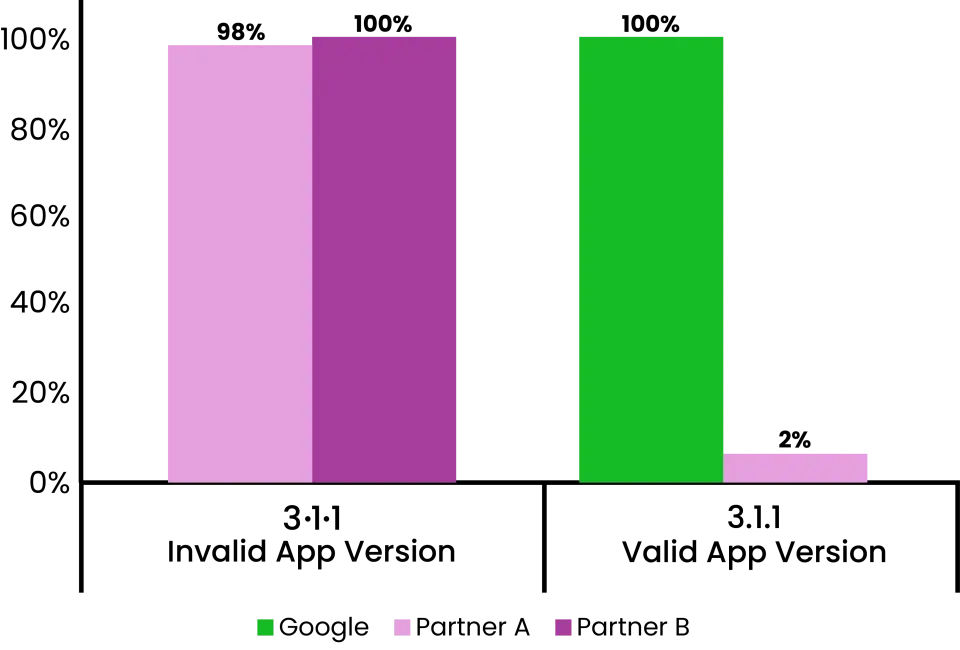
In legitimate mobile app versions:
The separators follow a standard baseline.
Formatting is uniform across devices.
This structure cannot vary from user to user.
But fraudulent installs often contain mobile app versions where:
The separators appear significantly higher than the baseline.
The structure does not match any valid release patterns.
These occur when bots simulate installs without replicating the technical precision of real app metadata.
Moreover, this pattern has been noticed across multiple publishers working with advertisers. Despite high install counts, purchase rates remain very low, confirming a clear metadata-level signature of bot traffic and app fraud.
Learn about the signs you might be experiencing device fraud.
How These Unusual App Version Patterns Impact Campaign Performance
While this technique might look very low impact, the consequences are not limited to just monetary.
Inflated Install Numbers
Bot-generated installs boost the number of total installs, making campaigns appear to be high-performing. This masks real performance and prevents marketers from spotting underperforming channels early.
Misleading Optimization Decisions
Fraudulent activity creates false engagement patterns. Due to this, marketers end up shifting budgets toward traffic sources that appear effective but are actually driven by bots, wasting spend and hurting long-term growth.
Unreliable Funnel Metrics
Fake installs never convert, engage, or retain. This skews entire funnel data, making it harder to understand real user behavior and accurately measure the quality of your audience.
Misleading Attribution and Affiliate Payouts
When bots generate fake installs, publishers or affiliates receive credit for traffic they didn’t actually deliver. This results in unfair payouts and inaccurate performance evaluation.
Lower ROI and LTV Ratio
Fake users add no revenue or long-term value, which pulls down overall ROI and LTV benchmarks. This leads marketers to overestimate channel performance while significantly underestimating the actual cost of acquiring genuine, high-quality users.
Therefore, one technical discrepancy like a misplaced dot can impact your entire growth strategy.
How Does mFilterIt Identify this Mobile Ad Fraud Technique?
Our ad fraud detection solution conducts a deeper analysis on every traffic source, to differentiate between human and bot-driven data. Some of the parameters used to identify these anomalies:
Analyses metadata that your dashboards can’t see
Studies deep metadata—mobile app versions, OS details, device integrity, APK sources, and user-agent patterns thoroughly, revealing subtle bot traffic signals that dashboards and attribution platforms cannot identify independently. It also helps confirm whether the installs came from trusted channels/sources or not.
Identifies abnormal OS-version distributions and mobile ad fraud clusters
It compares device versions against normal population patterns, flagging spikes in outdated or scripted versions, common in bot-driven installs operating on obsolete or emulated environments. It also maps recurring inconsistencies, like identical malformed app versions, repeating device signatures, or tight timestamp groupings, to uncover coordinated bot activity rather than isolated technical errors.
Assesses IP reputation and network behaviour
Our app fraud detection tool also checks whether installs originate from proxies, VPNs, or data-centre networks, revealing non-consumer routes often used by bots to mask location, identity, and device validity.
Analyses timing behaviour to detect injection patterns
By examining click-to-install and event timings, the tool identifies unrealistic timelines, signaling forced installs or automated triggers that do not follow natural user behaviour, generated by affiliates solely to achieve targets and earn payouts.
Blocks invalid traffic before attribution
Through pre-MMP and post-MMP checks, the app fraud detection tool stops fraudulent installs in real time, preventing bot traffic from entering analytics, inflating KPIs, or misleading optimization decisions.
Know why attribution platforms miss mobile ad fraud.
Way Forward
Unusual app version patterns are just one of many techniques fraudsters use to manipulate installs, which can be used as a red flag to identify an anomaly in your campaign data. However, mobile ad fraud involves multiple evolving techniques that often go undetected in surface-level checks. Identifying these signals is only the beginning. Advertisers need deeper, continuous ad fraud validation to detect anomalies across devices, metadata, networks, and user behaviour. Using an advanced app fraud detection tool enables advertisers to optimize confidently, prevent budget leakages, and build campaigns on clean, trustworthy data.
Strengthen your campaigns. Connect with mFilterIt experts and secure your traffic quality today.