
Imagine this: your audience associates your brand with inappropriate content that you never had the intention of funding.
Recently, advertisers raised concerns when their ads on Spotify were found appearing alongside sexually explicit audio content. The issue wasn’t the platform but the association.
These brands never intended to be associated with such content. The ads were placed through automated digital advertising systems designed to maximize reach and efficiency. Yet, the brands got associated.
This is exactly what happens to brands in the digital advertising ecosystem. Ads today travel across thousands of websites, videos, and platforms through automated systems. While brands carefully plan their messaging and targeting, they don’t always have visibility into where their ads finally appear.
When an ad shows up next to misleading, controversial, or inappropriate content, the brand gets associated with it, regardless of intent or awareness. Sometimes, one wrong association is enough to damage the brand reputation or trigger backlash. This is where the role of brand safety in digital advertising becomes prominent. It helps brands maintain control over where their ads appear and ensures marketing efforts build trust instead of unknowingly damaging it.
That’s why understanding what is brand safety, why it matters, and who needs to care about it is the first step towards ensuring safe advertising.
What is Brand Safety?
In digital advertising, brand safety refers to ensuring your brand ads do not appear next to irrelevant, inappropriate, illegal, or unsafe content that might harm your brand’s reputation, credibility, and brand values.
It includes measures taken to ensure safe ad placements across social media platforms, apps, and websites.
For example, when a reputed brand’s ad appears on a gambling or lottery results website, it creates a risky association, even if the ad itself is legitimate. Such placements can mislead users, violate brand safety norms, and damage trust, making brand safety a critical concern for advertisers.
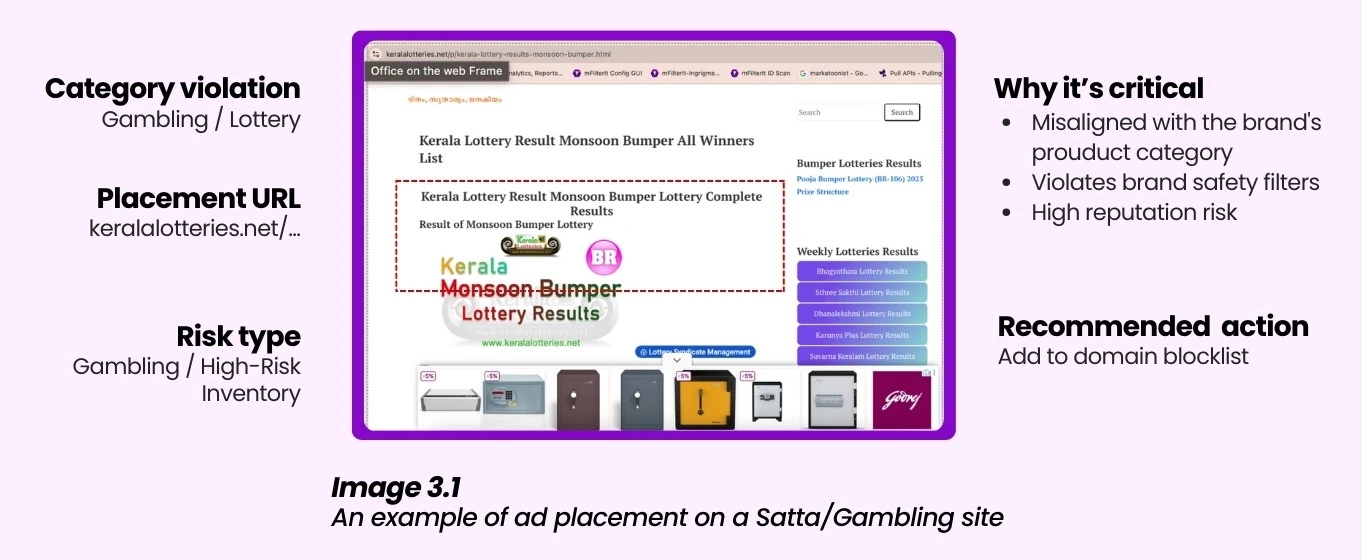
However, brand safety is ambiguous as the approach or definition of safety may vary from brand to brand and also from product to product that is being advertised. Thus, the approach taken by different brands, advertisers, or publishers also depends on two other related concepts:
Brand suitability
Brand suitability focuses on whether content aligns with a brand’s tone, values, and risk tolerance. Content may be safe, but still not appropriate for every brand.
Brand relevancy
Brand relevancy ensures ads appear in environments that make sense for the audience’s mindset, context, and intent.
Therefore, brand safety prevents ads from appearing next to harmful content. Brand relevancy and brand suitability help you ensure your ads appear next to not only safe but also contextually and sentimentally relevant content.
Why is Brand Safety Important in 2026?
The audience interacts with brands through ads and associates them with the content alongside. However, with digital advertising controls shifting from manual placements to algorithm-driven distribution, content is no longer static. User-generated videos, regional language content, short-form media, live streams, and AI-assisted content now dominate digital platforms.
Furthermore, in the era of AI, content is created, amplified, and modified quickly. This also means misinformation and disinformation also spread faster than ever, making it harder for brands to distinguish credible environments from misleading or manipulated ones.
Consumers don’t separate ads from the content around them. That is why, when an ad appears next to questionable or misleading content, the negative association sticks, often subconsciously.
What are the Risks of Brand Safety Violation?
The impact is not always immediate or dramatic. More often, brand safety failures lead to:
- Loss of trust as users start doubting the brand
- Wrong brand perception due to controversial or risky surrounding content
- Lower engagement because users ignore ads in unsafe environment
- Poor brand recall because the brand is remembered negatively or not at all
- Weaker campaign results such as lower clicks and conversions
- Wasted ad spend on impressions or views that bring no real value
- Higher compliance risk, especially for regulated industries
- Long-term damage to brand value, which is hard and costly to fix
Brand safety issues can cause instant backlash, weaken brand reputation, credibility, and create damage that is harder to reverse easily.
Who Should Care About Brand Safety and Related Issues?
Brand safety is a shared responsibility. Ensuring safe ad placements is not just a one-person job. It affects everyone involved in the digital advertising ecosystem. Therefore, everyone, including advertisers, publishers, agencies, and ad platforms, plays a distinct role in keeping advertising environments safe, credible, and effective.
Advertisers: Protecting Brand Trust and Long-Term Value
Advertisers face the most visible and immediate risk when brand safety filters fail. When an ad appears next to inappropriate, misleading, or unsafe content, consumers don’t blame the platform or the algorithm; they associate the experience with the brand.
For example, if a baby product ad shows up next to a terrorist attack video will instantly feel out of place. If advertisers don’t actively monitor such placements, the impact goes beyond reputation. Media budgets get wasted on low-quality environments; engagement drops, and
performance metrics become misleading. Over time, this erodes brand equity that took years to build.
Therefore, for advertisers, brand safety is not just about avoiding embarrassment; it’s about protecting trust, credibility, and ROI.
Publishers: Maintaining Credibility and Revenue Potential
Publishers depend heavily on advertiser confidence. When a website, app, or channel becomes known for hosting unsafe, misleading, or low-quality content, advertisers start pulling back, even if the publisher has strong reach or traffic.
For instance, publishers running sensational or unverified content may still attract impressions, but premium advertisers often avoid such environments. This leads to lower CPMs, reduced demand, and long-term monetization challenges.
If publishers don’t prioritize brand safety, they risk being labelled as unsafe or low-quality sites. Once that perception sets in, it becomes difficult to attract high-value advertisers again.
Therefore, for publishers, brand safety is directly linked to credibility, sustainability, and long-term revenue growth.
Agencies: Preserving Client Trust and Strategic Value
Agencies are responsible for planning, buying, and optimizing digital campaigns for various brands. Clients trust agencies not only to drive performance, but also to protect their brand image.
When brand safety issues occur, agencies often face difficult questions about why placements were not monitored closely, or why risks were not flagged early. Even if the issue originated from platform automation, it still impacts the agency’s credibility.
For example, repeated brand-unsafe ad placements can make clients question whether their agency truly understands their brand values and risk tolerance. This can strain relationships and reduce the agency’s role to execution rather than strategy.
Therefore, by proactively managing brand safety, agencies strengthen their position as trusted advisors, not just media buyers.
Ad Platforms: Balancing Scale with Responsibility
Ad platforms enable massive reach and efficiency, but with scale comes increased risk. Millions of ads are placed across billions of pieces of content, much of which is created and updated in real time.
While platforms provide standard brand safety controls, they are often broad and generalized. They cannot fully account for every advertiser’s unique brand values, industry regulations, or regional sensitivities.
If brand safety is not handled carefully at the platform level, it can lead to advertiser distrust, stricter regulations, and increased scrutiny from brands and regulators alike.
Therefore, brand safety is essential for maintaining advertiser confidence, platform credibility, and long-term ecosystem health.
What Modern Brand Safety Strategies Must Include?
Brand safety strategy is not just about avoiding ad placements besides the obvious “unsafe/irrelevant” content; it’s about actively understanding, monitoring, and managing risk at scale. Modern approaches go beyond keyword blacklists to make sure your ads not only avoid harm but also land in environments that enhance brand value and performance.
This is where advanced brand safety solutions play a critical role. Such tools proactively help in identifying and mitigating brand safety risks in real time. Here’s how:
Contextual and Relevancy Analysis
Traditional brand safety tools relied heavily on ad blocking based on unsafe keyword lists, which often missed contextual relevance. A modern strategy uses contextual targeting to understand the meaning of the content around placements. This means evaluating tone, sentiment, topic, and even cultural cues so that ads don’t run beside content that may inadvertently harm perception, even if it’s not explicitly “bad.” This includes:
- Detecting sarcasm or misinformation
- Frame-by-frame analysis of videos
- Distinguishing neutral discussion from harmful narratives
- Ensuring placement matches audience intent
Learn why brand safety matters more than ever on video platforms
Omni-Channel Coverage
Brand safety today cannot be siloed. It must work across every place your brand runs ads, including web and mobile sites, social media feeds, video platforms like OTT, CTV, and short-form video, and in-app placements.
Each channel has unique risks and signals. A comprehensive brand safety solution scans and protects your brand across all these touchpoints in real time.
Proactive Detection and Prevention
Instead of waiting for damage to show up in reports, modern strategies focus on proactive detection by scanning brand environments before ads go live, using AI/ML to identify emerging unsafe patterns, and blocking risky placements before impressions are served.
This shift from reactive defense to proactive protection helps brands avoid negative associations and costly brand reputation impacts.
Customizable Exclusion Controls
Not all brands have the same risk tolerance. What might be acceptable for one category may be unsuitable for another. Modern brand safety must allow:
- Flexible exclusion lists for specific keywords, topics, or channels
- Custom filters based on geography, language, or cultural nuances
- Brand-specific thresholds determined by risk appetite
This ensures your strategy aligns with your brand values, not a one-size-fits-all approach.
Advanced Blacklisting and Whitelisting
Dynamic blacklists and whitelists are essential to stay ahead of evolving threats. Blacklists should adapt to new unsafe environments, including fake or MFA sites. On the other hand, whitelists help prioritize placements that are verified as brand-safe and contextually relevant. This dynamic approach prevents over-blocking (which shrinks reach) and under-blocking (which introduces risk).
Understand in detail how to avoid overblocking and underblocking of ad placements.
Regional and Cultural Sensitivity
Global campaigns encounter varied cultural norms and sensitivities. Content that is safe in one market might be controversial in another. Advanced brand safety must include regional detection and classification, capable of understanding local languages, vernacular content nuances, and market-specific content patterns. This prevents missteps that could damage perception in a particular region.
Measurement and Insights for Future Decisions
Brand safety isn’t just about blocking risk; it’s about learning patterns and improving future performance. Strategies should include:
- Reporting on where unsafe placements were avoided
- Insights into why certain categories were flagged
- Analysis connecting placement contexts with engagement outcomes
This data informs smarter decisions over time and enhances campaign planning.
How mFilterIt Helps to Ensure Brand Safety?
By incorporating all the above features, our advanced brand safety solution – PACE, moves beyond checklist compliance to become a strategic advantage, protecting reputation, improving audience engagement, and supporting media efficiency. In a landscape where content environments are vast, dynamic, and unpredictable, our smart, adaptive approach ensures your brand stays in control of where and how it is seen.
Conclusion
In the modern digital landscape, brand safety is not merely a concern for the players involved in the digital advertising supply chain world but has become a necessity for everyone associated. Moreover, every ad placement influences how a brand is perceived, trusted, and remembered. Without the right safeguards, even well-planned campaigns can quietly harm reputation and performance.
Now is the time to move from reactive fixes to a proactive brand safety approach. Evaluate how secure your current ad placements truly are and strengthen your campaigns to ensure your advertising builds trust, not risk.