
The affiliate economy in the Middle East and Africa is scaling fast; valued at USD 370.24 million in 2024 and projected to grow at a CAGR of 7.7% through 2031. For BFSI brands, this isn’t just growth; it’s a fundamental shift in how customer acquisition happens. (Source)
The numbers clearly indicate that affiliate partnerships and Direct Selling Agents (DSAs) have become foundational to BFSI growth across MENA. Yet, the same ecosystem driving acquisition can impact compliance posture and customer trust often without immediate visibility.
Previously, we explained the factors polluting campaign metrics with a real analysis of campaign data. Read Here
But fixing performance without addressing partnership risk is only a partial solution. Because even clean metrics can sit on top of brand impersonation or non-compliant messaging.
In a region as vast, linguistically diverse, and fast-moving as MENA, these risks do not surface easily. They secretly slip into digital noise, adapt to local contexts, and scale faster than most teams can track using traditional methods.
In this guide, we break down:
- How affiliates and DSAs can misuse marketing programs intentionally or otherwise
- How brand infringement in MENA is rising faster than most brands realize
- What BFSI brands must do to build visibility, control, and trust across their partner ecosystem
How Affiliates Manipulate BFSI Campaigns and Attribution
While the stats reflect brand’s reliance on affiliate programs, one thing that they cannot afford to ignore is the misuse of marketing programs by brand’s own partners. Some partners very strategically claim the conversions of traffic they did not influence on the first page. Here’s how it happens –
Brand Bidding Violations
Under brand bidding, brands bid on their keywords so that if users search for a product/service, their website ranks on search engine, making user journey to your website, seamless. In this, the core purpose of affiliates is to attract organic traffic to brand’s website that later converts and adds value to the revenue. However, many affiliates divert that organic traffic through brand bidding violations.
These affiliates quietly bid on brand’s keywords causing two-fold impact on brand –
- First, it increases the cost of the brand’s keyword bids, making paid search campaigns more expensive.
- Second, it diverts traffic that was already likely to reach the brand organically, forcing the brand to pay twice for the same user, once through higher acquisition costs and again through affiliate commissions.
Real World Use Case
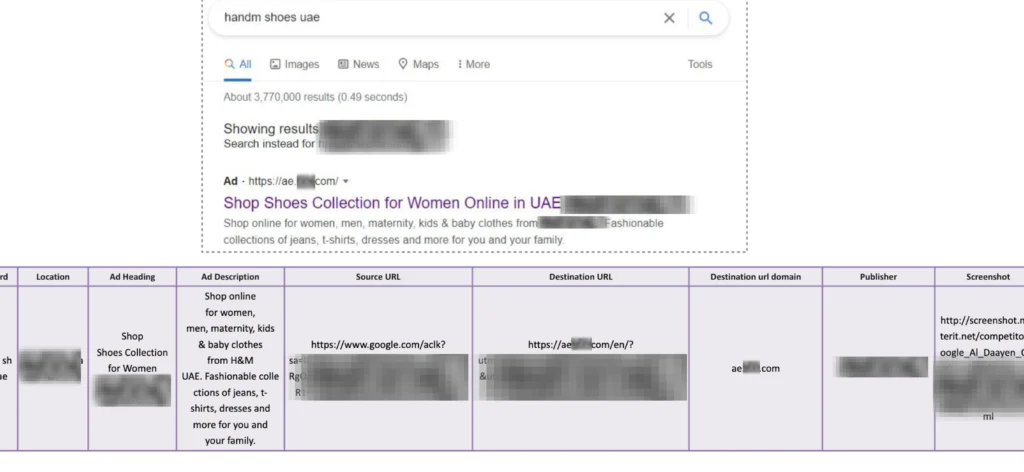
This is what we found in one brand’s case where an affiliate ad was running under brand’s name for a keyword the brand had already bid on.
When a user clicks on the affiliate ad, they are redirected to the brand’s website through an affiliate link, allowing the affiliate to claim credit and commission for traffic that would have reached the brand organically. This is also called organic hijacking.
Browser Extension
Another method that affiliates opt to claim wrongful attribution is dropping cookies in user’s browser extensions. Here’s how it goes a user has an extension (like coupon or deal tools) that silently triggers affiliate link without user’s permission. Hence, if a user makes any purchase from brand’s website, this link attributes the purchase to that affiliate.
How Brand Infringement Is Increasing Across MENA
Brand infringement is yet another very crucial factor for BFSI brands that they cannot overlook especially in a sensitive area like MENA. In markets, where digital adoption is growing at an unprecedented pace, even a single instance of fake listings, impersonation, or misleading brand communication can have far-reaching consequences.
Let’s know in what more ways the impact surrounds brands by creating a false angle around brand name.
Fake social media handles
Fraudsters create pages and profiles that closely mirror official brand accounts, matching names, logos, and messaging styles. These handles are used to push fake offers, fraudulent helpline numbers, and phishing attacks, misleading customers who engage in good faith believing they’re talking to the real brand.
Real world use case
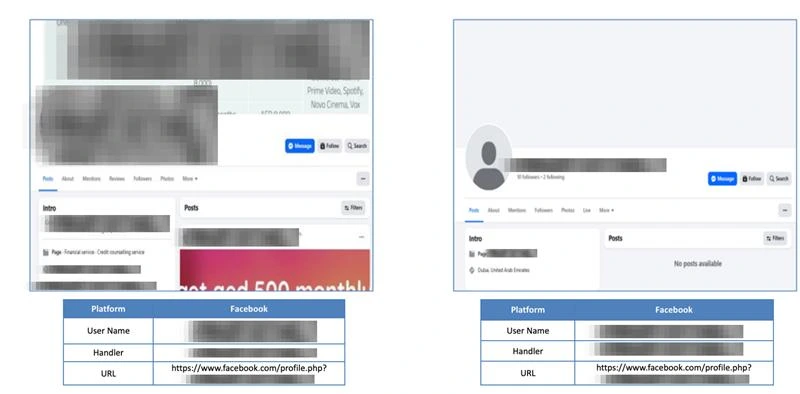
Suspicious social media handle of renowned bank of Dubai was discovered on Facebook where fraudsters were manipulating customers by using bank’s digital assets.
APK copycat apps
Cloned mobile apps replicate a brand’s interface, name, and user experience to deceive users into downloading them. Distributed outside official app stores, these fake APKs are used to steal login credentials, financial information, and sensitive personal data, posing a serious risk in markets where mobile is the primary touchpoint.
Phishing websites
Lookalike websites replicate official pages and login portals with enough accuracy to deceive users who aren’t scrutinising every detail. A minor domain variation is often sufficient. For BFSI brands especially, where customers routinely submit sensitive data through digital forms, the damage from a single phishing attack can be swift and far-reaching.
Logo misuse
Unauthorised use of brand logos and visual assets across rogue websites, affiliate pages, and social platforms lends false credibility to scams and fraudulent promotions. The familiar look is enough to make a scheme appear legitimate at first glance and repeated misuse gradually erodes the trademark’s legal strength and brand reputation.
Deepfakes and Synthetic identities
AI-generated videos, cloned voices, and fabricated identities are now being used by fraudsters for brand impersonation where these synthetic personas spread false investment advice, fake announcements, and scam communications at scale and by the time the content is debunked, the reputational damage is already done.
Misinformation and fake narratives
False claims, fabricated complaints, and manipulated stories about a brand can spread across digital channels faster than any correction can follow. For BFSI brands, misinformation around policy changes, rate updates, or security incidents can significantly dent public trust and algorithms keep surfacing these narratives long after they’ve been disproved.
For BFSI brands, where trust is the foundation of every customer relationship, any misdirect can invite irrecoverable repercussions.
The stats below highlight exactly this, the severity of brand infringement in MENA –
- 48% of infringement cases lead to revenue loss across BFSI and ecommerce sectors
- 72% of consumers lose trust after encountering fake or misleading brand content
- 7 in 10 MENA consumers hold the brand responsible, not the platform, for counterfeit or scam listings
These numbers highlight a simple but important reality: consumers rarely separate the platform from the brand being impersonated. When they come across fraudulent or misleading content, the loss of trust is directed at the brand itself.
What BFSI Brands Must Do to Bring Transparency in Affiliate Ecosystem
The reality is this: partnerships aren’t the problem; blind spots are.
Brands today are walking a tightrope. On one side, affiliates, DSAs, and partners are driving measurable growth. On the other, the same ecosystem introduces brand risk, compliance exposure, and fraud vectors that are increasingly difficult to detect. Shutting down partnerships isn’t an option. But continuing with fragmented, manual oversight isn’t viable either.
For years, brands have relied on traditional monitoring periodic audits, manual searches, isolated dashboards, and reactive reporting. It feels like control, but in practice, it’s full of gaps. Fraudsters don’t operate in silos; they move across platforms, languages, formats, and identities in real time. Meanwhile, brands are stuck switching between tabs, chasing signals that are already outdated. By the time a fake ad, phishing attacks, or impersonating handle is detected, the damage, lost revenue, broken trust, compliance risk, is already done.
What’s missing isn’t more effort. It’s a fundamentally different approach.
AI-led OSINT Based Framework: A Dire Need for MENA Brands
AI-led OSINT (Open-Source Intelligence) changes the equation for brands from reactive monitoring to continuous, intelligence-driven oversight. Instead of chasing threats, brands can build a unified layer of trust and transparency across every partner touchpoint without changing their ecosystem as OSINT based protection doesn’t demand any integration.
In practice, this looks like:
AI-Powered Threat Detection
AI models continuously scan the open web, marketplaces, social platforms, and ad ecosystems detecting patterns human teams would miss, from subtle logo misuse and affiliate link manipulation to coordinated fake narratives, flagging anomalies early rather than after escalation.
Multilingual OSINT for Regional Risk
In regions like MENA, multilingual OSINT is critical. Detection systems trained across Arabic, English, and hybrid dialects identify deceptive patterns that would otherwise bypass traditional keyword-based monitoring.
Speed & Automation at Scale
Speed is equally critical automation transforms response from days to minutes, triggering structured takedowns, escalating high-risk cases, and reducing dependence on manual intervention. This is risk containment at scale.
Contextual Intelligence, Not Just Detection
Detection with contextual intelligence not just tells what is suspicious but reveals why behind it as well. AI flags content based on IP misuse, tone deviation, redirect behavior, and inconsistencies, cross-referencing with internal brand assets to validate authenticity.
Unified Brand Footprint Visibility
Brands gain a unified view of their external footprint, with every brand mention, logo usage, affiliate ad, and social account mapped across channels creating a living intelligence layer. Combined with local expertise, this ensures even nuanced threats like culturally adapted scams or hybrid-language impersonations don’t slip through.
Conclusion
In a rapidly expanding affiliate ecosystem, growth without visibility is a liability. For BFSI brands in MENA, the real risk isn’t just fraud; it’s the silent erosion of trust driven by partner misuse and rising brand infringement. As threats become more sophisticated and decentralized, traditional monitoring falls short. The path forward lies in shifting from reactive control to proactive brand protection solution where every partner touchpoint is continuously verified, protected, and aligned with brand integrity.
FAQs
How do affiliates and DSAs impact BFSI marketing performance?
Affiliates and DSAs play a key role in customer acquisition, but unmanaged activities like brand bidding or misattribution can inflate costs, distort performance metrics, and affect campaign efficiency.
How do partners misuse marketing programs in BFSI?
Partners may misuse programs through practices like bidding on brand keywords, redirecting organic traffic via affiliate links, or using browser extensions to claim false attribution for conversions.
What is brand infringement, and why is it increasing in MENA?
Brand infringement includes fake social media accounts, phishing websites, copycat apps, and logo misuse. In MENA, rapid digital growth and linguistic diversity make it easier for such threats to scale undetected.
How can BFSI brands detect fake partners and brand impersonation?
Brands can identify such risks using AI-led OSINT solutions that continuously monitor digital channels, detect unauthorised assets, and flag suspicious patterns across regions and languages.
What are the key brand protection strategies for BFSI brands?
The most effective strategy is continuous, AI-driven monitoring combined with automated enforcement, multilingual detection, and unified visibility across all partner touchpoints.