Pricing in the travel industry moves faster than most teams can keep up with.
A difference of even ₹200 on a flight ticket is enough to lose a booking and send a potential customer straight to a competitor.
Pricing is a decision metric for customers, and pricing intelligence is what makes your platform compete with a strategy. If you don’t have a clear view of what your competitors are charging, you are losing potential bookings, burning discount budgets, and creating pricing gaps that directly impact margins.
This is what a major OTA platform was dealing with – limited visibility into competitor pricing across key routes. Continue reading to find out how we helped them identify the gaps using data as a service.
The Challenge: Limited Visibility into Competitor Pricing
This major OTA platform had limited visibility into what their competitor platforms were pricing flights at, in real time.
Their pricing optimization, discount updates were delayed and inconsistent. Sometimes they were underpriced, giving away margins unnecessarily. Other times, they were overpriced due to demand surge or other factors (which hikes prices – research a bit), sending customers to a competitor with a better deal.
However, without consistent pricing analysis, their aim was to stay competitive and to be considered by customers at all times.
The Fix: Proactive Data as a Service Using Pricing Intelligence to Map Exactly Where the Gaps Were
To address this, they partnered with mFilterIt to gain better visibility into what their competitors were doing as part of their pricing strategy.
Using DaaS (Data as a Service) feed, the pricing intelligence tool provided a structure data pipeline built on ecommerce analytics principles that gave the OTA platform a clear, side-by-side view of its own pricing vs a key competitor’s pricing across 100+ mapped flight sectors.
It also enabled an automated price gap detection system for quick discount recalibration. Whenever a pricing difference was mapped between the two platforms, the system flagged it automatically.
Here’s What the Data Actually Showed & Why It Matters for OTAs
Once the data started flowing, the insights were immediate, and the findings were structured across three clear layers of pricing.
Finding 1: Clear MRP gaps, the competitor was already pricing cheaper, even before the discounts were applied
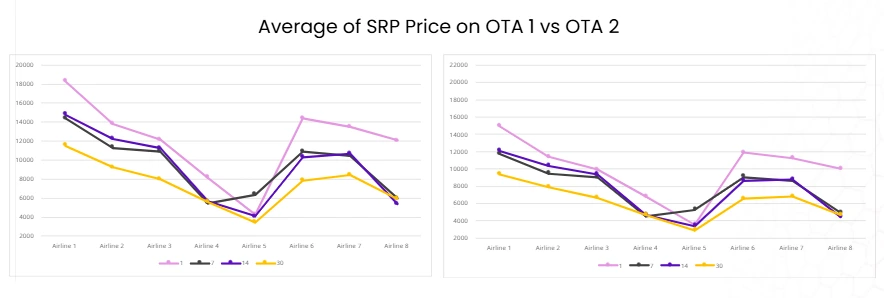
The first data set compared base ticket prices (the price before any coupon or offer is applied) across 8 airlines on both platforms. For several airlines, the competitor’s base price was consistently lower than the OTA’s.
Why does this data & insights matter?
- A higher base price puts you at a disadvantage before discounts are applied or even seen.
- Without competitor mapping, a systematic undercut on key routes can go undetected for months.
Finding 2: The competitors were giving bigger discounts on the same route flights
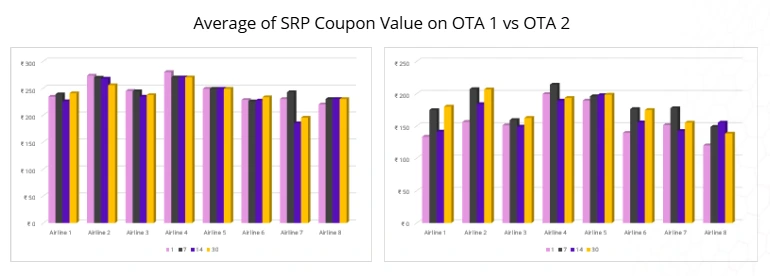
The second data set examined the coupon values (the discount amount each OTA was applying on top of the base price). This is where OTAs most actively compete, and the data showed the competitor was being significantly more aggressive with discounts on several airlines.
Why does this data & insights matter?
- If you don’t know how aggressively the competitor is discounting, you either lose bookings by under-spending or lose margin by over-spending.
- Platforms end up providing blanket discounts instead of targeted ones, which directly eats into margins.
Finding 3: The final price that customers saw were lower on the competitor’s platform
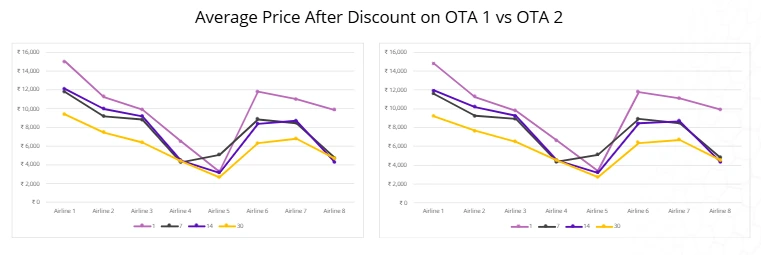
The third data set showed the price a customer sees when they’re ready to book, after all discounts have been applied. This is the number that makes or breaks a booking decision.
Why does this data & insights matter?
- The final price is the only number the customer acts on; if it’s higher than the competitor’s, nothing else on your platform matters for that booking.
- Route-by-route visibility into the final price gap gives the pricing team a clear, prioritized action list instead of broad, reactive fixes.
The same gaps exist across ecommerce too. Here’s what brands are missing.
The Outcome: How a Pricing Intelligence Tool Helps Identify Pricing Gaps
With the right pricing intelligence tool in place, the OTA platform was able to get a clear view of where gaps existed to make smarter decisions in both directions – when to discount and equally important, when to not.
Here’s how a pricing intelligence tool helps:
- Discount updates became faster and more targeted instead of blanket coupon changes. The team could identify exactly which airlines and routes had a gap worth closing and act on them immediately.
- Margin leakage reduced on routes where the OTA’s final price was already lower than the competitors. The team pulled back on unnecessary discounts entirely. Every rupee saved on an over-discounted route goes straight back to margin.
- Strategic price increases became possible when demand spiked on a specific route and competitor data showed rivals were also priced high; the OTA could price upward with confidence rather than holding prices down out of habit. Knowing when the market will bear a higher price is just as valuable as knowing when to discount.
- Price rank awareness improved. Not every route needs to be the cheapest option. With real-time data, the team could make a deliberate call to hold at rank #2 with a healthier margin rather than defaulting to the lowest price out of uncertainty.
- Competitive positioning strengthened across 100+ mapped sectors. The OTA moved from reacting to pricing problems to anticipating them, closing gaps before bookings were lost and capturing margin where the market allowed it.
The OTA platform was now able to anticipate pricing gaps and address them before customers had a reason to leave. This is what separates a reactive pricing team from a strategic one, and it starts with the right ecommerce analytics solution powering every decision.
Conclusion: Is Your Pricing Team Working with Complete Data?
If you’re in travel, e-commerce, or any industry where competitor pricing directly drives customer decisions, the question isn’t whether you need pricing intelligence. It’s whether you can afford to operate without it.
Talk to us about how pricing intelligence can work for your business.
FAQ,s
What is data-as-a-service (DaaS) in OTA pricing intelligence?
DaaS provides real-time OTA pricing data through cloud platforms, helping businesses access and analyze market insights without managing complex data infrastructure.
How can businesses detect pricing discrepancies across OTAs?
Businesses can use automated tools to track and compare prices across OTAs, quickly identifying inconsistencies, and maintaining pricing accuracy across all channels.
Can pricing intelligence tools improve revenue management strategies?
Yes, they offer insights into competitor pricing and demand trends, helping businesses optimize rates, increase bookings, and maximize overall revenue.
How does OTA pricing intelligence help travel businesses stay competitive?
It enables real-time competitor tracking and dynamic pricing adjustments, ensuring businesses remain competitive and attract more customers.
How does real-time data impact OTA pricing decisions?
Real-time data allows quick response to market changes, helping businesses adjust prices instantly and improve revenue optimization.