
Affiliates only get paid when a user takes a defined action, a lead, an install, or a purchase. So, the traffic must be intent-driven?
But that’s not the case everytime. Why? Because affiliate fraud exists. And it’s more common and sophisticated than marketers realize.
Fraudsters manipulate the payment models by generating fake traffic, fake leads, bot installs, duplicate accounts, organic hijacking, etc. The catch is they make all this look legitimate that makes ad fraud even more difficult to detect.
Therefore, in this blog, we are going to break the myth about affiliate marketing most advertisers still believe in.
Affiliate Traffic is Always High Intent.
The answer is not always. Affiliate traffic you’re paying for may not be as genuine as it appears. Continue reading further to know how affiliate traffic fraud impacts campaign performance.
What is Affiliate Fraud?
Affiliate fraud is when fraudulent affiliate partners manipulate the system to generate fake actions like leads, installs, or conversions that appear genuine. The purpose is to earn commissions without delivering value.
Effective affiliate fraud detection helps marketers identify and prevent such fraudulent activities before they impact campaign performance
Many affiliates prioritise volume over quality. Hence, the vulnerability to ad fraud and manipulation of results.
Here are some of the common affiliate fraud tactics they use
Lead punching
Fake or low-quality leads are submitted deliberately to trigger payouts. This is usually done using bots or fabricated data to fill in lead forms in bulk.
Cookie stuffing
Affiliates drop tracking cookies on a user’s browser through extension downloads, redirects, pop-ups, or hidden scripts. Users then get tagged with that cookie even though they never interact with affiliate’s content.
Know more about cookie hijacking in detail here.
Incentivized installs
Users are paid to install an app, with zero genuine interest in it. This happens when fraudulent affiliates use reward-based platforms or unapproved promotions on various platforms to drive installs, leading to high uninstall rates and lower LTV.
Referral and coupon fraud
Fake or duplicate accounts are created just to claim referral rewards. Affiliates exploit loopholes in referral or promo systems using multiple identities, devices, or disposable emails to generate repeated payouts.
Validation spoofing
Fraudulent signals are engineered to pass quality checks. This happens when attackers manipulate device data, IPs, or behavioral patterns to make fake leads appear legitimate during verification.
Bot-generated form fills
Automated bots fill out forms at scale to manufacture leads. Bots mimic human behavior to submit large volumes of fake entries, inflating lead counts without real user intent.
Organic traffic misattribution
Affiliates manipulate last-click hijacking attribution to hijack organic traffic and conversions. They inject tracking links at the final stage of a user journey, overriding the original source and falsely claiming credit for the conversion.
What Real Campaign Data Analysis by mFilterIt Reveals About Affiliate Fraud
Across audited campaigns, up to 35% of affiliate traffic shows signs of bot involvement, inorganic behaviour, or misattributed organic actions.
Case Overview 1: Lead punching by an automobile brand’s affiliate partner
A major global automobile brand was running affiliate campaigns to drive specific conversion events. In this case, customers completing a “cash thank you” or “lease thank you” action after a vehicle transaction.
The numbers looked fine from the outside. But when the campaign was audited, the findings were alarming.
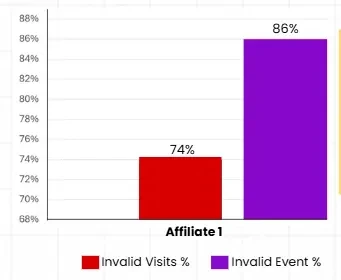
70% of all invalid traffic traced back to a single affiliate partner. That one partner had a 74% invalid visit rate, and an 86% invalid event rate. In plain terms: nearly 9 out of every 10 conversion events attributed to that affiliate were fraudulent.
The company had been paying for results that didn’t exist.
Case Overview 2: Referral coupon fraud under the name of a global petroleum brand
A global petroleum brand was running customer acquisition campaigns and spending well on them. But lead quality was still poor, and referral coupons were being flagged for suspicious activity.
When the mFilterIt SDK was deployed to analyse install-level data, the truth came out.
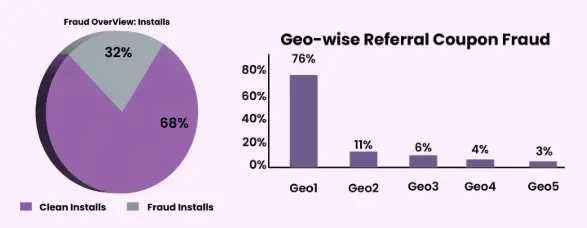
Of all the app installs that appeared to be clean and legitimate, 21% were actually referral coupon fraud. Automated bots or fake users were simply creating fake and duplicate accounts to claim referral incentives, with no intention of becoming actual customers. One geography alone accounted for 76% of that coupon fraud.
The Impact: How Affiliate Fraud Damages Your Business Outcomes?
When affiliate fraud goes undetected, the impact ripples across your entire marketing operation:
- Your sales pipeline fills with unqualified and fake leads that waste your team’s time.
- Your CPA and CPI benchmarks look artificially efficient, so you keep spending on the wrong sources.
- Your budget gravitates toward the channels “performing” best, which are often the most fraudulent.
- Channels that are actually working get defunded because they can’t compete with inflated affiliate numbers.
How to Protect Marketing Budget from Affiliate Fraud with mFilterIt’s Affiliate Fraud Detection Solution?
mFilterIt provides a full-funnel ad fraud detection solution that gives marketers visibility at every stage of the affiliate journey, not just at the click level, but all the way through installs, events, and conversions. It helps you:
- See where your traffic is actually coming from, identify underperforming or suspicious affiliate partners before they do more damage.
- Catch attribution manipulation, detect when genuine conversions are being falsely claimed by affiliates who had no real role in driving them.
- Spot incentivized users early, flag users who only took action to claim a reward, with zero intention of sticking around.
- Monitor referral and coupon activity in real time, identify patterns of abuse before they inflate your acquisition numbers.
- Validate traffic before it enters your funnel, filter out bots, fake devices, and spoofed signals at the pre-install stage itself.
The result?
You stop paying for performance that was never real and start making budget decisions based on data you can actually trust.
For a deeper look at how affiliate fraud shows up across different campaign types and what to watch for at each stage, read our complete Affiliate Fraud Guide for Marketers.
Conclusion
Affiliate marketing isn’t the problem. Blind trust in it is.
When you assume every action is genuine, fraudsters win. When you start auditing affiliate data correctly, you take control back and start seeing genuine results.
Your affiliates should be working for your growth. Not against it.
Find out what your affiliate partners are driving for you and how much of your affiliate spend is delivering real results. Connect with mFilterIt experts now.
Frequently Asked Questions
What is affiliate fraud and how does it work?
Affiliate fraud is when fraudulent affiliates manipulate the payout system to earn commissions without delivering real users. They do this by generating fake leads, bot installs, duplicate accounts, or stealing credit for conversions that would have happened organically.
What are the most common types of affiliate fraud?
The most common types of affiliate traffic fraud include lead punching, cookie stuffing, incent fraud installs, referral and coupon fraud, validation spoofing, bot-generated form fills, and organic hijacking, etc.
Is affiliate marketing safe for advertisers?
Affiliate marketing is a legitimate and effective channel, but it carries real fraud risk if left unmonitored. Campaigns audited by mFilterIt found up to 35% of affiliate traffic showing signs of bot activity or misattribution. With the right fraud detection in place, it can be both safe and highly efficient.
What is lead punching in affiliate marketing?
Lead punching is when affiliates deliberately submit fake or low-quality leads, often using bots or fabricated data, to trigger payouts. The leads look real enough to pass basic checks but have no genuine intent behind them, leaving your sales team chasing dead ends.
What is referral coupon fraud and how does it work?
Referral coupon fraud happens when fake or duplicate accounts are created solely to claim referral incentives or promo codes. Fraudsters use multiple identities, disposable emails, or bots to repeatedly exploit the same referral system and inflate acquisition numbers.
What is organic traffic misattribution in affiliate campaigns?
Organic traffic misattribution or organic hijacking is when affiliates inject their tracking links at the very last stage of a user’s journey, right before a conversion that was going to happen anyway. This lets them falsely claim credit for organic conversions, meaning you end up paying affiliate commissions for users you would have acquired for free.
What is full-funnel ad fraud detection?
Full-funnel ad fraud detection means validating ad traffic quality at every stage of the user journey, from the initial click, through the install or form fill, all the way to the conversion event. Most basic tools only check at the click level, which means fraud happening deeper in the funnel goes completely undetected.