When a media team says, ‘we’re running a pan-India video campaign,’ they’re treating India as a single content environment. But it isn’t.
India is a diverse market. Millions of content pieces go live on various video platforms every day. Each operating in a different language, shaped by different cultural norms, with entirely different definitions of what is acceptable, sensitive, or harmful.
This is exactly where the risk begins.
As an advertiser running programmatic ad campaigns across video platforms, you assume your targeting and exclusions are doing their job. But even as you read this, your ads could be appearing next to content you would never consciously choose to appear beside.
A vashikaran tutorial. A graphic crime reconstruction video. Content in a language your brand safety tool cannot read.
And the most concerning part? Traditional brand safety tools and platform filters don’t show you this side of reality.
To help you identify this gap before it turns into a brand risk, this blog breaks down:
- What unsafe ad placements actually look like in India’s content ecosystem
- Why your current brand safety tools are missing them
- What India-ready brand safety requires
- What changes for your brand when you get it right
Let’s start with what’s actually happening to your ads.
What Content Ad Placements Are Your Ads Actually Running Next To?
You didn’t choose these ad placements. But your brand is on them.
When advertisers try to tap onto wider audiences through ad campaigns, they approve creatives, audiences, and budgets. They almost never see where their ads actually land.
Here are the placement categories that brands in India often appear next to, without knowing it.
Placement 1: Occult, Black Magic & Superstition Content
What is it?
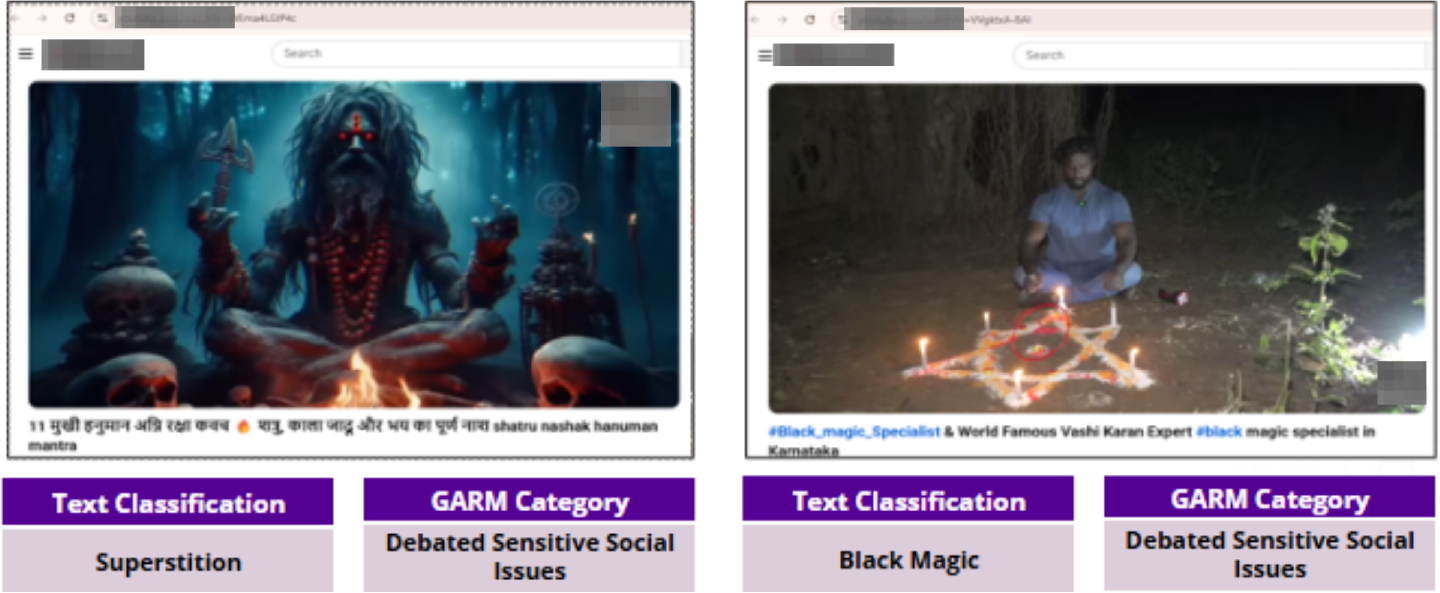
Channels dedicated to vashikaran rituals, black magic spells, tantric practices, and superstition-based content. These videos use occult imagery, ritual settings, and fear-based messaging to attract millions of views across regional markets.
Why it’s unsafe?
These channels are algorithmically treated as general interest content. Platform classifiers read the title and tags, and often miss what the content actually depicts. A brand’s ad plays in the middle of a black magic ritual video, not because anything went wrong technically, but because nothing flagged it.
Brand Impact
For FMCG, BFSI, or any brand built on consumer trust, appearing next to content that promotes supernatural harm, fear, and occult practice directly contradicts the brand’s credibility. Viewers in these markets don’t separate the ad from the content. If your brand appeared there, it’s perceived as endorsing it.
Placement 2: Made for Kids & Cartoon Content
What is it?
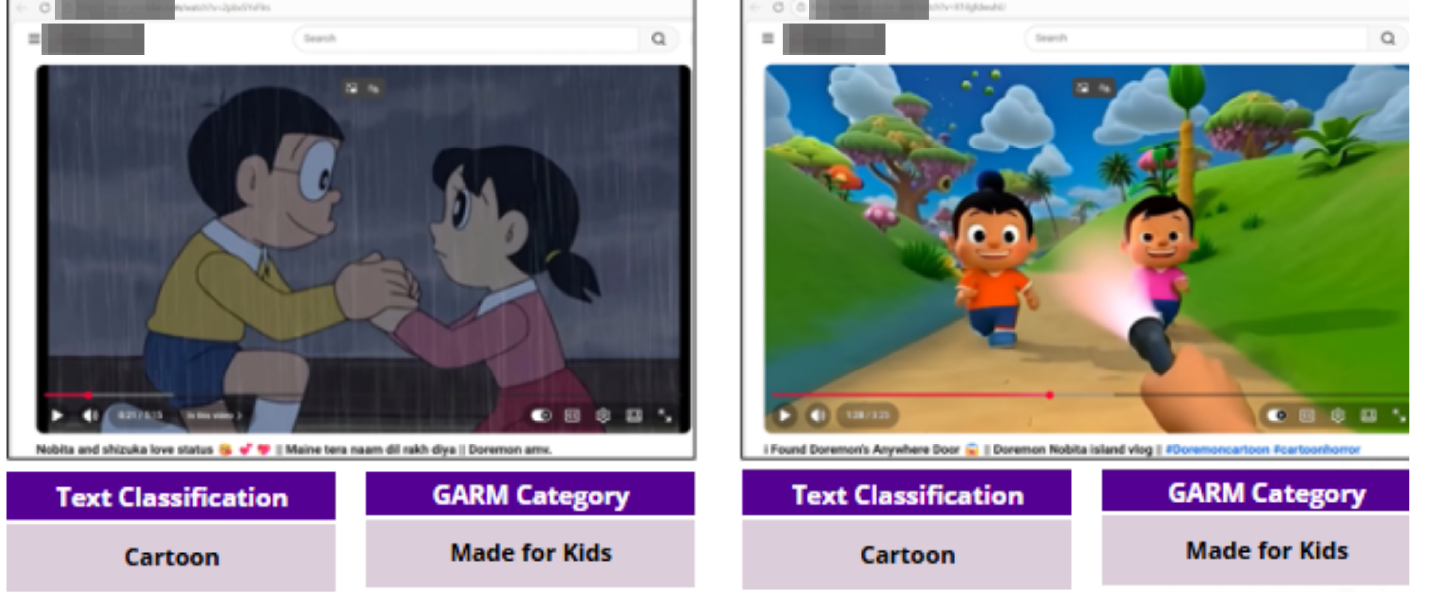
Children’s cartoon channels or animated content, that are classified by platforms as “Made for Kids.” These channels attract massive viewership across markets and are frequently part of broad run-of-network campaigns.
Why is it unsuitable?
“Made for Kids” content limits ad personalization, meaning your ad is reaching an unintended, non-converting audience. More critically, a brand running campaign for financial products, or adult-oriented services appearing on children’s content creates an immediate brand suitability issue.
Brand Impact
Every impression served on such content is a direct drain on campaign budget with zero return, no conversion intent, no brand recall, and no audience value. You end up paying for reach that does nothing for your brand.
Placement 3: Adult & Sexually Suggestive Content
What is it?
Adult fashion content or OTT platform trailers that appear as standard video inventory across platforms. These videos carry no explicit adult content warning but contain visually suggestive material such as nudity, intimate couple scenarios, and adult-oriented fashion that platforms routinely monetize as general content.
Why it’s unsafe?
The problem here is a categorization gap. This content doesn’t meet the threshold for explicit adult content, so it doesn’t get flagged. But it is still considered under a brand-unsafe zone for most advertisers, particularly family-facing categories.
Brand Impact
When a trusted brand ad appears mid-roll on adult suggestive content, the viewer’s perception shifts immediately. The brand is no longer seen as careful or credible. For brands that spend heavily on trust-building, the reputational cost of a single misplaced impression, when screenshotted and shared, far exceeds the media value of the placement.
Placement 4: Regional or Vernacular Content
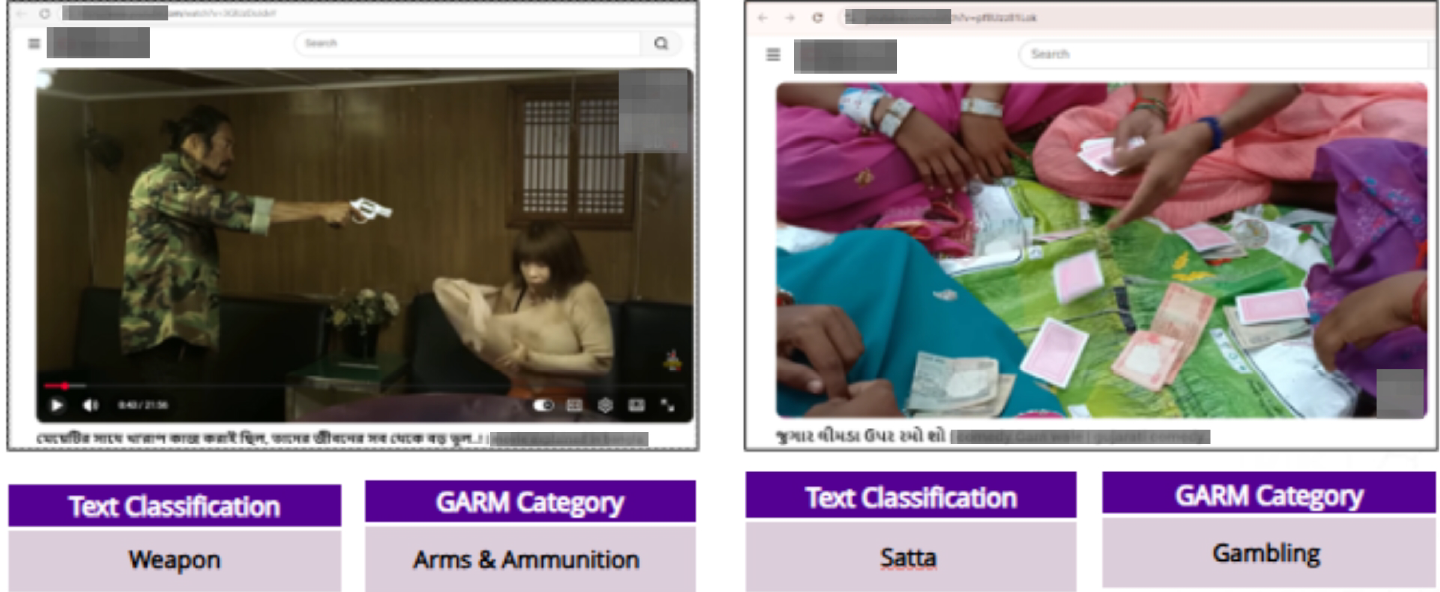
What is it?
Regional language videos, in Bengali, Gujarati, and other vernacular languages, that depict weapons and armed violence in dramatized formats or normalize illegal gambling and Satta culture as regional entertainment.
Why is it unsafe?
Such content never triggers standard brand safety filters. A Bengali crime thriller and a Gujarati Satta video look identical to a global classifier; both are regional language videos with no English tags to read. Traditional brand safety tools cannot identify the content category, the cultural context, or the risk the placement carries.
Brand Impact
A brand appearing next to a video depicting a man pointing a gun at a woman, or next to content that normalizes illegal gambling, signals a complete lack of campaign oversight. For any brand associated with responsibility and trust, these placements directly undermine the credibility being built through every other brand touchpoint.
Why Traditional Brand Safety Tools Miss Seeing Irrelevant or Brand-Unsafe Ad Placements?
Here are the reasons why basic brand safety platform filters and tools fail to identify brand unsafe ad placements:
Can’t read regional languages
Most tools scan video titles and tags to check for unsafe content. If a vashikaran video is titled entirely in Hindi script with no English text, the tool finds nothing to read, marks it as safe, and your ad runs.
Loses accuracy in translation
Some tools translate regional content into English before checking it. But slang, coded phrases, and culturally loaded words don’t translate accurately. By the time the tool reads it, harmful content looks completely harmless.
Moreover, some phrases or words that might appear to be safe in one region can be controversial or unsafe in another.
Relies only on metadata, titles, and tags for classification of content
Tools that only read titles and descriptions miss what is actually inside the video. A video titled “family entertainment” can contain graphic or inappropriate visuals. Without frame-by-frame analysis, the tool fails to identify what’s exactly inside the video.
Misclassification of content without cultural context
Surface-level detection gets it wrong in both directions. A Sundarkand devotional video gets flagged as adult content because of a bare-chested deity. A Tom and Jerry cartoon gets flagged for violence. A breastfeeding tutorial gets flagged for nudity. All three are safe, but a context-blind tool can’t tell the difference.
Lacks sentiment analysis of the content
A video can be brand-safe in content but completely wrong in tone — fear-driven, polarising, or deeply negative. Tools that don’t measure sentiment place your ad inside an emotional environment that works against your brand message.
What India-Ready Brand Safety Strategy Actually Looks Like?
India-ready brand safety isn’t about applying more restrictions. It’s about applying the right intelligence, built specifically for the linguistic complexity, the cultural nuance, and the speed of India’s regional content ecosystem. This is what mFilterIt’s brand safety solution – Pace is built to deliver. Here’s how:
| Capability | What it Means | How it Works |
|---|---|---|
| Vernacular-First Intelligence | Classification models trained on regional languages instead of relying on English metadata | Captures unsafe content in Hindi, Tamil, Telugu, Bhojpuri and more, where most global brand safety tools fail |
| Regional Context Understanding | Deep understanding of region-specific content categories and cultural nuances | Differentiates between what looks unsafe and what actually is unsafe in a local context |
| Content + Context + Sentiment Analysis | Multi-layered analysis that evaluates what the content is, what it means, and how it feels | Prevents misclassification and ensures your brand appears in the right emotional environment |
| Frame-Level Video Analysis | Analyzes actual video frames instead of relying only on titles, tags, or descriptions | Detects misleading or disguised content where metadata does not reflect reality |
| Advanced ML-Based Classification | AI/ML models trained on regional corpus and evolving content patterns | Keeps up with India’s rapidly changing content ecosystem and emerging risk categories |
| Real-Time Detection & Blocking | Identifies unsafe ad placements during live campaigns and adds them to exclusion lists instantly | Prevents damage before it happens, not after reporting |
| Dynamic Blacklisting System | Continuously updates unsafe channels, videos, keywords, and categories | Ensures ongoing protection as new unsafe content emerges |
| GARM-Compliant Classification | Classifies content into global brand safety categories like adult content, violence, hate speech, etc. | Aligns global standards with local execution for consistent safety benchmarks |
What Changes When You Get Brand Safety Strategy Right?
When your ads only run next to safe, contextually relevant content, the results compound for your brand and your campaign metrics.
- Your brand stops funding content it would never choose.
- Every placement aligns with your brand’s identity, values, and audience expectations.
- No spend is wasted on unsafe or irrelevant placements that deliver zero value.
- You go deeper into regional India with confidence.
- Audiences who encounter your brand in the right context are more engaged, and more likely to convert.
Conclusion
Branding ad campaign strategies are no longer limited to one audience or one content standard. So, your brand safety strategy can’t be relied on either. The risk isn’t just where your ads appear, but what they come to represent in the eyes of your audience. Brands that continue relying on global-only frameworks will keep operating with blind spots in the markets that matter most.
The opportunity is clear: build for India as it actually exists.
If you want to see where your ads are truly running, and how to fix it, start auditing your campaigns with India-ready brand safety intelligence today.
Talk to our mFilterIt experts today.
FAQ,s
What is a brand safety strategy in digital advertising?
A brand safety strategy defines guidelines and tools to ensure ads appear in appropriate environments, protecting brand reputation and preventing association with harmful or irrelevant content.
What are unsafe ad placements and why do they matter?
Unsafe ad placements occur when ads appear alongside harmful or inappropriate content. They matter because they can damage brand image, reduce trust, and negatively impact campaign performance.
How does poor brand safety impact brand reputation and ROI?
Poor brand safety can harm brand credibility, reduce customer trust, and lead to wasted ad spend, ultimately lowering campaign effectiveness and return on investment.
What role does AI play in detecting unsafe ad placements?
AI analyzes content in real time to identify risky or inappropriate environments. It helps automate detection, improve accuracy, and ensure ads are placed in brand-safe contexts.
How can real-time monitoring improve brand safety in campaigns?
Real-time monitoring detects unsafe placements instantly, allowing advertisers to take quick action. It minimizes risks, protects brand reputation, and ensures ads appear in suitable environments.