
“I have a bunch of shady affiliates bidding on our brand search keywords. Every time I ban them, they come back with a new account. I spend hours searching manually on incognito windows, geo-switching, digging URLs, and still miss half of them. Meanwhile, the CAC for our brand keywords keeps rising for no real reason, draining budget and even hijacking our organic traffic.”
Many marketers find themselves stuck in this exhausting loop: ban one affiliate for bidding on your brand terms… only to see them resurface under a new account the next day. Despite hours spent checking different SERPs, tracing URLs, or monitoring CPC fluctuations, a significant portion of this activity still goes undetected.
Frustrating, right?
What makes it worse is the assumption that traditional SEO or analytics tools can catch brand bidding violations. They can’t. Affiliates rotate accounts, cloak redirects, and trigger ads only in specific regions; tactics that most visibility tools were never designed to detect.
Let’s understand the problem and solution in detail.
What is Brand Bidding in Affiliate Marketing? Why Affiliates Bid on Your Brand Search Keywords?
Brand bidding is when someone runs paid search ads targeting your branded keywords (your company name, product names, or trademarked terms) to intercept users who were already looking for you.
Affiliates bid on brand keywords for the same reason – to divert organic users to their links, stealing the attribution of a traffic source that was directly coming to your brand’s website.
According to our 2025 analysis, we have found that 40-50% of affiliate traffic is generated using invalid patterns. (Source: FICCI EY Report 2026)
Your brand terms cost less, are high-intent, and convert far better than generic keywords. This makes an easy shortcut technique for affiliates to boost their numbers without putting in real effort. Instead of driving genuine incremental traffic, they piggyback on the demand you’ve already created through your own marketing.
In performance marketing programs, brand keyword violations are among the most common and costly forms of affiliate abuse often going undetected for weeks or even months.
Here’s why it gets even more difficult to detect affiliate brand bidding:
- Affiliates rarely use one stable link. They create multiple domains, subdomains, sub-IDs, and tracking variations to stay undetected.
- They rotate multiple accounts quickly. Even if you ban one, another pops up immediately exhausting marketers trying to track these fake accounts.
- They trigger most ads only when you are not looking, like during night hours, in specific cities, and on certain devices, timing chosen to avoid manual detection.
- Affiliates scale brand bidding activities aggressively during high-demand periods (sales, launches, festive shopping windows) when the value of each conversion is higher to earn more payouts.
The result? Rising CPCs and higher CAC. And unless you have visibility into every link and every identity behind the ads, the cycle continues.
Get a deeper understanding of affiliate fraud. Explore our complete guide for marketers.
Can Standard Marketing & Analytics Tools Track Affiliate Brand Bidding Violations?
No, the standard marketing tools cannot detect brand bidding violations. They can provide signals based on data, but miss the kind of visibility required to ensure enforcement and affiliate compliance in search campaigns.
|
What Traditional Tools Can Track |
What They Cannot Catch |
|
Which advertisers appear on search results |
Real-time brand bidding abuse |
|
Old ad copies and landing pages |
Hidden geo- or device-specific ads |
| Keyword trends and impression data |
Affiliate IDs and masked redirects |
|
Competitor activity and estimated spend |
Rotating accounts behind the ads |
|
Long-term campaign patterns |
Proof needed for affiliate enforcement |
|
Overall search market trends |
Cloaking and hidden redirects |
| Regular campaign activity |
Short burst campaigns during peak hours |
| General competitor insights |
Repeat offenders using new identities |
What Traditional Marketing and Analytics Tools Can Detect?
- Show which domains or advertisers appear in your auction over time.
- Provide historical ad copies and landing-page snapshots when captured during routine crawls.
- Reveal keyword-level insights such as search share, impression trends, and estimated spend.
- Help you understand broad auction dynamics and track competitors running stable, long-term campaigns.
These insights are useful for market visibility and strategy, but they only reflect a portion of what’s happening.
What Traditional Marketing and Analytics Tools Cannot Detect?
Affiliates don’t follow a stable pattern for brand bidding abuse. It is fast, fragmented, and intentionally designed to stay hidden. Here’s what they miss:
- Cannot monitor brand bidding violations in real time.
- Fail to capture ads targeted to specific geos, devices, or audiences that only some users see.
- Don’t identify affiliate sub-IDs, masked redirects, or rotating accounts behind the ads.
- Don’t capture thousands of tiny link variations or provide the forensic evidence (screenshots, redirect chains, timestamps) needed to enforce affiliate rules or deny payouts.
- Cannot detect cloaking in brand bidding, where a clean page is shown to you, but a redirect is shown to the user.
- They don’t track short-lived “burst campaigns” during nights, weekends, or peak sale hours.
- Fail to map patterns of affiliate brand bidding abuse, such as repeated offenders switching identities or redirect networks working in clusters.
Why Marketers Need an Advanced Affiliate Monitoring Tool to Detect Brand Bidding?
An advanced AI/ML-based affiliate monitoring tool is specifically built to offer visibility and transparency across all affiliate activities. Here’s what all provides:
- Continuously monitors brand keywords across multiple geo locations and devices. 24/7 coverage, not periodic scans.
- Detects hidden or time-specific ad triggers. It can catch short bursts and late-night campaigns.
- Captures every link and ad variation, even thousands of them. Including tracking parameters, sub-IDs, and UTM permutations.
- Identifies the source of each violation by mapping the publisher, sub-publisher, affiliate ID, or the redirect owner behind the ad.
- Generates enforceable evidence. Full screenshots, timestamps, and the redirect/log trails that serve as proof.
- Alerts you immediately when an unauthorized ad appears. Proactive notifications that allow fast action.
- Provides daily/weekly reports for pattern detection. Aggregate findings into actionable intelligence for program decisions and payout validation.
Check out the affiliate monitoring audit checklist every brand needs for fraud-free growth.
Foxtale’s 21% CPC Dropped: How mFilterIt Helped Them Combat Brand Bidding
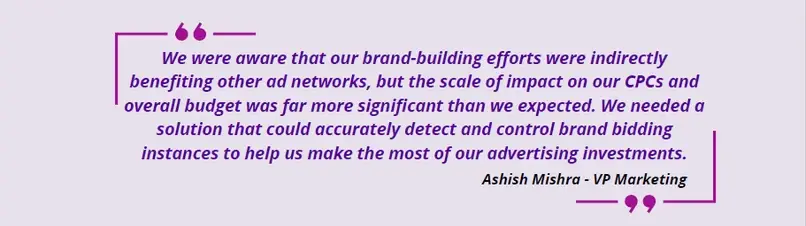
Foxtale, the fast-growing skincare brand, invested heavily in TOF and video campaigns to boost search volumes and drive high-intent users to their website. However, they noticed CPCs were rising on brand search terms by 25–30%, even though demand was strong. Search scalability was getting harder, and ROAS was dropping.
The Challenge
- Ad networks and affiliates were secretly bidding on Foxtale’s brand terms.
- Manual checks barely caught a fraction of what was happening.
- High-intent traffic was being hijacked, increasing Foxtale’s acquisition costs.
What Monitoring Revealed
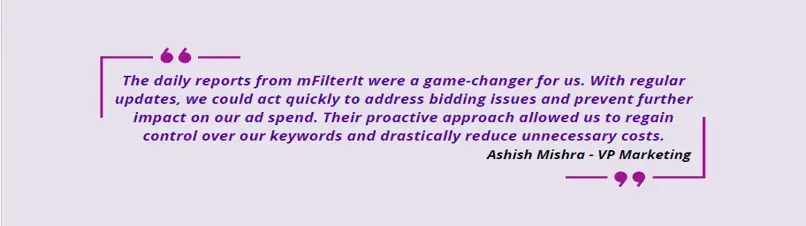
- 3,436 unique links were found bidding on Foxtale’s branded keywords.
- Many ran only in specific locations or time windows.
- Daily evidence-based reports helped the team take action immediately.
The Results
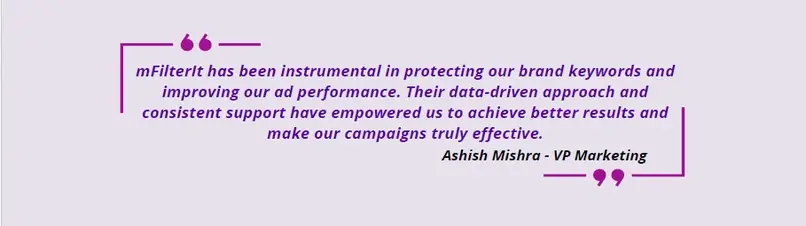
Within weeks, Foxtale saw a 21% drop in CPC, improved ROAS, and clearer visibility into which affiliates were driving genuine traffic versus hijacked clicks. This also helped the brand optimize payouts, ensuring partners were rewarded only for clean, incremental conversions.
Read the detailed case study here
Way Forward: Automate Your Affiliate Monitoring Strategy Before the Problem Scales
Brand bidding abuse isn’t slowing down; affiliates are getting smarter and faster. What used to be a simple compliance issue has now turned into a full-fledged performance leak, driven by rotating accounts, cloaked redirects, hidden URLs, and thousands of link variations designed to claim payouts they haven’t earned.
At this point, relying on manual checks or traditional SEO/PPC tools isn’t enough. Brands need automated affiliate monitoring tools that can track brand bidding violations proactively, identify who is behind each link, and give verifiable evidence to manage payouts fairly.
Automating this layer ensures your branded traffic stays protected, your CPCs stay stable, and your affiliate program stays clean, and performance driven.
Stop affiliates from hijacking your branded traffic and draining your marketing budget. Talk to our experts today.
Frequently Asked Questions
Why do affiliates bid on my brand search terms?
Affiliates bid on branded keywords because they convert at a higher rate and cost less than generic terms. By hijacking this traffic, they can inflate their conversions and commissions without adding any real value.
What is brand bidding in affiliate marketing and how does it affect my ad budget?
Brand keyword hijacking happens when affiliates bid on your brand terms to capture organic traffic. This increases CPCs, inflates CAC, and forces you to pay commissions on conversions that were likely going to happen anyway. Over time, it also distorts attribution data and creates a false picture of affiliate performance.
Why is it so hard to detect brand keyword hijacking manually?
Affiliates often use tactics like geo-targeting, device targeting, time-of-day triggers, and rotating accounts. What you see in a manual search is only a small fraction of what’s actually happening.
Can standard marketing and analytics tools detect brand bidding?
Not effectively. Traditional tools are built for visibility and competitive research, not enforcement. They don’t detect hidden ads, multi-geo triggers, redirect chains, or affiliate IDs, all of which are critical for identifying hijacking.
What kind of tool is actually needed to track these shady affiliate behaviors?
You need a monitoring solution that can:
- Scan your brand keywords continuously
- Track activity across multiple geos and devices
- Detect hidden/time-based bidding
- Capture evidence (screenshots, URLs, timestamps)
- Identify link sources, redirects, and affiliate IDs
This level of transparency is required to stop repeat offenders.
How does tracking and blocking hijackers help reduce costs?
Once unauthorized bidders are removed from the auction, branded CPC decreases, ROAS improves, and budgets stretch further. Many brands experience 20–30% CPC reduction after removing hijackers — leading to instant efficiency gains.
What is cloaking in affiliate brand bidding?
Cloaking is a tactic where affiliates show brands or monitoring tools a clean, compliant page while redirecting real users through hidden affiliate tracking links. This helps them bypass manual checks and continue bidding on brand keywords undetected. Since cloaked redirects often vary by IP, device, or location, detecting them requires advanced monitoring that mimics real-user behaviour.