
We have all seen the shift in shopping behaviour. The convenience of quick commerce and 10-minute delivery has changed everything about grocery and daily essential shopping.
Today, a consumer can stand right outside a hyperlocal store and still check out three other platforms for prices before deciding whether to buy from here or order online instead.
The competition is no longer about who has the biggest store and best assortments available. It is now about who has the best convenience, discounts, and prices available. This is the level of competition hyperlocal markets are facing in 2026.
Hence, the challenge. For hyperlocal markets, the challenge is not that quick commerce exists. It is that prices, promotions, stock, and demand on these platforms change multiple times a day. And most retailers lack visibility and have no continuous way to monitor this.
This is the gap that ecommerce analytics fills. Continue reading further to know how.
What is Fueling the Growth of Quick Commerce Brands in 2026
Before we move forward with understanding how ecommerce analytics helps. It is important to know the growth factors behind quick commerce growth so that hypermarket brands know exactly what to solve and why old pricing habits don’t work anymore.
- Shoppers increasingly expect essentials within minutes, not days.
- Checking three or four apps for the best price now takes seconds, not effort.
- With expansion into smaller cities, regional retailers now face the same pressure as city retailers.
- Platforms adjust prices continuously based on demand, competitor moves, and inventory levels.
- Two shoppers can see two different prices for the same product, based on their own app behaviour
Why Manual Pricing Strategies Don’t Work for Hyperlocal Markets Anymore
Most hypermarkets still price the way they did a decade ago:
- A weekly market visit
- Manual competitor check
- A spreadsheet update
- A monthly promotional review
This worked when prices moved slowly, and competitors were other physical stores. Now, without real-time market visibility, retailers often face:
- Lost sales due to higher prices than competitors
- Reduced margins from unnecessary discounting
- Limited understanding of market pricing trends
- Difficulty responding to competitor promotions and price changes
This is where pricing intelligence helps.
Instead of asking, “What price is my competitor offering today?”, retailers can answer far more strategic questions, such as:
- Which high-volume SKUs are consistently priced above competitors?
- Which categories are becoming increasingly price-sensitive?
- Are competitor discounts temporary campaigns or long-term pricing changes?
- Which products can maintain current pricing without affecting customer demand?
- Where should pricing be adjusted to improve competitiveness while protecting margins?
These insights help hyperlocal brands make targeted pricing decisions rather than just reacting to fluctuations.
How Ecommerce Analytics and Pricing Intelligence Make Informed Pricing Decisions
Pricing decisions are not a one-time audit. Here’s how the process works in a continuous loop to ensure better outcomes everyday:
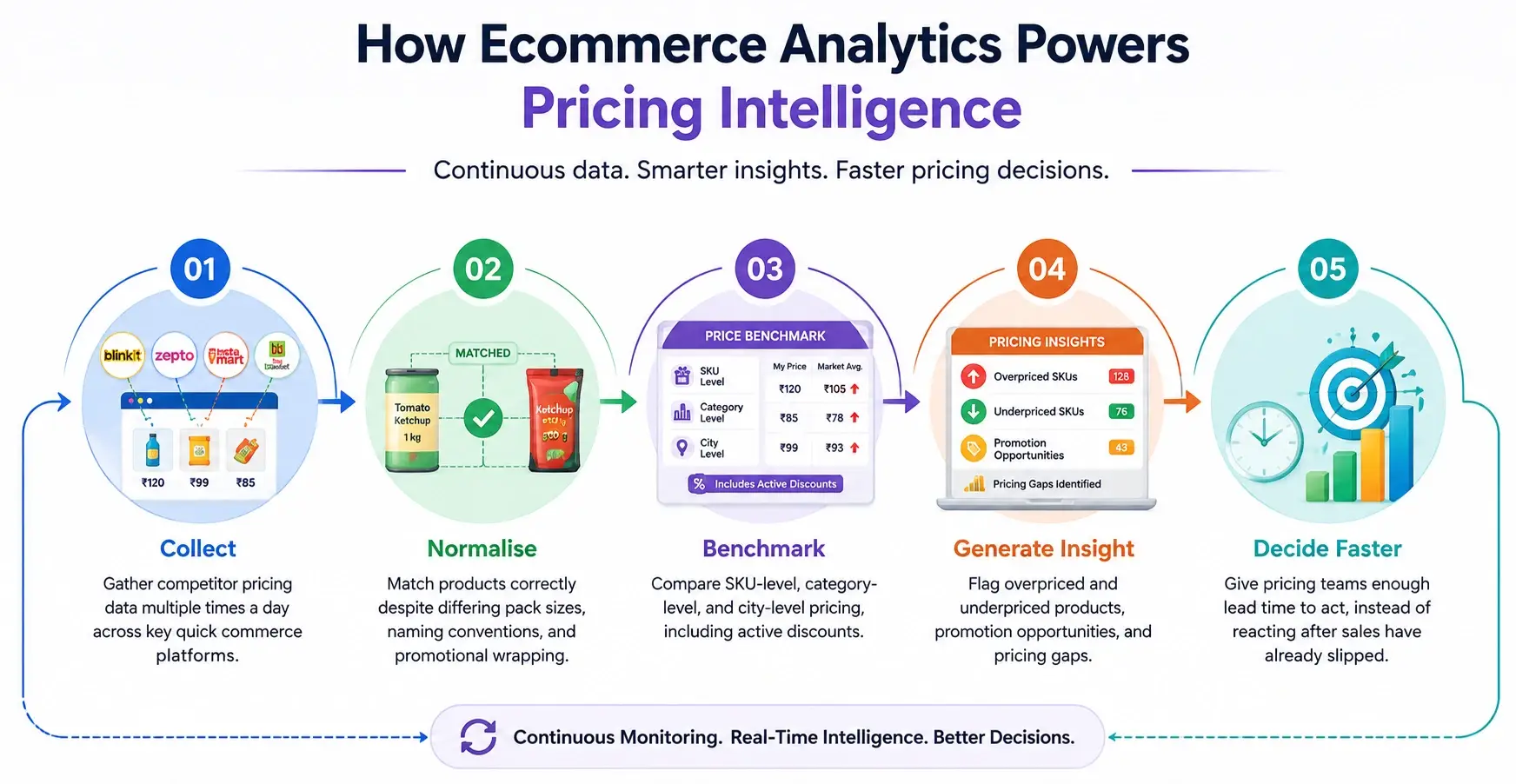
Collect – Capture pricing across every platform, every day
The process starts with systematically scanning competitor apps like Blinkit, Zepto, Instamart, Big Basket, multiple times a day, across every relevant category from grocery and dairy to fresh produce and household essentials.
This is where most manual efforts fail. A person checking prices once a week is comparing against a market that has already moved dozens of times since the last check. Automated, near-real-time collection closes that gap.
Normalize – Make sure you’re comparing the same product
Raw pricing data is messy. The same product can appear under different names, in different pack sizes, or wrapped inside a promotional bundle on each platform.
Before any comparison is meaningful, this data has to be cleaned and matched product-to-product; otherwise, a 500g pack ends up compared against a 1kg pack, and every insight downstream is wrong. This normalization step is what separates real pricing intelligence from a raw price scrape.
Benchmark – See where you actually stand
Once products are matched correctly, pricing gets compared at the level that matters for a decision: SKU-by-SKU, category-by-category, and city-by-city, including active discounts and promotional pricing.
A hypermarket chain can then see, for instance, that it’s priced competitively in Mumbai but consistently overpriced on the same SKUs in Pune, a gap a single national price list would completely hide.
Generate insight – Turn numbers into decisions, not just data
Raw comparisons become useful only when they’re translated into action: which products are overpriced, which are underpriced and leaving margin on the table, where a competitor’s promotion creates a short-term opportunity, and where a competitor going out of stock opens a window to capture demand.
This is the layer where dashboards and alerts replace spreadsheets, surfacing what pricing teams need to know instead of burying it in raw numbers.
Decide faster – Close the gap between insight and action
The final step is speed. Insight generated a day too late is close to worthless in a market where competitor prices shift multiple times within the same day.
The value of the entire process is measured by how quickly a pricing team can go from “the market moved” to “we’ve responded”, and that’s the gap ecommerce intelligence tools are built to close, by compressing days of manual tracking into a same-day, continuously refreshed pricing feed.
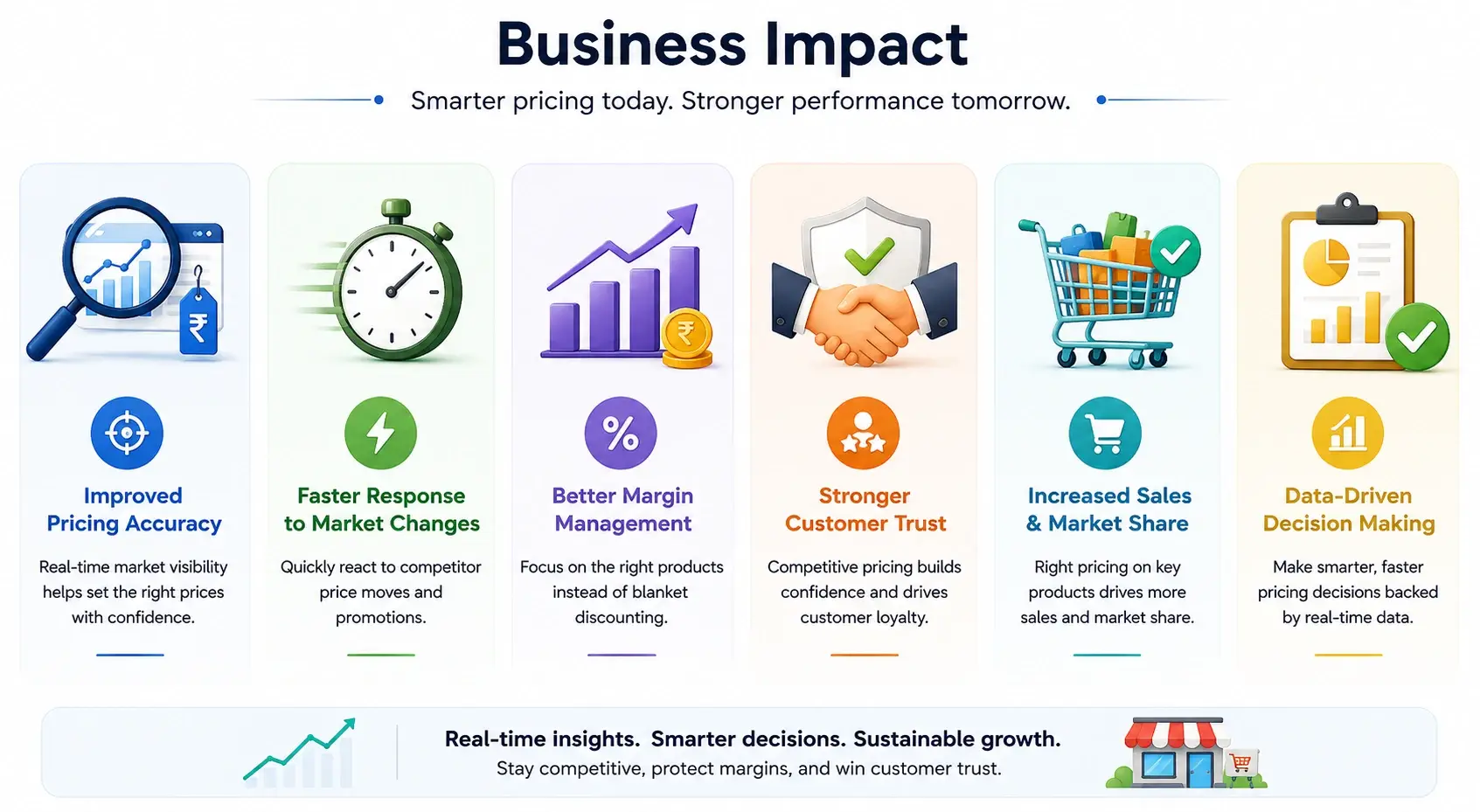
Looking Beyond Price: What Ecommerce Analytics Actually Reveals
A mature pricing intelligence practice goes further than a daily price list.
- It benchmarks overall market positioning.
- Tracks discount patterns rather than one-off offers
- Flags which categories a competitor is pricing aggressively.
- Surfaces regional price differences in real-time.
- Monitors out of stock and product availability, SKUs proactively.
These windows help hypermarkets capture demand they wouldn’t normally get, but only if someone is watching for it continuously.
How mFilterIt Helped a Hypermarket Brand with Pricing Intelligence
A leading hypermarket in Mumbai noticed declining sales in high-volume FMCG categories and initially assumed it was falling footfall or shifting customer preferences.
Using ecommerce intelligence tool by mFilterIt, the retailer identified that several high-volume SKUs were priced slightly higher than those offered by leading quick-commerce competitors.
After analyzing competitor pricing trends and selectively adjusting prices on key products:
- Price competitiveness improved significantly
- Customer footfall increased
- Sales volumes recovered
- Gross margin impact remained controlled through targeted pricing actions
The Results
- Monitored competitor pricing at scale
- Identified pricing gaps instantly
- Optimized pricing strategies using real-time market data
- Improved competitiveness against quick-commerce platforms
- Make data-driven pricing decisions with confidence
- Leverage Out-of-Stock (OOS) insights to capture demand opportunities
Conclusion
At the end of the day, quick commerce has changed what shoppers expect. For hypermarkets, that doesn’t mean racing to be the cheapest on everything. It means actually knowing which prices matter, catching changes before they cost you sales, and making smart calls instead of guessing. Once you can see the market clearly, pricing stops being a headache and starts being an advantage.
Tired of playing catch-up on pricing? Let’s fix that.
Book a quick demo with mFilterIt and see exactly how much easier pricing gets when you’re not tracking competitors by hand. Get in touch today.
Frequently Asked Questions
How is pricing intelligence different from just checking competitor prices?
Pricing intelligence involves consistent, automated tracking and analysis of competitor prices, promotions, and inventory. Unlike monitoring competitor prices, it converts fragmented data into effective pricing decisions.
How is quick commerce different from traditional ecommerce for hypermarkets?
Unlike ecommerce that uses warehouse fulfillment and focuses on variety, quick commerce fulfills orders within 10-30 minutes from nearby dark stores.
How often should hypermarkets track competitor prices to stay competitive
Ideally, multiple times daily.Since quick-commerce platforms change prices and offer multiple times per day, weekly or even monthly manual checks are obsolete.
Does competing with quick commerce mean hypermarkets must always offer the lowest price?
No.Universal discounting reduces profit margins. Competing intelligently implies matching the price of competitors only for high visibility and frequently compared SKU-s.
Can pricing intelligence tools track prices across different cities and store formats?
Yes.Contemporary pricing intelligence solutions benchmark prices on city and platform level because the same product may have different price in Mumbai and Pune on the same app.