
Welcome to the world of Pay Per Lead! A more trustworthy and monetized model.
When impressions were being faked, clicks were being hijacked, and brands were receiving barely any conversions. Hence marketers, especially in tier-1 markets like the United States, decided to do what any rational person would do. They stopped paying for clicks and started paying for outcomes. Fill a form, generate a lead, get paid. Simple, accountable, fraud-proof.
The moment payment moved to the lead event; some affiliates simply moved their operation there too. Suddenly, forms were being filled by scripts, credentials were being recycled, and conversion metrics were spiking in ways that looked extraordinary on a dashboard and meant absolutely nothing in a sales pipeline.
The model designed to eliminate fraud became the next frontier for it.
In this blog, we will discover –
- What is lead fraud and how affiliates exploit PPL campaigns
- What our latest analysis revealed on lead fraud
- Why your current measures are not enough to tackle lead fraud
- What a holistic ad traffic validation solution solves in lead gen campaign
What is Lead Fraud and How Affiliates Exploit Lead Gen Campaigns
Imagine opening a lemonade stand and suddenly getting 500 “customers” who ask for lemonade, write down their names, and then disappear before buying anything. Sounds exciting at first until you realize nobody actually wanted lemonade.
That’s exactly what lead generation fraud looks like in digital marketing.
In lead generation fraud, fake demand is created by fraudsters by filling up lead forms with credentials without having any real intent of buying any product/service. This means your brand who has partnered with affiliates are exploiting your marketing campaigns by filling out multiple fake leads and very subtly shifting the burden of non-conversion on sales team.
Lead fraud happens in two ways –
Fake Leads
Completely made-up entries with false details, often created by bots. They look like leads but have no real user behind them.
Punched Leads
Manually filled leads using random or reused information to hit targets. They seem real but don’t convert when contacted.
What is the Mechanic Behind Lead Fraud?
Lead fraud is not just another move to pollute your campaigns; it is a very strategic one that is noticeable only when the commission is attributed to partners.
Here’s how affiliate lead generation fraud typically works:
Fake lead generation
Affiliates submit fabricated or bot-generated leads using fake names, emails, and phone numbers, often sourced from data dumps or auto-filled by scripts, to hit volume targets and earn commissions.
Incentivized traffic manipulation
Real users are paid or incentivized (cash, gift cards) to fill out forms with no genuine purchase intent, inflating lead counts while producing zero conversion value for the advertiser.
Lead recycling
Old or previously sold leads are repackaged and resubmitted, sometimes with slightly altered details, to collect duplicate commissions from advertisers who lack deduplication checks.
Cookie stuffing / attribution hijacking
Affiliates drop tracking cookies on users’ browsers without their knowledge, falsely claiming credit for leads or conversions that originated organically or through other channels.
Device/IP farming
Using emulators, VPNs, rotating proxies, or device farms, affiliates simulate multiple unique users from a single operation, bypassing basic device fraud filters and generating large volumes of fraudulent leads at scale.
Affiliate Lead Fraud Exposed: 44 Leads Tracked to One Cookie
Upon analysing the lead generation campaign for a major USA brand that had partnered with affiliates to bring leads, we found severe lead punching use case –
The numbers looked great until they didn’t.
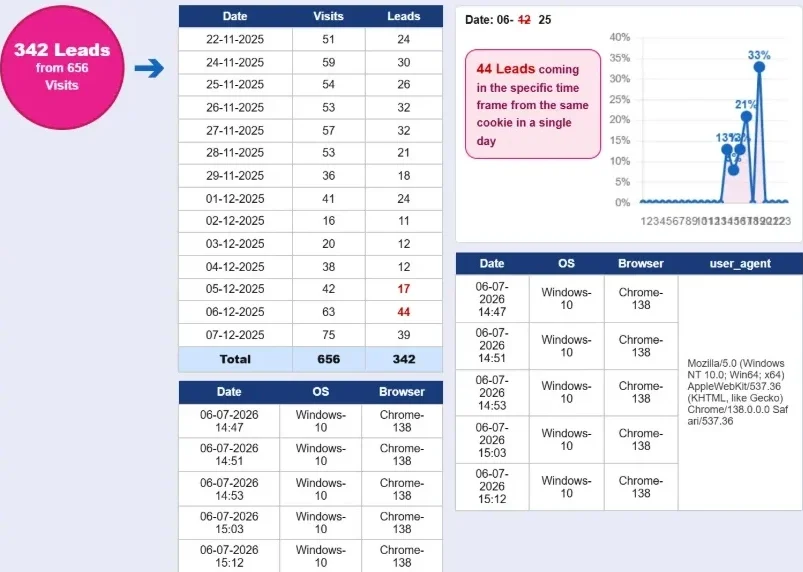
342 leads from just 656 visits. A conversion rate that most marketers would celebrate. On paper, this campaign was firing on all cylinders. In reality, it was being quietly gamed.
The Cracks Beneath the Surface
When traffic quality signals were layered over the raw data, the same fingerprints kept showing up — literally. Every suspicious lead traced back to the same affiliate source, the same device, the same desktop environment, the same location, and near-identical browser signatures. Not similar. The same.
That is not how real consumer behaviour works.
The Day the Mask Slipped
The clearest evidence of manipulation surfaced on 06-12-2025. A single cookie ID was used to submit 44 leads in one day. One device. One session fingerprint. Dozens of “different” users.
No genuine audience behaves this way. But an affiliate with a script, a quota, and a commission on the line? Absolutely.
The Graph Doesn’t Lie
Conversion rates don’t naturally leap from baseline to 13%, then 21%, then 33% in a matter of days. Organic growth curves they don’t spike like a heart monitor. When they do, it almost always points to the same culprits, automated submissions, recycled user pools, or incentivised form-filling dressed up as real demand.
The Real Cost of Fake Leads
This is where the damage moves from a data problem to a business problem. Behind every inflated metric sits a real consequence sales teams burning hours chasing contacts who never existed, budgets being doubled down on channels that are actively cheating, and acquisition cost calculations built on a foundation of fiction.
The campaign looked like a success. The business was paying for failure.
What This Should Change
Affiliate marketing remains one of the most powerful growth levers available — but only when the leads coming through it are real. The moment you measure performance purely by volume and conversion rate, you hand fraudulent affiliates exactly the playbook they need.
The brands winning this battle are looking deeper: behavioural patterns, device consistency, cookie-level tracking, and source-by-source forensics. Because in a world where lead generation fraud is this sophisticated, the only defence is an equally sophisticated offence.
Why Surface Level Analysis is not Enough to Detect Lead Fraud
Lead exploitation is a broader ecosystem with affiliates disrupting the campaigns through sophisticated tactics. Surface level solution only covers the basic obvious signals like duplicate signals and repeated IP addresses but not something advanced, here’s why they aren’t enough –
- Fraud has moved from pattern to behaviour: Basic filters catch duplicate emails and repeat IPs, but sophisticated affiliate fraud rotates identities, devices, and locations specifically to avoid these checks.
- Fraudsters map your rules before they operate: Conversion thresholds, IP blacklists, and volume caps are not deterrents, they are a blueprint. Fraud operations stay comfortably within every limit your detection layer has published.
- Surface tools measure outputs, not intent: They confirm a lead arrived. They cannot see the 400-millisecond form fill, the missing scroll behaviour and the absence of genuine session activity.
- One signal caught in isolation means nothing: A single location is unremarkable. A single cookie ID is unremarkable. But the same cookie ID generating 44 leads in one day from the same device in the same location, that is a pattern no single-layer filter is designed to surface.
- Conversion spikes are invisible to volume-based tools: Jumping from baseline to 33% conversion in a narrow window is statistically anomalous but if you are only tracking totals, the spike hides inside a “successful” campaign report.
What an Advanced Solution Solves in Lead Gen Campaigns
Now it is clear that brands need a more advanced approach and a comprehensive solution that is seamlessly integrated in their operations without disrupting the existing systems yet solving the complexities of lead generation.
For this, the most effective approach is device fingerprinting followed by multiple checks for pattern identification. Here’s how an advanced lead fraud detection solution can empower brands against lead fraud –
Device Fingerprinting
It is one of the most effective strategies to tackle lead fraud. Brands identify users based on hardware, software, and configurations with unique device things like OS versions/IP addresses. Even if fraudsters change names, emails, or phone numbers, repeated device patterns can still reveal suspicious activity.
Deterministic Checks
Applies predefined validation rules using signals like IP addresses, cookies, and browser metadata to detect and block basic invalid traffic and allow the right one to flow.
Heuristic Checks
Detects suspicious activity by recognising behaviour patterns commonly linked to bots, such as unusual browser identities, frequently changing IP addresses, or repetitive clicking activity.
Conclusion
Attribution based only on lead volume can be misleading without proper validation. Fraudulent or low-quality leads may still get credited. This not only impacts brands but unfairly make genuine affiliates a prey of fraudulent tactics. To build a trustworthy ecosystem, brands must verify traffic authenticity before assigning credit and ensure complete transparency across channels. Unusually high performance should always be questioned, not celebrated blindly as it often signals deeper issues. The goal is not just more leads, but real, high-intent users driving growth.
If you want to protect your campaigns, improve lead quality, and reward the right partners, it’s time to act.
Frequently Asked Questions
What is lead generation fraud?
It’s the creation of fake or non-genuine leads using bots, fake data, or manipulated user activity to inflate lead volume and earn payouts without real customer intent.
How do fake leads affect performance marketers?
They waste ad spend, distort campaign data, reduce conversion rates, and mislead optimization decisions.
What are the signs of lead generation fraud?
High lead volume but low conversions, invalid contact details, repeated patterns (IP/device), and unusual spikes in performance.