
All performance marketing activities have one thing in common: getting new clients and making more sales.
In order to do so, brands spend lots of money on organic demand generation with ASO, SEO, CRM, branding campaigns, influencers, and content marketing. In parallel, they depend on affiliate channels in order to get more exposure and users.
Affiliate marketing has become an integral part of the growth strategy for such companies as Amazon, Flipkart, and other e-commerce and fintech leaders. When managed well, it helps to install apps, gain new clients, and grow acquisition in an efficient way.
But what happens when installs, you are rewarding affiliates for, were not made because of them and you are just paying extra money to re-acquire your current audience?
Here comes the problem of organic poaching.
It is a silent killer of your marketing efforts and a serious obstacle to measuring campaign performance.
And here is the problem for advertisers:
- It makes attribution data unreliable and hides actual performance.
- It makes budgets allocated improperly as fraudulent sources get rewarded instead of the genuine ones.
- It decreases ROI accuracy which affects decision-making about scaling, optimizations, and payments to partners.
In this blog, you will discover:
- What is organic poaching?
- How organic poaching works?
- The cost of overlooking organic poaching
- Protecting true performance with ad traffic detection solutions
What is Organic Poaching?
Mobile ad fraud continues to expand, making tracking and validation more complex than ever. Organic poaching is one such deceptive form of mobile ad fraud that’s increasingly hard to detect. It occurs when some affiliates manipulate last click attribution to claim credit for users who would have installed your app organically. Fraudsters manipulate the journeys of genuine users and steal the credit for the organic installs. In short, brands end up paying affiliates for traffic and conversions that were already theirs.
How Organic Poaching Works?
The primary aim of organic poaching is to steal the last-click attribution credit for an install. Let’s know how it is done –
- User intent (organic) – A real user finds your app organically (search, store browse, friend recommendation) and taps to install.
- Presence of a malicious actor – The user’s device has a malicious app that gets active whenever an install is processing in the device (broadcasts, package events, referrer hooks, or page navigation).
- Last-second signal injection – Right before the install finishes, the fraudster fires a fake click and sends that event to the Mobile Measurement Partner (MMP) or tracking endpoint. This is timed to be the ‘last touch.’
- MMP attributes by Last-click – Through MMP’s last-touch logic, the last click right before the install is recorded in affiliate’s name, giving them the credit of the install.
- Fraudster receives credit/payout – The hijacked attribution shows up in reporting and triggers commission or KPI credit for the bad partner, making them pay for the organic traffic.
Common Forms of Organic Poaching
There are sophisticated forms of organic poaching that directly impact the installs –
Click Spamming: The Volume Illusion
Fraudsters generate a flood of invalid clicks to steal credit for genuine installs. Often, users unknowingly install apps infected with malware. The user never sees it, but it lives in the background, and the fraudsters are clicking on it, a tactic known as click flooding.
Click Injection: The Millisecond Hijack
More alarming than click spamming, click injection is yet another advanced form of click fraud. Instead of firing multiple fake clicks, it uses one perfectly timed click to steal credit for an organic install, letting fraudsters claim last-click credit and payment for an install that happened organically.
Read in detail the difference between click spamming and click injection
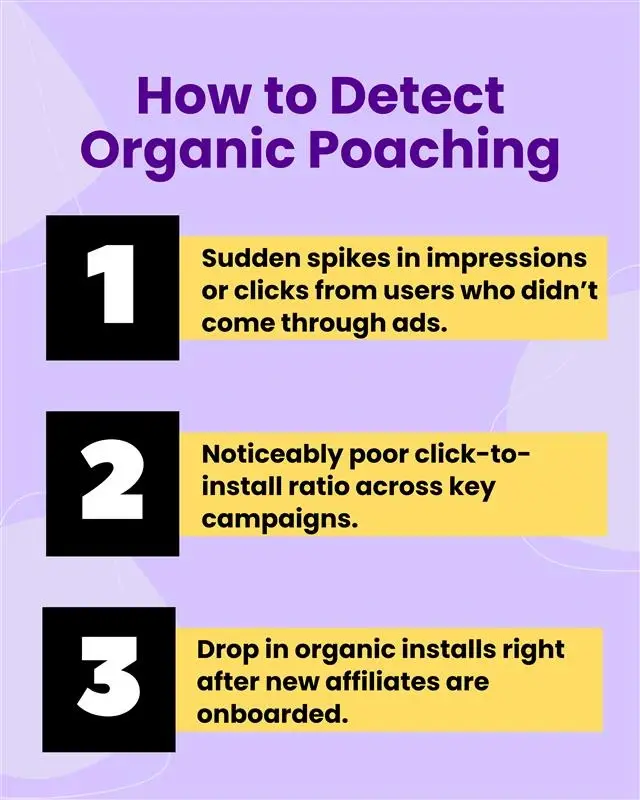
The Cost of Overlooking Organic Poaching
Overlooking organic poaching doesn’t just lead to wasted ad spend, it impacts the accuracy of your entire performance ecosystem. Here’s what’s at stake:
- Payout to Affiliates: Affiliate fraud generates revenue from installs that would have happened anyway, reducing budget that could be used for actual user acquisition.
- ROI Channel: Attribution of wrong installs to a channel creates the impression of profitability for fraudulent channels but does not reveal the real effect of legitimate ones.
- Optimization Choices: The money is redirected from effective campaigns into those with fabricated success, and optimization is based on false results.
- Measurement Integrity: If the organic installers are counted as paid installers, all your attribution will be corrupted.
- Loss of Trust: Honest affiliates do not receive any credit for their work. Advertisers’ trust in partners decreases.
- Growth Strategy: Decision-making based on fraudulent statistics will be used for future acquisitions.
How Brands can Catch What Attribution Platforms Miss
The core problem is structural: last-click attribution was designed to answer, “who touched this user last,” not “who actually influenced this install.” Fraudsters don’t need to beat your fraud detection; they just need to exploit a system that was never built to ask the second question.
Closing that gap means looking past the attribution event itself and into the behavior behind it. mFilterIt’s Valid8 does this in real time, examining:
- Click-to-install timing patterns: A click firing two seconds before an install, with no preceding engagement, gets flagged as implausible rather than accepted at face value.
- Device-level signal analysis: Devices generating abnormal click volumes or behavioral patterns inconsistent with genuine user activity are identified before their affiliate gets paid.
- User journey authenticity: The actual path a user took (search, store browse, referral) is cross-checked against what the attribution event claims, exposing journeys that were intercepted rather than influenced.
- Real-time validation, not after-the-fact audits: Fraud is caught before commission payouts are approved, not weeks later in a reconciliation report.
Conclusion
As affiliates and ad networks gain more control over attribution, protecting true performance has never been more crucial. The right ad traffic validation solution helps you monitor and measure affiliate performance with confidence. For end-to-end traffic monitoring, mFilterIt’s Valid8 ensures your command on every click, install, and conversion.
But all this can be tracked with a right ad fraud detection tool like mFilterIt’s Valid8 that empowers brands to monitor affiliate traffic in real time, detect anomalies before they drain performance, and protect integrity of affiliate marketing campaigns when it matters most.
Advertise Fearlessly with transparency, accuracy, and trust in every conversion.
Frequently Asked Questions
What is organic poaching?
Organic poaching is affiliate fraud where partners claim credit for installs that would have happened organically.
How does organic poaching impact ROI?
It wastes ad spend, skews attribution, and inflates affiliate performance, leading to poor optimization decisions.
Is organic poaching the same as click spamming?
No. Click spamming floods fake clicks, while organic poaching includes tactics like click spamming and click injection to steal attribution.
Can attribution platforms detect organic poaching?
Not always. Last-click attribution alone cannot reliably identify fraudulent attribution or fake influence.
How can brands stop organic poaching?
By using an ad traffic validation solution to detect fake clicks, validate user journeys, and prevent fraudulent affiliate payouts.