
Google positioned Performance Max campaigns as a way to simplify campaign management for marketers. But it also created new areas that can be exploited if not monitored closely.
One campaign covered every Google channel. The AI handles everything from where your ads show up, who see them, how much you bid, to which creative runs where. You just goal, upload your assets , and let AI do the rest.
And honestly, Performance Max made running ads across Search, Display, YouTube, Gmail, Discovery, and Shopping genuinely simpler. Marketers moved their budgets in, trusted the system, and watched the reach numbers grow.
But here’s the red flag nobody talks about enough: when you hand everything over to an AI, you also hand over your ability to see what’s really going on. Not being able to see what’s happening with your money is exactly the kind of gap that fraudsters exploit.
Therefore, every performance marketer needs to understand how ad fraud impacts performance max campaigns, what it costs, and what you can do about it.
What Are Performance Max Campaigns?
Before we move to the ad fraud side, let’s talk about Performance Max campaigns and how it works.
In a regular Google campaign, you can pick your placements, adjust bids by audience, and control where your budget goes.
On the other hand, Performance Max is a type of Google campaign where you provide your ad creatives (images, videos, headlines, text), your target goals (like getting leads or sales), and some hints about who your audience might be. From there, Google’s AI takes over completely. It decides which ads to show, who to show them to, on which platform, at what price, and in what format.
This is where the problem begins. AI learns from the signals it receives, clicks, form fills, and conversions. If the signals come from real people genuinely interested in your product, great.
But what if they’re coming from bots and fake traffic sources? The AI doesn’t know the difference. It just sees activity and calls it “performance.”
This is what people mean when they call performance max a “black box.”
In traditional programmatic advertising, if brands deal with invalid traffic, across Search, mobile, and display channels, marketers have access to tools that surface placement data, flag suspicious traffic, and allow manual intervention.
However, in the case of performance max campaigns, much of that visibility is not even available. Hence, ad fraud slips in.
How Ad Fraud Happens in Performance Max Campaigns?
One of the most important things to understand about ad fraud in performance max campaigns is that it isn’t limited to a single stage or technique. Ad fraud occurs at every level, from the moment your ad loads to the moment a “lead” is generated. And with automation in place, here’s what the fraud risks actually look like:
Ad placements that put your brand at risk
Automated placement decisions often send ads on MFA sites, placing ads besides adult content, piracy sites, or hate speech networks. Such sites exist purely to inflate ad impressions and earn revenue from advertisers. They have little to no real content, but generate a huge amount of impressions or clicks coming from low-intent users or bot traffic.
Moreover, bots mimic real user behaviour and visit websites (even low-quality websites). This means your ad “loads” on a page, but no real human ever sees it.
The result? Inflated reach metrics, misplaced ads, compromised brand safety, distorted frequency data, and a campaign algorithm that gets trained on fake signals.
Clicks that drain your budget but are not high intent & don’t convert
Click fraud is one of the most common types of ad fraud that performance campaigns are vulnerable to.
It happens when clicks on your ads come from click farms, competitors trying to drain your budget , accidental clicks on display ads, or automated bots generating large volumes of invalid traffic.
The impact is twofold. First, every invalid click directly wastes your ad spend without delivering any real value. Second, it misleads the algorithm. These fake clicks make poor-quality traffic sources appear effective, causing the system to allocate more budget toward them, hurting campaign performance even further.
Fake journeys, visits, and leads that distort entire campaign metrics
Visit and lead fraud causes the most downstream damage. Sophisticated bots are now programmed to simulate the complete conversion journey. They click on ads, land on pages, browse content, and submit lead forms. This generates fake leads that appear legitimate in reporting.
The more conversion fraud goes undetected, the more your campaign AI actively optimizes toward the sources producing it, pulling spend away from placements that might actually reach real people.
The damage here is threefold: ad budget is spent acquiring fake leads, sales teams waste time chasing non-existent prospects, and the CRM is polluted with junk data that corrupts future targeting. Furthermore, every fake conversion further trains the Pmax campaign algorithm to optimize toward the traffic sources generating them.
What the Data Shows: Performance Max Campaigns Have Nearly Double the Fake Traffic of Google Search
You don’t just have to take our word for it. We measured it.
Based on our analysis of ad fraud and invalid traffic (IVT) across all major Google campaign types revealed a clear pattern – Performance max is the most vulnerable to bot-driven traffic, with the highest IVT% observed among all channels.
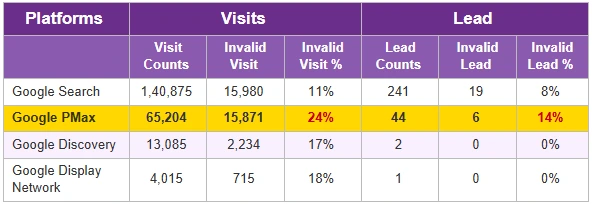
- Google Search, the channel most associated with high-intent, human-driven traffic, recorded 11% invalid traffic rate and an 8% invalid lead fraud. Google Discovery at 17% invalid traffic and Google Display Network at 18%.
- In the case of Google PMax, a 24% invalid traffic rate and a 14% invalid lead rate were recorded. This means nearly 1 in 4 visits generated by PMax was non-human traffic. And 1 in 7 leads generated by PMax were fraudulent.
Despite generating less than half the total visit volume of Google Search (65,204 vs 1,40,875), the performance max campaign produced almost the same absolute volume of invalid visits — 15,871 vs 15,980.
This shows the ad fraud density in PMax is nearly double that of Search. It isn’t just the most fraud-vulnerable channel; it is an outsized contributor to total invalid traffic in absolute terms.
Where PMax Traffic Actually Comes From & Why It Matters
To really understand why performance max campaigns are so vulnerable to ad fraud, you need to look at where its ad traffic is actually coming from.
When we analyzed the internal channel distribution within a PMax campaign, here’s what it revealed.
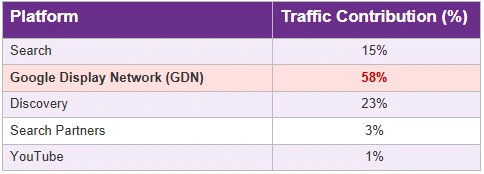
A large majority of the traffic didn’t come from high-intent environments like Search. Instead, it came from channels designed for scale.
Over 80% of PMax traffic was driven by Google Display Network (GDN) and Discovery. These channels are built for reach. They offer lower CPCs and broader inventory, which makes them attractive for algorithms trying to maximize volume. But they also carry a much higher exposure to low-quality placements, MFA sites, and bot-driven traffic.
In comparison, Search contributed only a small share of the total traffic. In PMax campaigns, you don’t choose where your ads appear. The algorithm does. It automatically shifts budget toward channels that generate more activity at lower costs. On paper, this looks efficient. But in reality, it often means over-indexing on inventory that is more susceptible to ad fraud.
There’s another layer to this.
Search Partner inventory, which also contributes to PMax traffic, has historically been difficult to audit. It can include parked domains, directories, and third-party websites where traffic quality is inconsistent, and transparency is limited. This creates a structural problem.
PMax isn’t just exposed to ad fraud; it is naturally biased toward the parts of the ecosystem where fraud is more likely to exist. And because of the lack of visibility, most advertisers don’t even realise where their traffic is coming from or what they’re actually paying for.
Ads Were Appearing on Risky & Brand-Unsafe Ad Placements. Would You Have Approved Ever That?
Nothing makes the black box problem more real than seeing actual placement data. Here’s what we found when we dug into the placements within a live PMax campaign.
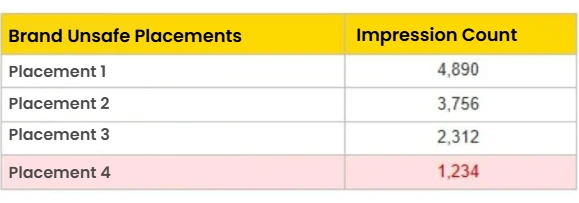
That is what “limited visibility” actually looks like. Not a technical limitation you read about in a whitepaper, but a brand’s ads appearing on irrelevant or unsafe sites, completely unknown to the advertisers spending the budget.
Way Forward: What Every Performance Marketer Running Performance Max Campaigns Need To Do Now
Knowing about the problem is step one. Here’s a practical checklist every marketer must follow:
- Audit your placement reports regularly. Don’t wait for Google to surface problems, actively pull placement data and review it for MFA sites, app-adjacent placements, and brand-unsafe environments.
- Monitor invalid traffic percentage as a campaign KPI. If your PMax campaign is generating a significantly higher IVT rate than your Search or other campaigns, treat it as a performance issue, not just a data anomaly.
- Watch your lead quality indicators. Sudden volume spikes, unusual geographic clusters, duplicate submissions, and nonsensical form fill data are all signals that conversion fraud bots are active.
- Understand your PMax channel split and ads distribution among all channels.
- Start leveraging independent ad traffic validation and ad fraud detection solutions that provide placement-level transparency, real-time IVT signals, and full-funnel validation of data.
- Maintain proactive exclusion lists. Build and update placement exclusion lists based on identified MFA sites, adult content domains, and other low-quality placements, and apply them systematically across campaigns.
- Treat lead quality as a campaign metric. The number of leads your performance max campaign generates is meaningless without a parallel measure of lead validity.
How mFilterIt’s Ad Fraud Solution Helps Protect Your Performance Max Campaigns from Ad Fraud
Performance Max gives you automation. mFilterIt’s ad traffic validation solution gives you accountability.
It is purpose-built to close the visibility and transparency gap for advertisers with a comprehensive ad fraud intelligence layer that works alongside PMax, not against it. Here’s how it works:
| Feature | What It Does For Your PMax Campaigns |
|---|---|
| Real-Time IVT Detection | Catches fake traffic (bots, click farms, etc) the moment it hits your campaign, across every channel PMax runs on. So, your data stays clean and your budget goes to real people. |
| Placement-Level Transparency | Shows you the exact websites where your PMax ads are actually running. No more guessing. No more surprises. Just a clear list of every domain getting your impressions, including the ones you’d never have approved. |
| MFA Site Identification & Blocking | Automatically spots Made-for-Advertising (junk) websites in your PMax inventory and blocks them. These sites exist purely to absorb ad spend, mFilterIt makes sure yours doesn’t go there. |
| Brand Safety Monitoring | Scans every placement in real time for adult content, unsafe environments, and anything that doesn’t belong next to your brand. You get an alert before the damage is done, not after. |
| Lead Quality Validation | Checks every lead your PMax campaign generates and flags the fake ones. So, your sales team is only ever calling real people, and your CRM stays clean and useful. |
| ML Signal Protection | Removes fraudulent data from the feedback loop before Google’s algorithm can learn from it. This keeps PMax optimizing toward real customers, not bots, so performance actually improves over time. |
| Cross-Channel IVT Benchmarking | Gives you a side-by-side comparison of invalid traffic rates across Search, PMax, Discovery, and GDN. So, you always know which channels are clean and which ones need attention. |
| Actionable Reporting & Alerts | Delivers clear, specific fraud reports, not just numbers. You’ll know exactly what to block, what to exclude, and where to act next, without needing to be a data analyst to understand it. |
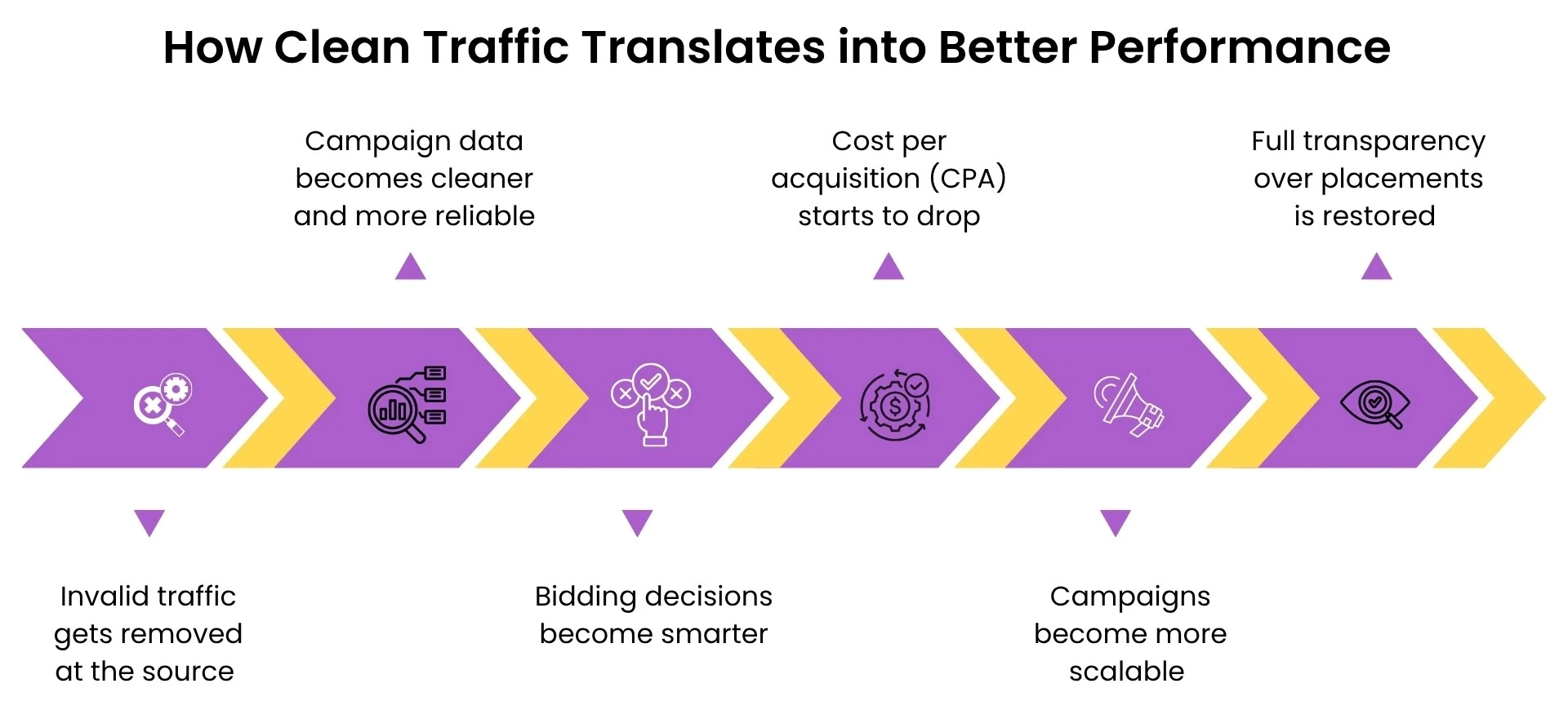
The goal is to run campaigns based on clean data and accuracy. When the ad fraud solution removes fraud from the data loop, Google’s AI optimizes campaigns for real people with genuine intent, not bots.
Conclusion: Leverage Performance Max and Automation in the Right Way
Performance Max will continue to grow as Google’s flagship campaign type. Its automation capabilities are genuinely powerful, and the reach it offers is unmatched across the Google ecosystem. Marketers should not abandon it, but they should stop running it blindly.
Ad fraud does not take time off. Bad actors are not waiting for platforms to close the gaps they exploit. Every day a PMax campaign runs without independent fraud monitoring is a day of budget leakage, data corruption, and brand exposure.
The marketers who win with PMax in the long run will not simply be those who trust the algorithm most. They will be those who pair algorithmic power with independent oversight — combining Google’s reach with the visibility and accountability that only a dedicated fraud intelligence solution can provide.
Ready to see what’s really happening inside your PMax campaigns?
Get in touch with our experts today.
Frequently Asked Questions
What is ad fraud in Performance Max campaigns?
Ad fraud in performance max campaigns refers to any fraudulent activity that generates fake impressions, clicks, visits, leads, or conversions within your campaign. This includes bots mimicking real user behaviour, click farms draining your budget, fake form submissions, and ads being served on low-quality or brand-unsafe placements, all of which waste ad spend and corrupt the data your campaign uses to optimize.
Why are performance max campaigns more vulnerable to ad fraud than other Google campaign types?
AI operates performance max campaigns. The algorithm controls where your ads run, who sees them, and what gets counted as a conversion, with very limited visibility for the advertiser. This lack of transparency makes it difficult to spot and block fraudulent activity. This combination of automation, limited control, and broad inventory reach creates more entry points for ad fraud than any other Google campaign type.
What is invalid traffic in performance max campaigns?
Invalid traffic refers to any clicks, impressions, or conversions in your PMax campaign that don’t come from a real person with genuine intent. Invalid traffic doesn’t just waste budget; it feeds false signals into Google’s algorithm, causing it to optimize toward the sources generating the fraud.
Can algorithm detect ad fraud in performance max campaigns?
Platform filters are designed to protect the platform broadly, not to give individual advertisers placement-level transparency or real-time ad fraud alerts specific to their campaigns. Conversion fraud, fake leads, and MFA site placements frequently go undetected by platform’s invalid traffic filters, which is why independent third-party fraud monitoring is necessary for full protection.
How do bots generate fake leads in PMax campaigns?
Sophisticated bots land on your page, browse through content, and fill out your lead form with fabricated details. Your CRM logs it as a lead, and your sales team follows up on a contact that never existed. These fake leads are particularly damaging because they not only waste sales resources but also train the PMax algorithm to send more budget toward the traffic sources that produced them.
How do I know if my performance max campaign is getting fake traffic?
There are several warning signs to watch for:
- A sudden spike in traffic or leads without a corresponding improvement in sales outcomes
- Unusually high visit volumes from specific geographies that don’t match your target market
- Nonsensical or duplicate entries in your lead forms
- Significantly higher invalid traffic rate in campaigns.
These patterns often indicate bot activity, and the only way to confirm and quantify it accurately is through independent ad fraud detection solutions.
What should I look for in an ad fraud detection tool for PMax?
Look for an ad fraud detection tool that:
- Catches fake traffic in real time, across every channel PMax runs on, not just Search
- Shows you exactly which websites your ads are appearing on
- Flags and blocks junk MFA sites before they waste your budget
- Checks whether the leads your campaign generates are actually real
- Compares fraud levels across campaigns so you know where the problem lies
- Gives you clear, actionable reports, not just data dumps