Meta’s advertising ecosystem (Facebook, Instagram, Messenger, and the Facebook Audience Network) is where billions of marketing dollars flow every single year. The platform offers unmatched reach, precise targeting, and a direct line to almost every consumer demographic.
But here’s a number that should make every CMO pause. Meta reportedly projected 10% of 2024 sales came from scam and fraud ads. (Source: CNBC.com)
This is not just a statistic. This directly impacts your budget, brand, and business. And considering that Facebook is an ecosystem in itself, it carries the three major risks that you need to be aware of:
- Ad fraud that drains your budget invisibly
- Brand safety violations that put your ads next to content you would never approve
- Brand infringement that lets fake versions of your brand steal your customers
Now the question is, what each of these risks include and how to fight back?
This is exactly what we are going to cover in our detailed guide. Continue reading further to know more.
Why Meta Deserves Your Closest Attention While Evaluating Fraud Risks
Not all platforms carry equal risk. Meta is unique because of two things working at the same time: enormous scale and an open, user-generated content environment.
When you run a campaign on Facebook or Instagram, your ad does not just appear on those apps. It travels to thousands of third-party apps and websites that Meta partners with through the Facebook Audience Network. You never approved those placements individually. You often do not even know where your ad ended up.
And while Meta does have its own fraud filters, no platform can catch everything because of its closed walled garden nature. The numbers from mFilterIt’s tracking across geographies make this very clear:
Average Ad Fraud Rates on Meta Platforms by Region
| Platform | Europe | US | India | MENA |
| FB Audience Network | 13% | 15% | 15% | 18% |
| FB.com (Direct) | 9% | 7% | 9% | 8% |
However, these numbers only address ad fraud risks. But the problem goes beyond that, including brand safety and brand infringement risks.
Risk 1: Ad Fraud on Facebook- When Ad Budget Gets Drained on Invalid Traffic
Ad fraud is one of the major growing concerns in digital advertising today. Your dashboards look healthy. Clicks and leads flow in but somewhere in that data, real impact gets affected.
What Ad Fraud Actually Looks Like on Meta
There are various types of Facebook ad fraud. It operates in layers across the full campaign funnel:
Invalid Clicks & Bot traffic
Bots and automated scripts click on your Facebook ads at scale, inflating CTR, traffic volumes and campaign performance signals. Due to this, your algorithm thinks the ad is performing well and keeps spending on placements where bots are visiting.
Fake Leads or Punched Leads
CRMs get flooded with fake leads containing incorrect contact details like fake phone numbers, invalid emails, or zero intent to buy leads, often generated by click farms or automated scripts. This creates a false impression of campaign success while wasting the sales team’s time on low quality prospects.
Click Injection
Fraudsters fire fake click right before conversion is registered for app install campaigns, hijacking the attribution and getting paid for installs they didn’t influence.
Duplicate Users
The same user or bot keeps interacting with ads multiple times across sessions, artificially inflating your reach and frequency metrics.
Engagement Fraud
Fake page interactions, likes, comments, and video views generated by bots incentivized networks to make campaigns appear successful.
Audience Network Fraud
Low-quality publishers, device farms and invalid traffic originating from third-party apps and websites participating in Meta’s Audience Network.
Ad Stacking/Hidden Ads
Multiple ads are layered on top of one another, so only one is visible to the user, while impressions are counted for all ads. This is more common in programmatic ecosystems but can affect traffic sources feeding Meta campaigns.
These fraudulent ad fraud techniques used to generate invalid traffic directly create financial damage. You pay for every fraudulent click, every fake form fill, every bot-generated impression. However, the more serious damage is to your data.
The Domino Effect of Ad Fraud
Marketing teams optimize toward fraudulent signals, pushing more budget into bot-heavy placements.
Genuine audience reach shrinks as budget gets misallocated.
Sales teams waste hours chasing junk leads, higher CPL, lower morale, and missed revenue targets.
Attribution breaks entirely. Nobody knows which campaign, creative, or channel actually worked. Future campaigns are planned on corrupted historical data, repeating the cycle.
Risk 2: Brand Safety Violations on Facebook- When Ads Get Placed Beside Irrelevant or Harmful Content
Imagine spending weeks on planning a campaign; it’s creatives with impactful visuals and precise targeting. And then those ads end up running beside video glorifying violence, drug abuse, etc.
We know you did not choose that placement yourself; you might not even know it happened. But your audience saw it, and they associate your brand with that content.
This is what brand safety violations on Meta or Facebook impact: your brand reputation and brand perception.
Why is Brand Safety Harder to Control on Meta?
Facebook’s algorithm decides where your ad appears based on audience matching and bidding. Content is created by billions of users in real time. The Facebook Audience Network extends your ads to thousands of external apps and websites, none of which you have individually approved or audited.
As a result, your brand ads end up appearing alongside content that violates every value your brand stands for.
What Brand Unsafe Categories Actually Mean
| Brand Unsafe Categories | Why It Matters for Brands |
| Adult & Explicit Sexual Content | Association damages brand reputation across all audiences |
| Arms & Ammunition | Brands appear to endorse weapons, creating legal and reputational risk |
| Crime & Harmful Acts / Human Rights Violations | Severe reputational and ethical implications |
| Death, Injury, or Military Conflict | Trauma-adjacent content alienates audiences |
| Hate Speech & Acts of Aggression | Direct contradiction of brand values |
| Obscenity & Profanity | Damages brand perception, especially for family brands |
| Debated Sensitive Social Issues | Risks polarizing audiences unnecessarily |
| Illegal Drugs, Tobacco, Vaping, Alcohol | Regulatory and reputational exposure |
| Online Piracy | Association with IP theft damages brand credibility |
| Spam or Harmful Content | User trust erosion through poor adjacency |
| Terrorism | Most severe category, zero tolerance required |
What This Looks Like in the Real World
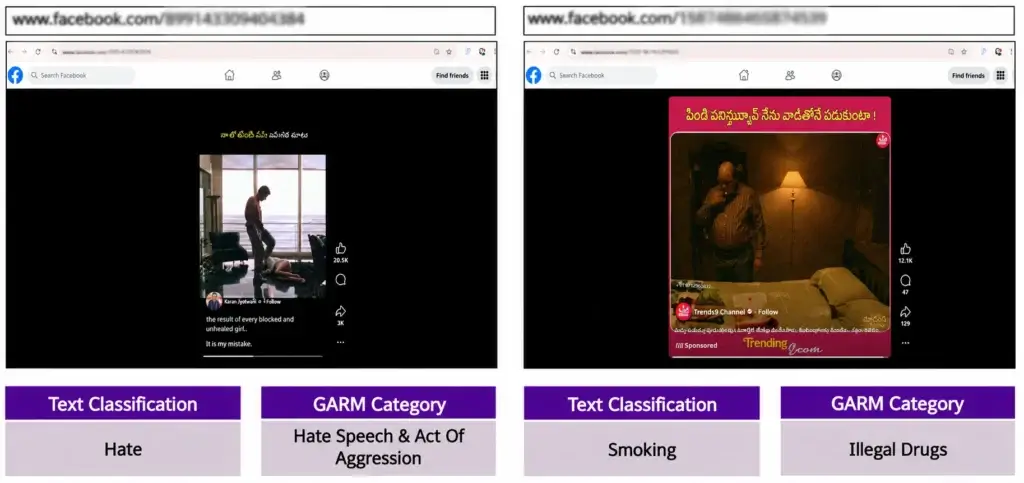
Here’s real data from a brand safety audit mFilterIt conducted for a leading financial services brand running campaigns on Meta in March 2026, and the numbers are striking:
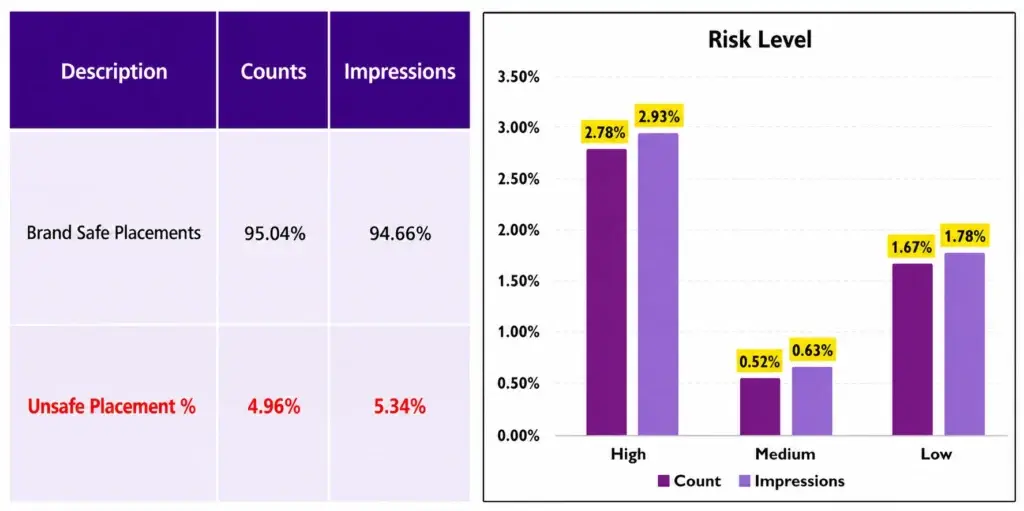
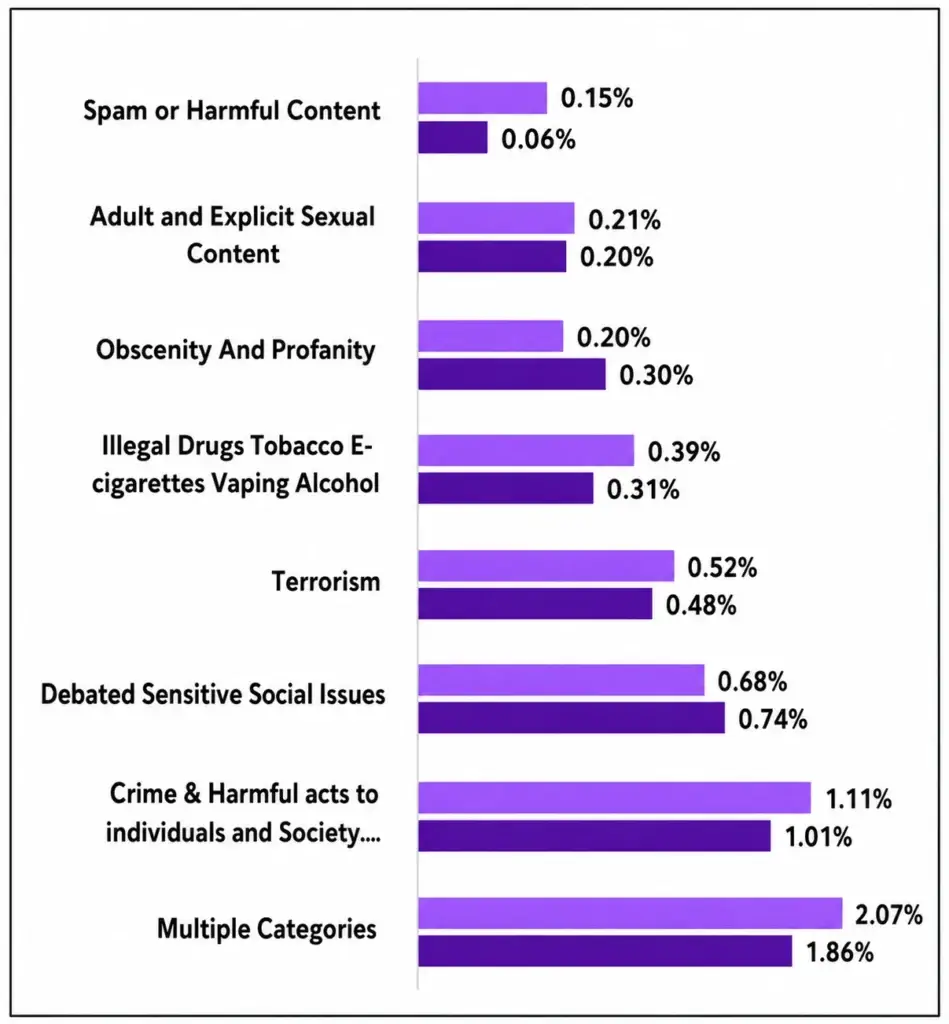
Nearly 1 in 20 placements for this campaign were sitting next to brand-unsafe content.
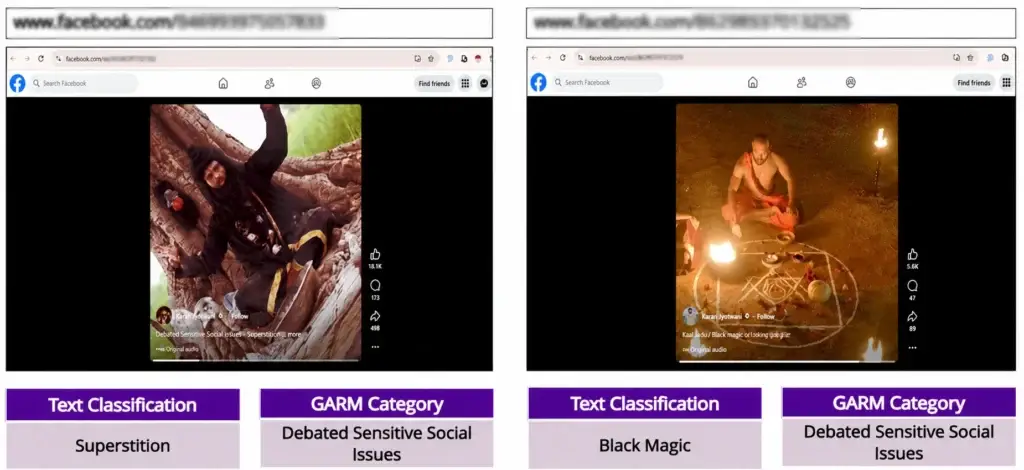
The audit flagged real Facebook reels containing black magic and superstition rituals, videos depicting kidnapping scenes, content featuring hate speech and acts of aggression, drug and smoking content, scenes of armed violence, and graphic injury, all appearing as ad placements in an active, live campaign for a financial services brand.
The Business Impact of Brand Unsafe Placements
- Tarnished brand image: Consumers associate the brand with content it never endorsed and cannot un-see that association.
- Loss of consumer trust: Particularly devastating for BFSI brands where trust is literally the product or service.
- Wasted budget: Every rupee or dollar spent on an unsafe placement delivers zero brand equity and real reputational risk.
- Loss of campaign control: Once placed, you cannot take that impression back.
Risk 3: Brand Infringement Issues of Facebook- When Your Brand Has Multiple Lookalikes
Now that we have talked about the risks of Meta ad fraud and brand safety, another major concern brands need to be aware of is brand infringement. There is a good chance that fake versions of your brand might be appearing across platforms, hijacking your customers and even harming your brand identity.
What Brand Infringement Looks Like on Meta
Here are a few ways fraudsters target and harm your brand reputation using various brand infringement techniques:
Fake Social Media Handles
Fraudsters create impersonated pages and profiles that look almost exactly like your official brand account. Users interact thinking they are engaging with you, submitting queries, complaints, or even financial information to fraudsters.
Fake Posts Infringing Brand IPR
Unauthorized posts misuse your brand name, images, or messaging, often promoting fake offers or unapproved discounts through malicious links.
Logo Misuse
Unauthorized use of your brand logo on fake content, counterfeit products, or misleading communications that falsely appear to be officially approved by your brand.
Fake Brand Communications
Fraudulent announcements, promotions, or campaigns created in your brand’s name to deceive users, collect sensitive data, or redirect payments to fake accounts.
Intellectual Property Infringement
Illegal use of trademarked names, taglines, or creative assets in third-party ads or posts that appear to be from or endorsed by your brand.
To dive deeper into types of brand infringement and how to keep your brand protected, click here.
How Brand Infringement Impacts Brands and Businesses
- Consumers deceived by fake brand pages lose trust in the real brand, and they rarely distinguish between the two.
- Fake pages often run active scams, causing direct financial harm to customers who believe they are dealing with you.
- Your official ad spend is undercut. Users who would have converted through your real campaign instead get diverted by impersonators.
- For BFSI brands especially, fake customer care numbers and phishing content masquerading as official brand communication can result in customers losing money and blaming your brand.
- Not just this, it quickly turns into public backlash and negative word of mouth.
How mFilterIt Protects Your Brand from Facebook Ad Fraud, Brand Safety Violations, and Brand Infringement
Our approach is built on a unified trust framework. Each solution addresses a distinct risk, and together they give brands a complete protection layer across Meta’s ecosystem and beyond. Here’s how each solution works in favor of your brand:
Ad Fraud Solution: Breaking Through Meta’s Walled Garden
Here is the fundamental challenge with validating ad traffic on Meta. Facebook is a walled garden. It is a closed ecosystem. Third-party ad fraud detection tools cannot plug directly into Meta’s ad serving infrastructure to inspect what is happening inside the platform. Meta controls what data it shares, and what it hides.
This means the fraud happening within Meta’s walls largely stays invisible, unless you bring the traffic out.
The solution is the landing page strategy. By directing Meta campaign traffic, whether from lead gen ads, click-to-website campaigns, or retargeting, to a dedicated external landing page, brands move users into an environment they own and can fully monitor. This single shift is what makes meaningful ad fraud validation on Meta possible.
Native Meta lead gen forms are built for speed and convenience. Users can fill them in with pre-populated profile data in two taps. But that same ease makes them extremely vulnerable. Bots bypass basic CAPTCHAs using readily available solvers. Click farms fill thousands of forms in minutes. Zero-intent users submit accidentally and never respond.
When you redirect traffic to a landing page instead, the dynamic changes completely. Users manually enter their information. Behavioural signals become visible. And most importantly, the independent ad fraud detection tools can observe everything that happens from the moment a user arrives.
Native Meta Lead Forms vs. Landing Page Strategy
| Factor | Meta Native Lead Forms | Landing Page + Ad Fraud Detection Layer |
| Data Control | Meta owns the data | Brand owns the data |
| Fraud Visibility | Hidden inside Meta’s ecosystem | Fully visible and measurable |
| Bot Detection | Basic bots bypass easily | Multi-layer detection in real time |
| Lead Quality | Volume-driven, unverified | Intent-scored, validated before CRM entry |
| Behavioral Analysis | Not available | Full scroll, click, and session tracking |
| Optimization Data | Meta’s black box reporting | Clean, verified first-party data |
| CRM Quality | Polluted with junk leads | Only genuine leads enter CRM |
Meta lead gen or landing page forms, which brings you better leads? Read here
Once traffic is on a brand-controlled landing page, our ad fraud prevention tool deploys a multi-layered detection framework:
Behavioural Analysis
It tracks real-time user interactions like mouse movement, scroll depth, time-on-page, and click flow, etc. Bots scroll mechanically, click instantly, and leave no natural interaction trace. These behavioural anomalies are flagged immediately.
Deterministic & Heuristic Checks
Rule-based signals like IP address, cookies, device metadata, and VPN/proxy usage are cross-referenced against known bot signatures and suspicious patterns to filter out fraud at multiple levels of sophistication.
Device Fingerprinting
A unique device profile is built using multiple attributes, catching sophisticated bots that rotate IPs or mimic browsers to avoid detection.
Lead Validation & Intent Scoring
Every form submission is scored in real time, cross-referencing contact detail authenticity, engagement signals, and behavioural history. Genuine, high-intent leads are surfaced. Junk leads are flagged before they ever reach your CRM.
Placement Blacklisting
Our system continuously monitors placements associated with invalid traffic, unsafe content, and low-quality engagement. Suspicious publishers, apps, websites, and placements are flagged and blacklisted in real time.
Audience Exclusion & Traffic Filtering
Traffic sources are evaluated using behavioural patterns, device intelligence, and risk signals. Audiences originating from device farms, outdated devices, emulators, or suspicious engagement patterns are excluded automatically.
Brand Safety Solution: Real-Time Protection Against Unsafe Placements
Our brand safety solution monitors each Meta ad placement continuously against brand unsafe categories, using AI and machine learning that goes well beyond basic keyword matching.
Content Analysis
It scans every video, reel, and post your ad is placed against, frame by frame for video, word by word for text. It does not just read titles or descriptions. It looks at what the content actually shows and says, catching unsafe material that surface-level tools routinely miss.
Contextual Relevance Mapping
A bare-chested man in a video does not automatically mean adult content; it could be a religious ceremony or a sports clip. Brand safety solution analyses the full context around the content to understand what it is, not just what it superficially appears to be. This prevents over-blocking of safe content while ensuring genuinely unsafe placements are never missed.
Sentiment Analysis
Beyond what content shows, it evaluates the emotional tone and intent a piece of content carries, like anger, aggression, fear, or harm, and matches that against how your brand wants to be perceived.
GARM Classification & Risk Scoring
Every flagged placement is classified against brand unsafe categories and assigned a risk level (High, Medium, or Low), giving your team clear, actionable visibility into exactly where your brand is being exposed.
Real-Time Exclusion List Updates
Unsafe placements identified are immediately added to exclusion lists in your campaign manager, stopping further budget from flowing to those placements the moment they are flagged, not at the next reporting cycle.
Brand Infringement Solution: Finding Fakes Before They Find Your Customers
mFilterIt uses Open-Source Intelligence (OSINT) technology to continuously scan Facebook, Instagram, and the broader web for any unauthorized use of your brand, like fake handles, brand impersonation pages, logo misuse, fake posts, and more. The approach works in three clear stages:
Identification
It scans social media platforms, websites, search engines, app stores, and more continuously, not periodically, to surface potential infringement cases.
Classification
AI/ML algorithms, sentiment engines, and data interlinking tools score each identified case for risk level. Cases with low ML confidence scores are escalated for manual human review.
Action
Confirmed infringement cases are actioned for takedown without requiring formal legal filings in most cases. Complaints are filed with social media grievance redressal officers on the brand’s behalf.
Conclusion: Meta is Worth Fighting for with Right Protection and Prevention Solutions in Place
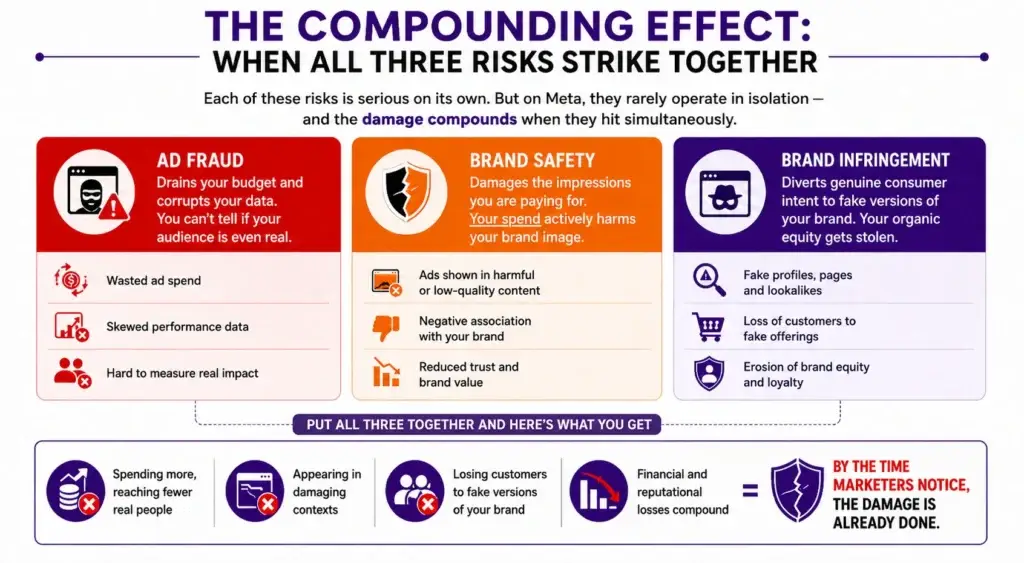
Meta offers unmatched scale and growth potential. But it also exposes brands to invisible risks that can quietly drain budgets, damage reputation, and divert genuine customers. Ad fraud, unsafe ad placements, and brand infringement are no longer isolated problems; they are interconnected threats that demand continuous monitoring and protection.
The solution is not spending less on Meta. It is advertising smarter and safer.
With mFilterIt, brands can validate invalid traffic, protect brand reputation, and stop brand impersonation threats before they impact business performance. Sustainable growth on Meta is not just about reach. It is about trust, transparency, and protection.
Ready to secure your Meta campaigns?
Connect with our experts to protect every impression, click, and customer interaction.
Frequently Asked Questions
What is Facebook ad fraud and how does it affect my campaigns?
Ad fraud on Facebook involves bots, fake clicks, and invalid leads artificially inflating your campaign metrics. It wastes your budget, corrupts your data, and makes genuinely poor-performing campaigns appear successful.
What is a walled garden and why does it make Meta fraud harder to detect?
Meta controls all its data internally, giving third-party tools no direct access. The only way to validate traffic authenticity is by driving users to an external landing page you own and monitor.
What are GARM brand unsafe categories and why should I care about them?
GARM defines unsafe content categories, including terrorism, adult content, and hate speech, etc., that are unsafe for brand adjacency. Your ad appearing next to any of them can seriously damage brand reputation.
How do I know if my Meta ads are appearing next to unsafe content?
Without a dedicated brand safety tool, you likely cannot tell. mFilterIt’s brand safety tool continuously scans and classifies your Meta placements against all brand unsafe ad placements, flagging unsafe adjacencies in real time.
What is brand infringement on Facebook and is my brand at risk?
Brand infringement includes fake pages, logo misuse, impersonator accounts, and unauthorized use of your brand assets. If your brand has any digital presence on Meta, the risk is real and ongoing.
What is the difference between brand safety and brand infringement?
Brand safety is about what your ad sits next to. Brand infringement is about fake versions of your brand operating independently. Both damage reputation but through completely different mechanisms requiring different solutions.
Can mFilterIt protect my brand across both Facebook and Instagram?
Yes. Brand safety, ad fraud detection, and brand infringement solution covers both Facebook and Instagram, as well as the broader Facebook Audience Network, giving you unified protection across Meta’s entire advertising ecosystem.
How quickly can mFilterIt take down fake brand pages or impersonator accounts on Facebook?
mFilterIt achieves 70–80% of successful takedowns within 48 hours on Facebook and Instagram, with an overall takedown success rate of 85–95% across platforms.