
Ad fraud is not just a basic bot traffic problem anymore. It’s an issue contaminating the entire marketing funnel silently. Here’s what the data says, and what leaders must do next.
Imagine spending ₹100 on a digital campaign and losing ₹20–30 before a single real customer ever sees your ad. Not due to a bad creative. Not a flawed targeting strategy. But because the digital advertising ecosystem, the programmatic advertising pipelines, the affiliate networks, and the ad placements, are structurally misplaced.
According to mFilterIt analysis of campaigns run in 2025, featured in the FICCI Media & Entertainment Report 2026, digital ad spend wastage is widespread, and leaders are only beginning to understand its scale.

That is why the gap between awareness and action is a real crisis. And that’s what we are going to cover in this blog.
- Business costs of ad fraud that directly impact the business review
- Where invalid traffic is highest, broken down by channel and platform
- What full-funnel ad fraud detection and mitigation actually looks like in practice
The Business Costs of Ad Fraud Impacting Business Performance
When marketers think about bad ad campaign performance, they usually blame it on creative misses or wrong audiences. But media leakage operates invisibly, creating four distinct business harms:
- Wasted Media Spend: A significant portion of ad budgets is lost on invalid traffic, bot activity, and low-quality engagements that do not contribute to real business outcomes.
- Distorted Performance Analytics: Fraudulent and low-intent interactions contaminate campaign data, making optimization decisions unreliable and impacting overall marketing efficiency.
- Poor/Junk Lead Quality: Fake clicks and invalid conversions result in low-quality leads entering the funnel, increasing acquisition costs, and reducing sales effectiveness.
- Brand Trust Risk: Ads appearing alongside unsafe or fraudulent environments can damage brand reputation, weaken consumer trust, and negatively impact long-term brand perception.
How Invalid Traffic Travels Across Platforms and Channels
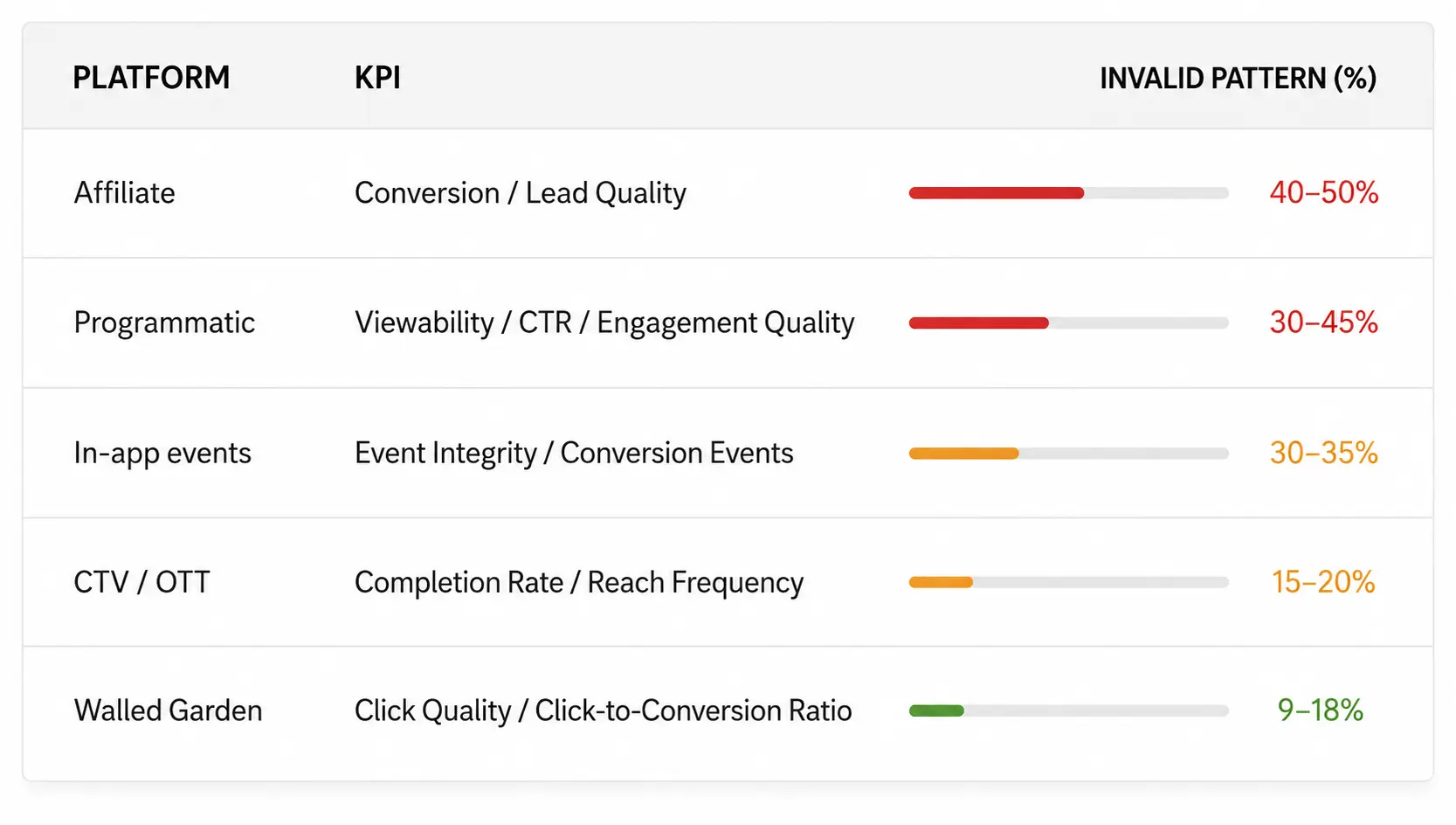
The data breaks this down in granular terms. Invalid traffic patterns vary significantly by platform, and some of the highest-risk channels are also among the most aggressively used by marketers to reach their target audiences.
Affiliate Marketing
Affiliates are paid based on results. But if 40–50% of conversions or leads are invalid, marketers end up paying for manipulated and fake results, instead of the real ones. Performance-linked pricing only works when the performance is real.
Read more about how affiliates exploit lead gen campaigns here.
Programmatic Advertising
Global programmatic ad spend reached $642 billion in 2025 and is expected to grow to nearly $800 billion by 2028. (Source: Start.io) Considering the growth, fraud is also widespread. With invalid traffic at impression level ranging between 30–45% as per mFilterIt’s analysis of digital brand campaigns, nearly half of what you’re buying could be going to bots, not buyers.
In-App or Mobile Advertising
In-app fraud no longer stops at fake installs. It extends into fabricated post-install actions such as sign-ups, lead submissions, purchases, and in-app events, polluting attribution, and CRM data before it even reaches the sales team. With nearly 30–35% invalid activity patterns, mobile advertising ecosystems are increasingly vulnerable to synthetic engagement at scale.
CTV and OTT Advertising
Connected TV and OTT platforms are where the budgets are shifting rapidly.
But 15–20% frequency cap violations mean your ads are repeatedly hitting the same device, not reaching new audiences, just burning spend.
Walled Gardens
Platforms like Google and Meta are often assumed to be clean. They’re cleaner, but 9–18% invalid click patterns show that even here, not every click is a real person.
Moreover, ad fraud gets even more complicated and sophisticated to identify as it moves down the funnel.
Platforms like Google and Meta are often perceived as relatively cleaner ecosystems. While they do have stronger fraud controls, 9–18% invalid click patterns still indicate that not every engagement originates from a genuine user.
To understand the impact of click fraud in performance campaigns, read this blog.
What makes ad fraud increasingly difficult to detect is its evolution deeper into the funnel. As fraudulent activity progresses from clicks to installs, leads/purchases, and post-conversion events, the signals become more sophisticated, making detection, attribution validation, and quality assessment significantly more complex.
How Ad Fraud Leaks Budget Across Every Stage of the Marketing Funnel
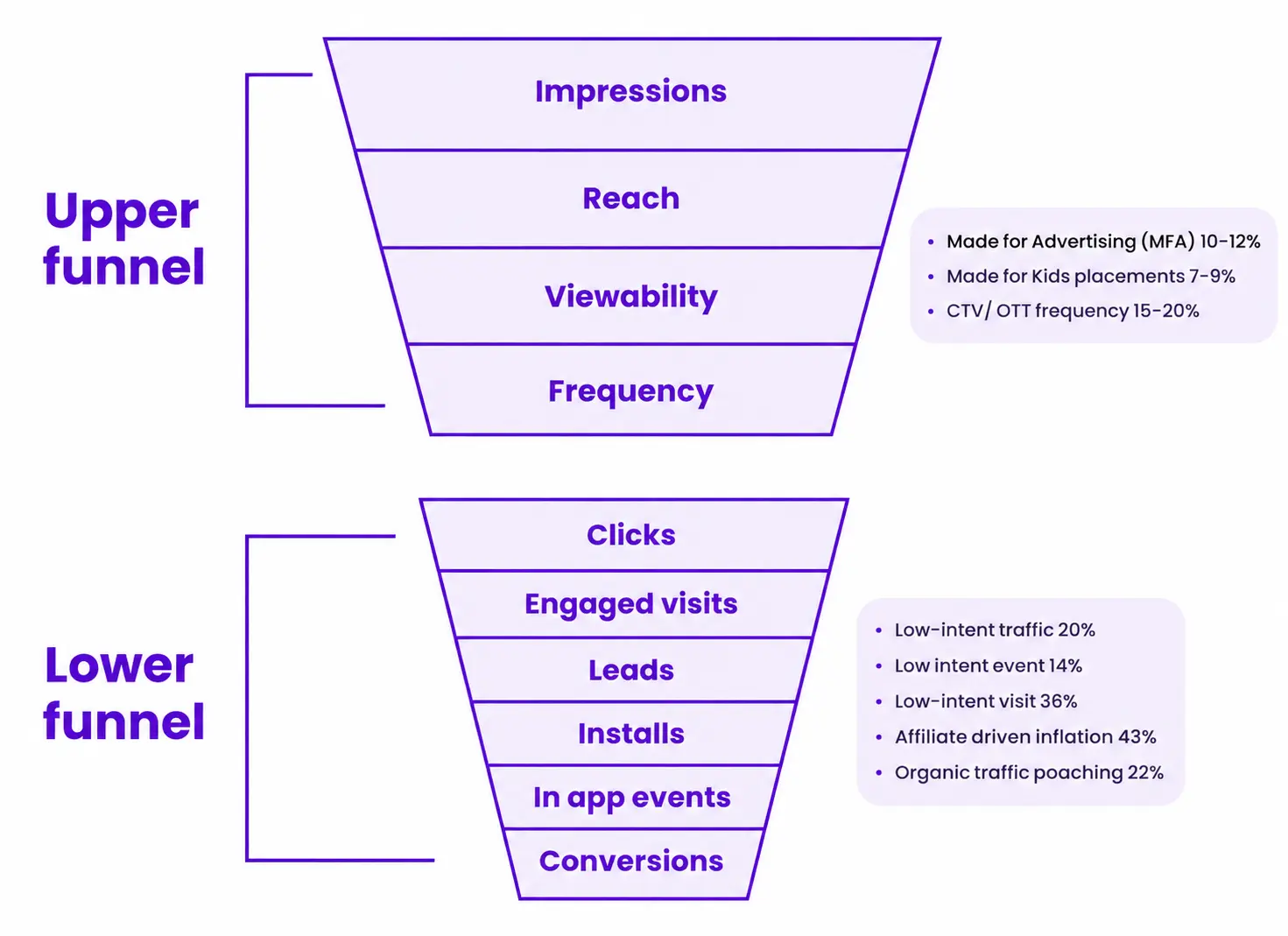
Fraud doesn’t enter at just one stage. It impacts the entire funnel, from impressions to conversions. Here’s how:
Upper Funnel: Reach Isn’t Always Real
- Made-for-Ad Sites (10–12% leakage): Ads appear on websites created only to serve ads, not real users.
- Made-for-Kids Placements (7–9% leakage): Your ads appear beside content where your actual audience doesn’t exist.
- CTV & OTT Frequency Capping Violations (15–20% leakage): The same user keeps seeing your ad repeatedly, wasting budget instead of expanding reach.
Lower Funnel: Ad Fraud Gets More Expensive
- Low-Intent Traffic (20% inflated visits): Traffic numbers look strong, but many users never intended to engage or convert.
- Low-Intent Events (14% leakage): Fake or low-quality interactions distort campaign optimization signals.
- Ad-Driven Conversion Inflation (43% leakage): Bots and fraudulent actions inflate conversion numbers, creating a false sense of performance.
- Organic Traffic Poaching (22% leakage): Users who would have converted organically are wrongly attributed to affiliates.
- Therefore, the C-suite has a direct stake here. As the digital marketing budget grows, so does accountability across both the CMO and the CFO.
Campaigns are increasingly expected to move beyond impressions toward measurable outcomes: engaged visits, site conversions, and real revenue signals. That expectation becomes impossible to meet if the underlying data is compromised. Hence, the need for a full funnel strategy and an ad fraud solution that uses advanced technologies to identify and prevent ad fraud proactively.
How mFilterIt’s Ad Fraud Solution Helps Using the Full Funnel Strategy
mFilterIt’s ad fraud solution helps solve the problem not just by auditing campaigns after the damage is done, but by detecting and blocking invalid traffic in real time, across every stage of the customer journey. Here’s how it works across three critical areas:
Branding campaigns: Where your reach is being stolen
For every branding campaign, the foundational question isn’t just ‘did people see the ad?’ but ‘Was the impression served to a real user, and how many times was it viewed?’ mFilterIt’s Ad fraud suite tackles this at the source by validating impression authenticity, filtering invalid traffic, and identifying fraudulent exposure patterns before distorting campaign performance metrics.
- Impression Validation detects and filters GIVT (General Invalid Traffic) and SIVT (Sophisticated Invalid Traffic) in real time, blacklisting fraudulent inventory directly in your ad manager before budget is burned.
- MFA (Made-For-Ad) Site Detection identifies low-quality, junk-content sites that exist purely to generate ad revenue. It maintains a live MFA repository and blocks them automatically.
- Frequency Cap Violation Control uses a creative serving hub to enforce frequency caps in real time, ensuring your brand message reaches the maximum unique audience rather than the same device repeatedly.
- AI-powered Brand Safety ensures your ads never appear next to arms and ammunition, hate speech, adult content, or any of the GARM-defined unsafe categories.
Performance campaigns: Where your conversions are being faked
On the web performance side, the problem isn’t just fraudulent clicks; it’s an entire fabricated funnel. Bots don’t just inflate impressions; they generate clicks, simulate visits, and stuff CRMs with junk or punchedleads. Our ad fraud solution addresses this across the complete journey:
- Click Traffic Validation filters bot-generated clicks, data center IPs, and automated scripts that mimic real user behavior without relying on cookies.
- Visit validation and Intent Scoring go beyond the click to assess whether a visit originates from bots, anomalous patterns or genuine users with real purchase or engagement intent. By leveraging behavioral,heuristic, and intent-based signals, it helps in distinguishing high-value traffic from fraudulent visits.
- Lead Validation and Prioritization integrate directly into the CRM to score and rank leads by quality and intent, so sales teams spend time on leads that convert, not those that never will.
App campaigns: Where installs are being manufactured
App fraud is uniquely insidious because fraudsters operate across the entire install funnel, from click spamming and fake attribution to event spoofing, incent fraud, and referral abuse. App Traffic Validation suite catches all of it:
- Impression and Click Integrity blocks fraudulent signals before they even reach the MMP, reducing wasted CPM/CPC spend at source.
- Install and Event Validation verifies that installs and post-install events (registrations, purchases, deposits) were triggered by real users, not device farms or SDK spoofing.
- Incent Fraud Detection monitors over 50 incent walls, identifying when non-incent campaigns are being run over incentivized platforms to inflate installs with zero-LTV users.
- Referral and Coupon Fraud Prevention use device-environment analysis (not just IP repetition) to detect fraudsters gaming reward campaigns via cloned apps, VPNs, and multiple accounts.
- Post-back Blocking ensures payouts are fired to affiliates only for validated events, structurally removing the incentive for fraud at the publisher level.
The coverage is not partial or sampled. mFilterIt evaluates every data set across App, Web, CTV, and OTT environments, spanning programmatic, biddable, and performance campaigns.
Conclusion: How CMOs Can Protect Their Budgets from Ad Fraud
If you’ve read this far, one thing should be clear: ad fraud is not a technical problem you can hand off to your agency or your ad platform. It’s an issue that is directly affecting your numbers.
The good news is that it is solvable. But only if you decide to look at it directly. The fix starts with three decisions: stop trusting reports that come from the same people running your campaigns, make media leakage a boardroom metric and not a footnote, and audit your highest-spend channels like affiliate, programmatic, and performance marketing diligently.
Let us help you identify where your budget could be leaking. Get in touch with our experts for an ad traffic validation audit now.
Frequently Asked Questions
How can CMOs detect and prevent ad fraud?
CMOs should demand independent ROAS verification, implement real-time invalid traffic detection across all channels, and make media leakage metrics a formal part of their governance framework.
What is full-funnel ad fraud detection?
Full-funnel ad fraud detection validates every stage of the customer journey from impression to conversion, rather than checking only one touchpoint like the click. It ensures that fraud is caught regardless of where in the funnel it enters.
How does ad fraud affect app marketing campaigns?
In app campaigns, fraud manufactures entire install funnels, fake clicks, fake installs, and fake post-install events like registrations and purchases, making campaigns appear to perform while delivering zero real users.
How does ad fraud affect affiliate marketing specifically?
Affiliates are paid based on performance, clicks, leads, or sales. Affiliate fraud generates fake versions of these actions to trigger payouts, meaning brands pay for results that were never real.
What is an ad traffic validation audit?
An ad traffic validation audit is an independent review of your campaign traffic, examining impressions, clicks, visits, and conversions for signs of ad fraud or invalid activity. It gives brands an unfiltered view of where their budget is actually going.
How does ad fraud impact CMO marketing ROI?
Ad fraud inflates clicks, conversions, and ROAS, making campaigns look better than they are. CMOs end up optimizing budgets based on false data, widening the gap between reported results and actual business outcomes.
How to reduce wasted ad spend in programmatic campaigns?
Implement real-time invalid traffic detection, block made-for-ad sites, and enforce frequency caps actively. Most importantly, verify programmatic performance through independent reporting that sits outside your agency’s own dashboard.