
Brands spend millions daily on programmatic advertisements with the belief that the ads are shown to genuine users on authentic websites. The truth is that an increasing number of this inventory does not cater to any readership, rather to bids. The advent of artificial intelligence has led to the creation of content farms that produce articles purely based on the objective of getting advertised.
The term used for such content is referred to as AI slop and poses one of the most significant challenges to media quality and brand safety in digital advertisement today.
AI has made it possible to write articles, generate graphics, and create landing pages much faster than even the most professional editorial teams ever could. Such high speeds allowed for incredible scalability, but the downside was that it led to something worse – scalability without substance. Content produced by artificial intelligence in large quantities often does not inform anything; rather, the content is geared towards gaining traffic and earning from ad views. That’s what AI slop is all about.
AI Slop is not only a problem in terms of content generation in digital marketing today; it has also become a problem of media quality
The numbers back this up:
- Top-performing advertisers converted 54% of their programmatic spend into qualified impressions, while lower-performing advertisers converted only 32.1% — a 21.9 percentage point gap, the largest the benchmark has ever recorded. (Source)
- MFA (Made-for-Advertising) exposure climbed to 1.1%, with the same benchmark flagging AI-generated low-value content, AI slop, as an emerging subtype that now demands ongoing monitoring and active mitigation. During peak season, this number is expected to rise exorbitantly.
In this blog, you will discover –
- Why AI Slop is the next evolution of MFA websites
- What is the mechanism behind AI slops?
- How AI slops actually cost a brand?
- How can brands identify and mitigate AI slop?
Why AI Slop is the Next Evolution of MFA Websites
Made for Advertising (MFA) sites have always been one of the easiest and most prominent ways for fraudsters to exhaust brand’s budgets.
Traditional MFA sites relied on outsourced content, clickbait headlines, and SEO manipulation. AI has dramatically reduced the cost of creating such environments.
Today, a single operator can launch hundreds of AI-generated websites, each capable of attracting hefty programmatic advertising budgets despite offering little value to consumers.
It is not just text either. AI slop now includes AI-generated images, videos, and even full social media accounts, completed with fake followers and engagement, designed to appear like legitimate, active communities.
The key thing to understand is these are not passion projects gone wrong. They are built deliberately to attract viewability through advertising money and irrelevant ad placements.
None of it is meant for a human reader. It’s meant for an ad auction.
What is the Mechanism Behind AI Slops?
AI slop sites are built on one principle – creating content in bulk but the mechanism that goes from creating to exhausting budgets is what makes it critical for brands. Following is the mechanism behind AI slops –
AI slop thrives because every layer of the digital ecosystem relies on automated signals instead of human judgment.
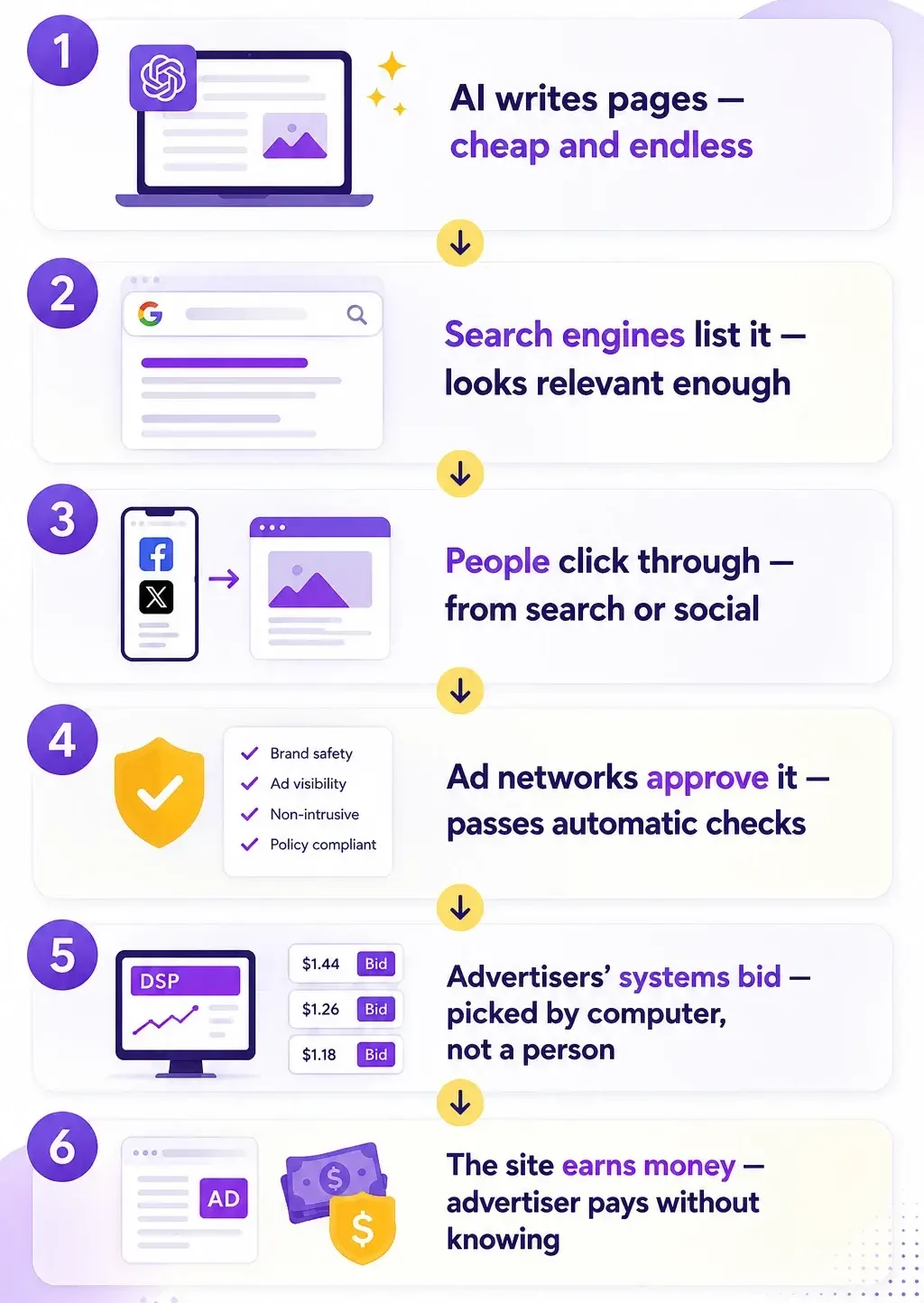
- Artificial intelligence has made it very easy to create content so publishers can make thousands of pages every day. Search engines do not really look at how good the content’s they just look at things like keywords and links and how new the content is. The content made by intelligence is usually made to do well with these things even if it is not really worth reading.
- When these pages get ranked high or shared, they get a lot of visitors. This can be used to make money from ads. The companies that handle ads mainly check if the page is working properly and not if the content is actually good. Long as the page is safe and follows the rules and is about the right topic it can usually have ads on it.
- People who buy ads usually buy them in amounts through computer programs, so humans do not often see where the ads actually show up. There are tools to catch content, but they do not catch content that is just not very good.
- This creates a circle: the money from ads pays for content made by artificial intelligence, which makes more space for ads. The system is not really broken. It is just based on things that are supposed to show quality and artificial intelligence content has gotten very good at pretending to be good without being worth anything. Artificial intelligence content is very good at this. It keeps getting better at making content that is not really good.
How AI Slops actually Cost a Brand?
AI slops cost the brand more than money. The loss can also be reputational, and once lost, a reputation might be even harder to fix than gained. Here is what the effects of AI slops actually do to brands:
- Measurement Distortion: AI Slop environments frequently generate inflated engagement metrics, creating a false perception of campaign success while delivering limited business outcomes.
- Audience Quality Degradation: Even when impressions are technically viewable, audiences interacting with AI-generated content environments often demonstrate significantly lower engagement and conversion rates.
- Optimization Risks: Media buying algorithms may unintentionally optimize toward cheaper AI-generated inventory, directing larger portions of budget toward low-value placements over time.
- Lack of Trust: Consumers believe that brands appear in trustworthy environments. Failing to do that can undermine their trust and brand reputation, which is more costly than gaining it.
How Brands Can Identify and Mitigate AI Slop
AI slop is becoming an increasingly serious challenge for brands. But identifying and avoiding these environments doesn’t have to be a guessing game. With mFilterIt’s comprehensive and always on brand safety solution, brands can separate quality inventory from low-value placements through three layers of detection. Each layer is designed to catch signals that the others might miss, ensuring ad placements meet stricter standards before they are considered safe.
Repetitive Content Detection
With our manual checks keeping hawk’s eye at your ad placements, we ensure your ads are not placed in slopped environments that do not bring any value to your content. Each pattern is manually validated, so brands can trust the accuracy of what’s flagged and what’s not.
Ad Visibility & Ad Block Analysis
An ad served isn’t the same as an ad seen. This layer confirms that ads were actually rendered, visible, and placed in genuinely viewable environments, not hidden, buried below the fold, or blocked, and flags pages so cluttered with ad units that they were clearly built for impression volume rather than user experience.
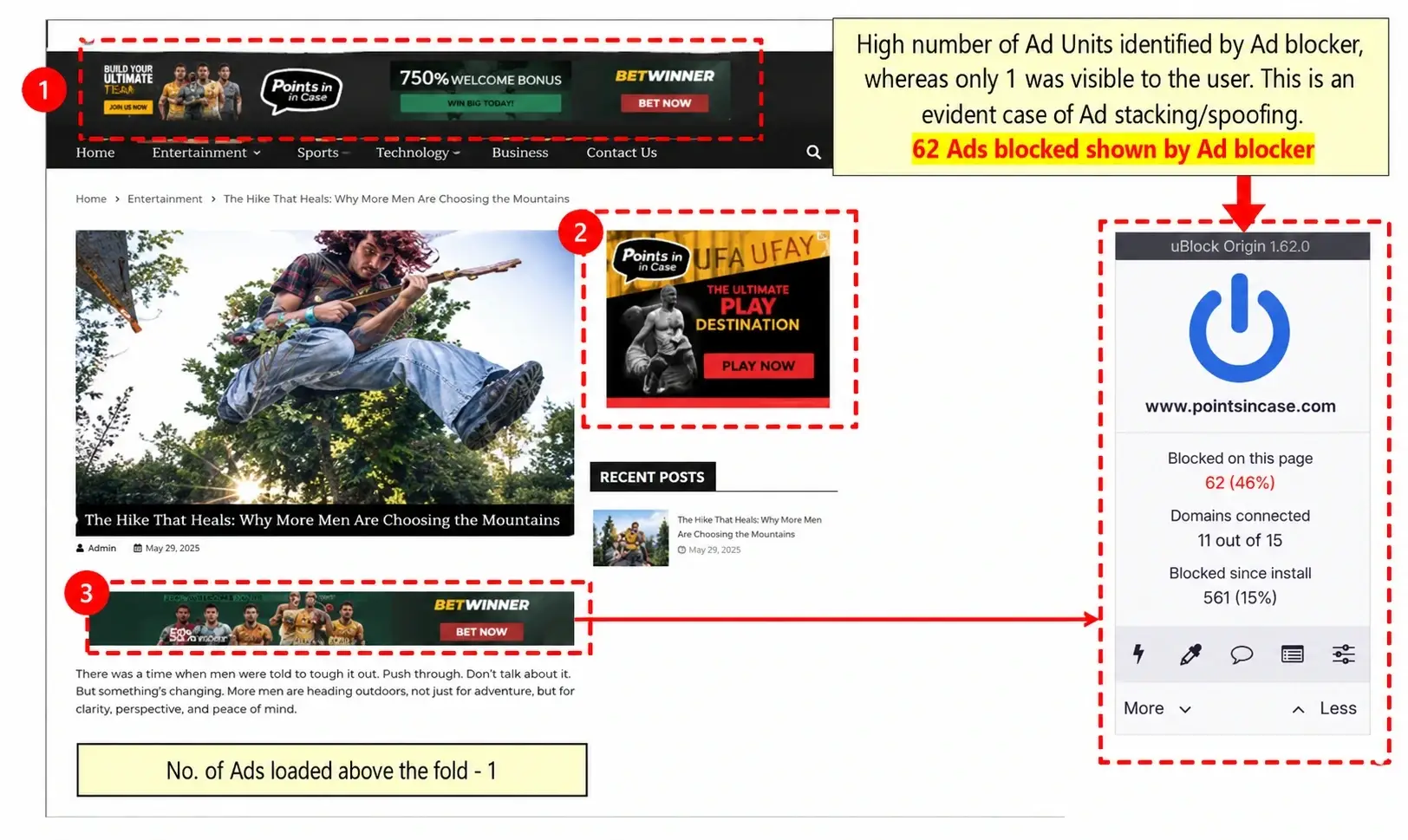
Ad stacking is one of the most common tricks here, especially across AI-generated and made-for-advertising (MFA) sites, where maximizing revenue takes priority over user experience.
In above case we caught, a webpage displayed a single visible banner ad, but an ad-blocker inspection revealed 62 ad units loaded behind it. Since only the topmost ad was actually visible, the other 61 never had a chance of being seen or engaged with. This kind of stacking artificially inflates impression counts while delivering little to no value to advertisers, brands end up paying for impressions that were never really viewable, wasting media spend and distorting campaign metrics.
Placement Transparency & Domain-level Monitoring
Knowing where your ads appear is only half the story. We provide complete visibility into every placement, down to the exact domain and URL, while continuously monitoring those domains for reputation changes, unusual traffic patterns, ownership shifts, and content changes. This helps brands not only understand where their budgets are being spent but also identify emerging AI slop and low-quality environments before they impact campaign performance.
Conclusion
AI Slop represents a new challenge for the digital advertising ecosystem. Unlike traditional fraud, it often operates within technically compliant environments, making it harder to identify through standard fraud detection methods alone.
As AI lowers the cost of content production, brands need to evolve their media quality frameworks beyond viewability and invalid traffic metrics.
The next frontier of media verification should focus on content quality, publisher authenticity, audience legitimacy, and contextual relevance.
Frequently Asked Questions
What is AI Slop?
AI Slop refers to large volumes of low-quality, AI-generated content created primarily to attract traffic and advertising revenue rather than provide value to readers.
How is AI Slop different from MFA websites?
While traditional MFA sites rely on clickbait and SEO tactics, AI Slop uses artificial intelligence to rapidly create content at scale, making these sites cheaper and faster to operate.
Why should brands be concerned about AI Slop?
AI Slop can waste ad budgets, distort campaign metrics, and place brands in low-quality environments that may harm consumer trust.
How can brands identify AI Slop?
Common signs include repetitive content, excessive ad placements, low engagement, and limited transparency around where ads are appearing.
How can brands reduce exposure to AI Slop?
Brands should monitor placement quality, verify ad visibility, track domain activity, and use independent brand safety solutions to assess content quality.